Updated on June 22, 2026, by OpenEDR
Cyberattacks are becoming more sophisticated every year. At the same time, organizations are embracing cloud computing, hybrid work, and connected devices at an unprecedented pace. Traditional perimeter-based security models can no longer keep up with today’s threat landscape. This is why zero trust solutions have become a critical component of modern cybersecurity strategies.
According to industry research, attackers often exploit trusted accounts and compromised devices to gain unauthorized access to corporate environments. Organizations that rely solely on traditional security approaches face increasing risks from ransomware, insider threats, credential theft, and advanced persistent threats (APTs).
Zero trust solutions help businesses address these challenges by continuously verifying users, devices, applications, and network activity before granting access. Instead of assuming trust, organizations validate every request based on identity, context, and risk.
For cybersecurity teams, IT managers, business leaders, and executives, understanding zero trust solutions is essential for building a resilient security posture that protects critical assets while supporting modern business operations.
What Are Zero Trust Solutions?
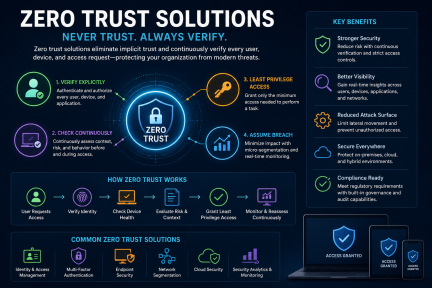
Zero trust solutions are cybersecurity technologies and frameworks designed to enforce the principle of “Never Trust, Always Verify.” Rather than automatically trusting users or devices inside a network, zero trust solutions continuously evaluate access requests before granting permissions.
The core objective is simple: reduce the attack surface and prevent unauthorized access.
Core Principles of Zero Trust Solutions
Every effective zero trust strategy is built upon three key principles:
Verify Explicitly
Every user, device, application, and connection must be authenticated and authorized.
Use Least-Privilege Access
Users receive only the permissions necessary to perform their tasks.
Assume Breach
Organizations operate under the assumption that attackers may already have access to portions of the environment.
These principles help reduce risk and improve overall cybersecurity resilience.
Why Traditional Security Models Are No Longer Enough
Historically, organizations protected their environments through perimeter-based security.
The assumption was straightforward:
“If a user is inside the network, they can be trusted.”
However, today’s environments look very different.
Modern organizations rely on:
- Remote employees
- Cloud applications
- Mobile devices
- Third-party vendors
- Multi-cloud environments
- Internet-connected devices
As a result, traditional security boundaries have largely disappeared.
Challenges with Legacy Security Models
Increased Attack Surface
Organizations now manage significantly more endpoints and access points.
Credential-Based Attacks
Attackers frequently target usernames and passwords.
Insider Threats
Authorized users can intentionally or accidentally expose sensitive data.
Cloud Complexity
Traditional security tools often lack visibility across cloud environments.
This is where zero trust solutions provide a more effective approach.
How Zero Trust Solutions Work
Zero trust solutions continuously evaluate trust before granting access to resources.
The Zero Trust Access Process
- Verify user identity.
- Authenticate devices.
- Assess device health and compliance.
- Evaluate contextual risk.
- Apply security policies.
- Grant least-privilege access.
- Monitor activity continuously.
- Revoke access if risk levels increase.
This process occurs continuously rather than only during login.
Continuous Security Validation
Unlike traditional security models, zero trust solutions reassess trust throughout a session.
Factors evaluated may include:
- User identity
- Device status
- Location
- Network conditions
- Behavioral patterns
- Threat intelligence
This dynamic approach significantly improves security effectiveness.
Key Components of Zero Trust Solutions
Organizations often deploy multiple technologies to support a comprehensive zero trust architecture.
Identity and Access Management (IAM)
IAM solutions authenticate users and enforce access controls.
Key capabilities include:
- Single Sign-On (SSO)
- Role-based access control
- User lifecycle management
- Access governance
Multi-Factor Authentication (MFA)
MFA strengthens identity verification by requiring multiple authentication factors.
Benefits include:
- Reduced credential theft risk
- Stronger user authentication
- Improved compliance support
Endpoint Security
Devices must meet security requirements before access is granted.
Endpoint protection solutions help:
- Detect malware
- Assess device health
- Enforce compliance
- Monitor activity
Network Segmentation
Microsegmentation restricts lateral movement within environments.
Benefits include:
- Reduced attack spread
- Improved visibility
- Enhanced containment
Security Analytics
Behavioral analytics help identify suspicious activity and potential threats.
Continuous Monitoring
Organizations gain real-time visibility into:
- User behavior
- Device activity
- Network traffic
- Application usage
Benefits of Zero Trust Solutions
Organizations adopting zero trust solutions often experience measurable improvements in security and operational efficiency.
Reduced Attack Surface
Access is limited to only what users need.
This reduces opportunities for attackers.
Improved Ransomware Protection
Zero trust solutions help contain ransomware infections by limiting lateral movement.
Stronger Identity Security
Continuous authentication reduces the risk of compromised credentials.
Enhanced Compliance
Many compliance frameworks emphasize access controls and monitoring.
Examples include:
- HIPAA
- PCI DSS
- NIST
- ISO 27001
- CMMC
Better Cloud Security
Zero trust solutions provide visibility across cloud applications and workloads.
Improved Incident Response
Security teams can identify and contain threats more quickly.
Zero Trust Solutions vs Traditional Security
| Feature | Zero Trust Solutions | Traditional Security |
|---|---|---|
| Trust Model | Never trust by default | Trust internal users |
| Authentication | Continuous | One-time |
| Access Control | Least privilege | Broad permissions |
| Network Design | Microsegmentation | Flat architecture |
| Threat Assumption | Assume breach | Assume trust |
| Visibility | High | Limited |
Quick Comparison
Traditional security focuses on defending the perimeter. Zero trust solutions focus on continuously validating trust throughout the environment.
Industries That Benefit Most from Zero Trust Solutions
Nearly every industry can benefit from zero trust security.
Healthcare
Protects patient data and supports HIPAA compliance.
Financial Services
Secures financial transactions and customer information.
Government
Protects sensitive systems and national infrastructure.
Manufacturing
Secures operational technology (OT) environments.
Education
Protects students, faculty, and institutional data.
Retail
Secures customer transactions and payment systems.
Common Use Cases for Zero Trust Solutions
Organizations implement zero trust solutions for a variety of reasons.
Remote Workforce Security
Verify users regardless of location.
Third-Party Access Management
Control vendor and contractor access.
Cloud Application Security
Protect SaaS and cloud-based workloads.
Data Protection
Limit access to sensitive information.
Insider Threat Prevention
Reduce risks associated with authorized users.
Best Practices for Implementing Zero Trust Solutions
Successful adoption requires a strategic approach.
Inventory Assets
Identify users, devices, applications, and data.
Deploy MFA Everywhere
Strong authentication is a foundational requirement.
Apply Least-Privilege Policies
Limit access based on business needs.
Segment Critical Resources
Separate sensitive systems from broader environments.
Monitor Continuously
Visibility is essential for detecting threats.
Educate Employees
User awareness remains a critical defense layer.
Future Trends in Zero Trust Solutions
Zero trust continues to evolve as organizations face new challenges.
AI-Powered Security
Artificial intelligence improves threat detection and response.
Secure Access Service Edge (SASE)
Organizations increasingly combine networking and security functions.
Cloud-Native Security
More security controls are moving into cloud environments.
Identity-Centric Security
Identity will continue to become the primary security perimeter.
Automation and Orchestration
Automated policy enforcement reduces operational complexity.
Organizations that embrace these innovations will be better positioned to address future threats.
Conclusion
The cybersecurity landscape has fundamentally changed. Traditional perimeter-based defenses are no longer sufficient to protect modern organizations from sophisticated attacks.
Zero trust solutions provide a more effective approach by continuously verifying identities, devices, and access requests while enforcing least-privilege access policies. Whether protecting cloud applications, supporting remote work, securing sensitive data, or strengthening compliance efforts, zero trust solutions offer a proven framework for reducing cyber risk.
As cyber threats continue to evolve, organizations that adopt zero trust principles will be better equipped to protect critical assets, maintain business continuity, and support digital transformation initiatives.
Frequently Asked Questions
What are zero trust solutions?
Zero trust solutions are cybersecurity technologies that continuously verify users, devices, and applications before granting access to resources.
Why are zero trust solutions important?
They reduce cyber risk by eliminating implicit trust and enforcing continuous authentication and authorization.
What industries use zero trust solutions?
Healthcare, finance, government, manufacturing, education, retail, and technology organizations commonly implement zero trust security.
How do zero trust solutions prevent ransomware?
They limit lateral movement, enforce least-privilege access, and continuously monitor user and device activity.
Are zero trust solutions only for large enterprises?
No. Organizations of all sizes can benefit from implementing zero trust principles and security controls.
Strengthen Your Security with Modern Zero Trust Protection
Cyber threats continue to evolve, but your defenses can evolve faster. Discover how advanced security solutions help organizations implement zero trust principles, improve visibility, and reduce cyber risk.
Start protecting your environment today: https://openedr.platform.xcitium.com/register/

 Loading...