Updated on January 19, 2026, by OpenEDR
Cyberattacks no longer follow predictable paths. They move across endpoints, networks, cloud environments, and email systems—often faster than traditional tools can respond. That’s why organizations are increasingly asking about xdr security and how it changes the way threats are detected and stopped. If your security team struggles with fragmented alerts, slow investigations, or blind spots, XDR may be the answer.
XDR security, short for extended detection and response, unifies visibility, analytics, and response across the entire IT environment. For cybersecurity professionals, IT managers, and business leaders, XDR represents a shift from reactive defense to proactive, intelligence-driven security. This guide explains what XDR security is, how it works, and why it’s becoming essential for modern organizations.
What Is XDR Security?
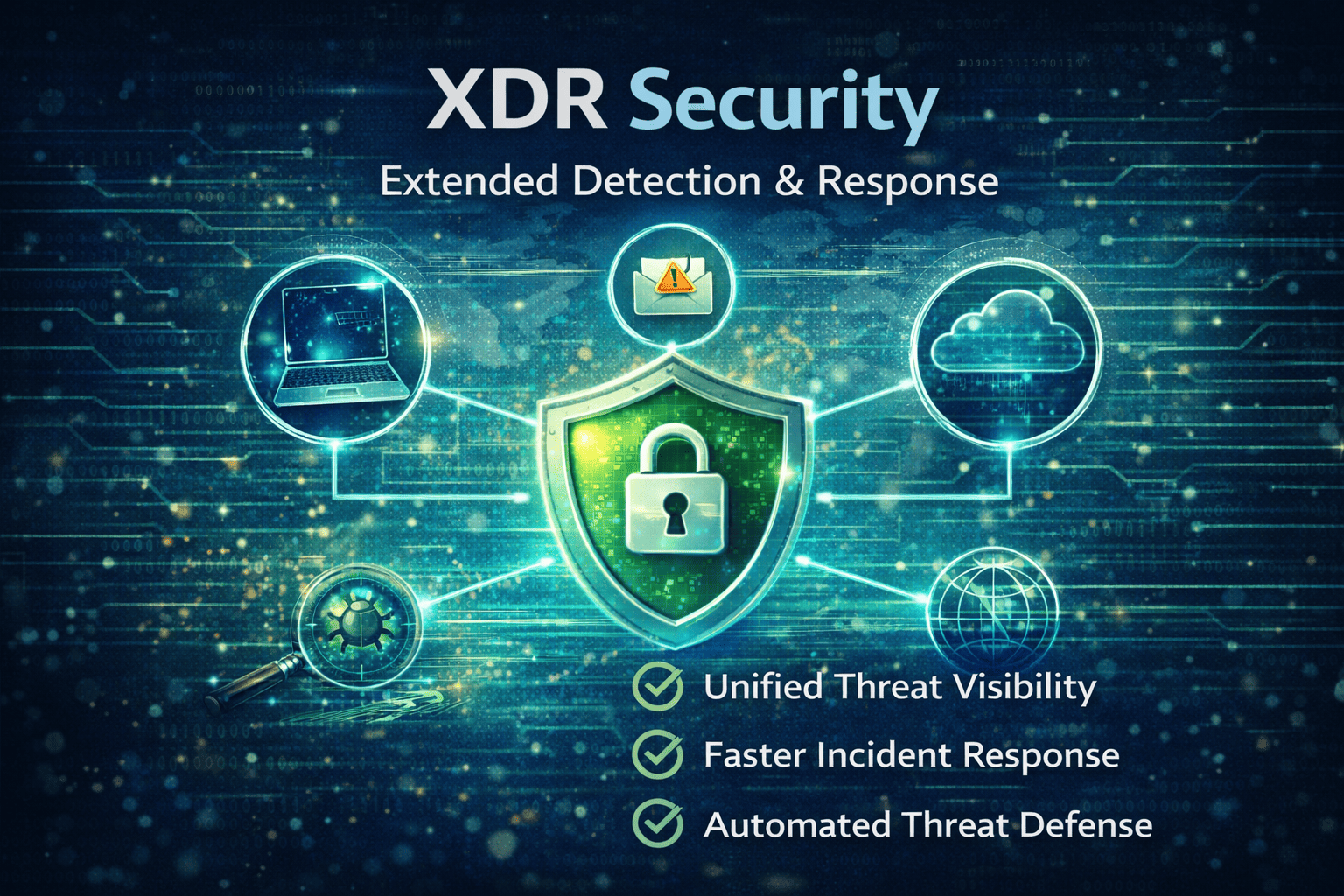
XDR security is an integrated cybersecurity approach that collects and correlates data from multiple security layers—endpoints, networks, servers, cloud workloads, and email—into a single platform. Instead of analyzing threats in isolation, XDR security connects the dots across the attack lifecycle.
So, what makes XDR different? Traditional tools focus on individual layers. XDR cybersecurity focuses on context.
Core Purpose of XDR Security
Detect complex, multi-stage attacks
Reduce alert fatigue
Speed up threat investigation
Automate response actions
Improve overall security visibility
At its core, xdr security is about seeing the full picture.
Why Traditional Security Tools Are No Longer Enough
Many organizations rely on a mix of disconnected tools: antivirus, firewall, EDR, SIEM, and email security. While useful, these tools often operate in silos.
Limitations of Traditional Security Approaches
Too many alerts, not enough context
Manual investigation slows response
Limited visibility across environments
High operational overhead
XDR security addresses these gaps by centralizing detection and response into a unified system.
How XDR Security Works
XDR security operates by collecting telemetry from multiple sources and applying advanced analytics to identify threats.
Step-by-Step XDR Workflow
Data Collection – Gathers signals from endpoints, networks, cloud, and email
Correlation – Links related events across systems
Threat Analysis – Uses AI and behavioral analytics
Detection – Identifies suspicious or malicious activity
Response – Automates containment or remediation
This end-to-end approach allows xdr security to detect threats that would otherwise remain hidden.
XDR vs EDR vs MDR: Understanding the Differences
Many professionals confuse these security models.
Endpoint Detection and Response (EDR)
Focuses only on endpoints
Limited visibility beyond devices
Effective but narrow in scope
Managed Detection and Response (MDR)
Outsourced security monitoring
Depends on provider expertise
May still rely on siloed tools
XDR Security
Covers multiple security layers
Correlates data automatically
Designed for faster, smarter response
XDR cybersecurity expands EDR capabilities rather than replacing them.
Key Benefits of XDR Security for Organizations
XDR security offers both technical and business advantages.
Major Benefits of XDR Security
Faster threat detection
Reduced false positives
Improved analyst efficiency
Better incident context
Lower mean time to respond (MTTR)
For executives, xdr security translates to reduced risk and improved operational resilience.
XDR Security and Threat Detection
Modern threats rarely stay in one place. Attackers move laterally, escalate privileges, and exploit multiple systems.
How XDR Improves Threat Detection
Identifies attack chains, not just alerts
Detects stealthy and fileless malware
Uncovers insider threats
Detects zero-day exploits
XDR security excels at detecting threats that bypass traditional defenses.
XDR Security in Enterprise Environments
Enterprises face complex IT landscapes that demand scalable protection.
Why Enterprises Adopt XDR
Supports hybrid and cloud environments
Integrates with existing tools
Improves SOC efficiency
Reduces investigation time
For large organizations, xdr security simplifies security operations without sacrificing depth.
XDR Security and Zero Trust Architecture
Zero Trust assumes no system or user is trusted by default. XDR aligns naturally with this model.
How XDR Supports Zero Trust
Continuously monitors behavior
Validates activity across layers
Detects credential misuse
Limits lateral movement
This makes xdr security a strong foundation for Zero Trust strategies.
Use Cases Where XDR Security Excels
XDR is not a one-size-fits-all tool—it shines in specific scenarios.
Common XDR Use Cases
Ransomware detection and containment
Advanced persistent threat (APT) detection
Insider threat monitoring
Cloud workload protection
Phishing-driven attack chains
Organizations facing sophisticated threats benefit most from xdr security.
Best Practices for Implementing XDR Security
Successful adoption requires planning and alignment.
Actionable XDR Implementation Tips
Define clear security objectives
Integrate key data sources first
Automate response cautiously
Train analysts on investigation workflows
Continuously tune detection rules
XDR security is most effective when treated as a strategic program, not just a tool.
Measuring the Effectiveness of XDR Security
Security leaders should track performance metrics to demonstrate value.
Key XDR Metrics to Monitor
Mean time to detect (MTTD)
Mean time to respond (MTTR)
Alert reduction rate
Incident containment success
Analyst workload reduction
These metrics help quantify the ROI of xdr security investments.
Common Misconceptions About XDR Security
Myth 1: XDR replaces all other security tools
Reality: XDR integrates and enhances existing tools.
Myth 2: XDR is only for large enterprises
Reality: Mid-sized organizations also benefit from unified detection.
Myth 3: XDR is too complex
Reality: XDR simplifies workflows by reducing fragmentation.
Understanding xdr security helps organizations avoid these misconceptions.
XDR Security and the Future of Cyber Defense
As attack surfaces grow, security must evolve. XDR represents the next step in cybersecurity maturity.
Why XDR Is the Future
Threats are multi-vector
Automation is essential
Context matters more than volume
Security teams need efficiency
XDR cybersecurity reflects how modern attacks actually happen.
Frequently Asked Questions (FAQ)
1. What is XDR security used for?
XDR security is used to detect, investigate, and respond to threats across multiple security layers.
2. Is XDR better than EDR?
XDR builds on EDR by extending visibility beyond endpoints to networks, cloud, and email.
3. Does XDR replace SIEM?
XDR can complement or reduce reliance on SIEM, depending on use case.
4. Is XDR suitable for small businesses?
Yes. Many XDR platforms scale to fit mid-sized organizations.
5. How does XDR improve incident response?
By correlating data automatically and enabling faster, more accurate response actions.
Final Thoughts: Why XDR Security Matters Now
Cyber threats are faster, more complex, and more interconnected than ever. Relying on isolated tools is no longer enough. Xdr security provides the visibility, intelligence, and response speed needed to stay ahead of modern attackers.
For cybersecurity teams and business leaders, XDR is not just a technology upgrade—it’s a strategic shift toward smarter, more resilient defense.
Take the Next Step Toward Smarter Threat Detection
See how unified detection and automated response can transform your security operations.
👉 Get started now:
https://openedr.platform.xcitium.com/register/
Because modern threats demand modern defense—and XDR security delivers it.

 Loading...