Updated on January 6, 2026, by OpenEDR
Cyber threats no longer target just one layer of an organization. Today’s attacks move across endpoints, networks, cloud environments, and user identities in seconds. This growing complexity has pushed many organizations to ask an important question: what are universal protection services, and why are they essential for modern cybersecurity?
Universal protection services provide a unified security approach designed to protect all digital assets—devices, users, data, and infrastructure—under a single, coordinated defense strategy. In this guide, we’ll explore what universal protection services are, how they work, why they matter, and how organizations can use them to reduce cyber risk and improve operational resilience.
What Are Universal Protection Services?
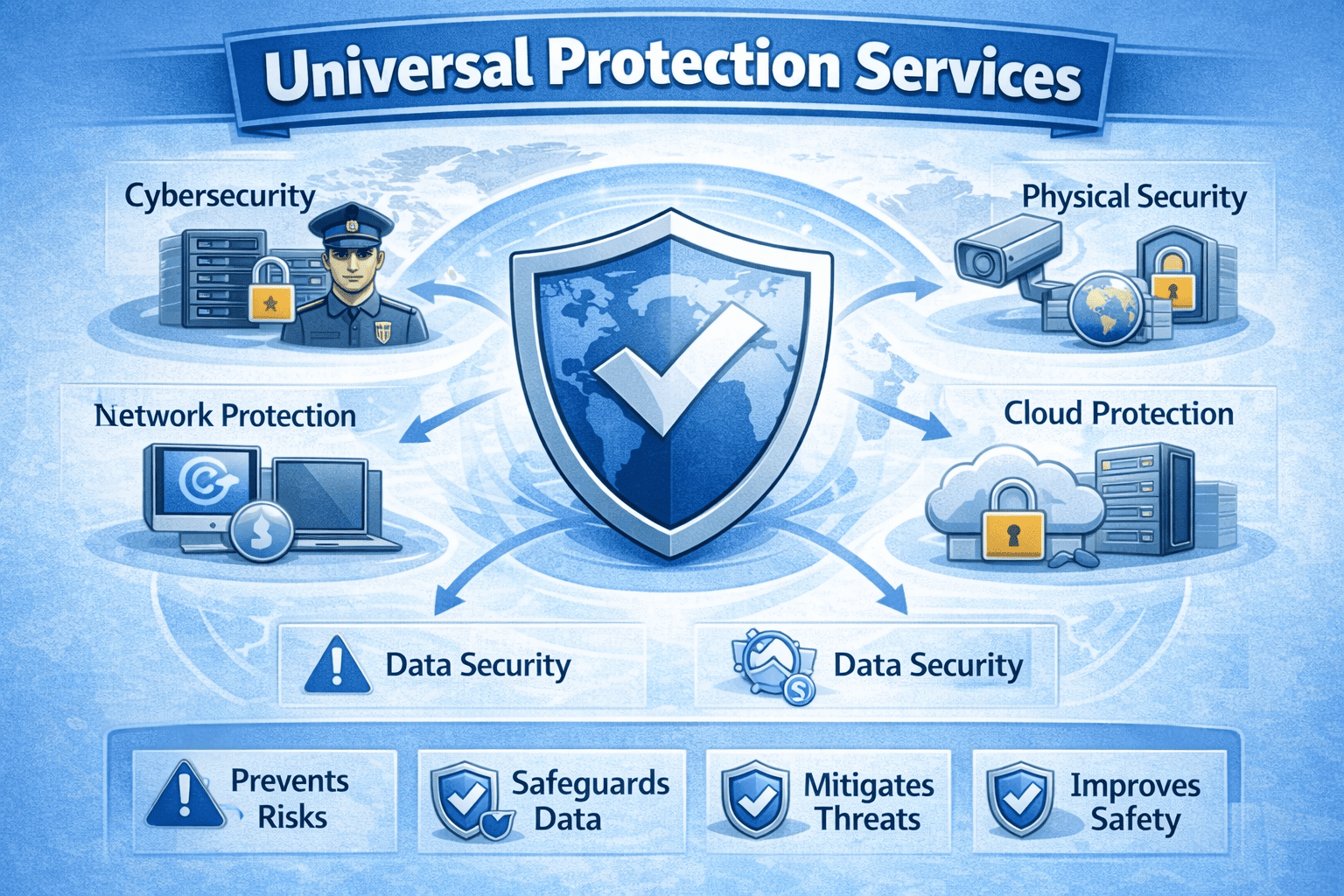
Universal protection services are integrated cybersecurity solutions that deliver comprehensive protection across endpoints, networks, cloud workloads, applications, and users. Instead of relying on fragmented security tools, these services provide centralized visibility, control, and response capabilities.
In simple terms, universal protection services aim to:
Protect everything, everywhere
Detect threats early
Prevent lateral movement
Respond automatically to attacks
They represent a shift from isolated security products to a unified, risk-based defense model.
Why Universal Protection Services Are Needed Today
Traditional cybersecurity tools were built for isolated environments. Modern organizations operate across:
Remote and hybrid workforces
Cloud and on-prem infrastructure
Third-party ecosystems
Mobile and IoT devices
Universal protection services are needed because:
Attack surfaces are expanding rapidly
Point solutions create visibility gaps
Manual response is too slow
Compliance requirements are increasing
Cyberattacks are more automated
A unified security approach is no longer optional—it’s essential.
How Universal Protection Services Work
Universal protection services operate by combining multiple security capabilities into a single, cohesive framework.
Core Operational Layers
Unified Visibility
Centralized monitoring across endpoints, networks, cloud, and applications.Continuous Threat Detection
Real-time analysis of behavior, activity, and anomalies.Risk-Based Prevention
Blocking known and unknown threats before damage occurs.Automated Response
Immediate containment, isolation, and remediation.Centralized Management
One dashboard for policy enforcement and reporting.
This integrated approach allows security teams to move faster and smarter.
Key Components of Universal Protection Services
Effective universal protection services typically include several core security functions.
Endpoint Protection
Malware prevention
Ransomware protection
Script and file control
Device isolation
Network Protection
Traffic monitoring
Threat detection
Segmentation enforcement
Intrusion prevention
Cloud Security
Workload visibility
Misconfiguration detection
Access control
Threat monitoring
Identity and Access Security
Least-privilege enforcement
Authentication monitoring
Credential misuse detection
Together, these components create a comprehensive security fabric.
Universal Protection Services vs Traditional Security Tools
Many organizations still rely on siloed tools.
| Traditional Security Tools | Universal Protection Services |
|---|---|
| Disconnected solutions | Unified platform |
| Limited visibility | End-to-end visibility |
| Manual response | Automated response |
| High complexity | Simplified management |
| Reactive defense | Proactive protection |
Universal protection services reduce complexity while improving security outcomes.
Benefits of Universal Protection Services
Organizations adopt universal protection services because they deliver measurable advantages.
Key Benefits
Reduced attack surface
Faster threat detection
Automated containment
Improved security visibility
Lower operational overhead
Better compliance readiness
For executives, this translates into lower risk and improved business continuity.
Universal Protection Services and Zero Trust Security
Zero Trust security assumes no user or device should be trusted by default.
Universal protection services support Zero Trust by:
Continuously validating users and devices
Enforcing least-privilege access
Preventing lateral movement
Monitoring all activity in real time
Zero Trust and universal protection services work together to minimize breach impact.
Universal Protection Services in Enterprise Environments
Large organizations face unique challenges.
Enterprise Use Cases
Securing thousands of endpoints
Protecting remote employees
Managing hybrid cloud environments
Supporting compliance audits
Detecting insider threats
Universal protection services scale to meet enterprise security demands.
Universal Protection Services for IT Managers
For IT managers, security complexity is a constant challenge.
Universal protection services help by:
Reducing tool sprawl
Simplifying policy enforcement
Improving incident response time
Providing actionable insights
Supporting IT automation
This allows IT teams to focus on strategy rather than firefighting.
Universal Protection Services for CEOs and Founders
Cybersecurity is a business risk, not just an IT issue.
For leadership teams, universal protection services:
Protect brand reputation
Reduce financial exposure
Support regulatory compliance
Improve resilience
Enable secure growth
Unified protection supports confident decision-making at the executive level.
Universal Protection Services and Compliance
Many regulations require continuous security controls.
Compliance Frameworks Supported
SOC 2
ISO 27001
HIPAA
PCI DSS
NIST
GDPR
Universal protection services simplify audits by providing centralized reporting and visibility.
Threats Addressed by Universal Protection Services
Universal protection services defend against a wide range of threats.
Common Threats
Malware and ransomware
Zero-day exploits
Phishing attacks
Credential theft
Insider threats
Living-off-the-land attacks
By monitoring behavior instead of signatures alone, these services stop unknown threats.
Automation in Universal Protection Services
Automation is a defining feature.
Automated Capabilities
Threat detection
Endpoint isolation
Process termination
Policy enforcement
Incident reporting
Automation reduces response time from hours to seconds.
Universal Protection Services and Endpoint Security
Endpoints are a primary attack vector.
Universal protection services enhance endpoint security by:
Monitoring behavior continuously
Blocking malicious scripts
Preventing unauthorized access
Containing compromised devices
This proactive approach minimizes damage even when attacks succeed.
Challenges When Implementing Universal Protection Services
Despite their advantages, implementation requires planning.
Common Challenges
Change management
Integration with legacy systems
Staff training
Policy alignment
Data volume management
Clear strategy and phased deployment help overcome these challenges.
Best Practices for Using Universal Protection Services
To maximize value, organizations should follow best practices.
Best Practices
Maintain accurate asset inventory
Define clear security policies
Leverage automation responsibly
Monitor alerts and metrics
Conduct regular security reviews
Train staff on security awareness
Process discipline enhances the effectiveness of technology.
Measuring the Success of Universal Protection Services
Metrics help demonstrate value.
Key Metrics
Mean time to detect (MTTD)
Mean time to respond (MTTR)
Reduction in incidents
Endpoint coverage
Compliance audit outcomes
Measuring success ensures continuous improvement.
Universal Protection Services vs Managed Security Services
While related, they serve different roles.
| Universal Protection Services | Managed Security Services |
|---|---|
| Technology platform | Outsourced expertise |
| Automation-driven | Analyst-driven |
| In-house control | External support |
| Scalable tools | Human oversight |
Many organizations combine both for optimal protection.
The Future of Universal Protection Services
Cybersecurity continues to evolve.
Emerging Trends
AI-driven threat analysis
Predictive risk scoring
Deeper cloud integration
Unified security analytics
Increased automation
Universal protection services will continue to adapt to emerging threats.
Frequently Asked Questions (FAQs)
1. What are universal protection services?
They are integrated cybersecurity solutions that protect endpoints, networks, cloud, and users through a unified platform.
2. Are universal protection services suitable for small businesses?
Yes. Many solutions scale to support organizations of all sizes.
3. How do universal protection services differ from antivirus?
They go far beyond antivirus by providing behavior-based detection and automated response.
4. Do universal protection services support Zero Trust?
Yes. They align closely with Zero Trust principles.
5. Are universal protection services required for compliance?
While not always required, they strongly support regulatory compliance.
Final Thoughts: Why Universal Protection Services Matter
Cybersecurity threats are no longer isolated events—they are continuous, coordinated, and complex. Universal protection services provide the visibility, control, and automation organizations need to defend against modern attacks effectively.
For IT managers, security teams, and executives alike, universal protection services are a strategic investment in resilience, trust, and long-term success.
Start Protecting Everything—Everywhere
Unified security starts with visibility and control. To experience how modern universal protection services can reduce risk and stop threats in real time:
👉 Get started with Xcitium OpenEDR today
Register Now

 Loading...