Updated on January 30, 2026, by OpenEDR
Running a small business today is more digital than ever—and that comes with both opportunity and risk. From cloud apps and remote work to cyber threats and compliance demands, small business IT solutions are no longer optional. They’re essential.
The challenge? Many small businesses struggle to balance cost, security, and scalability. You need technology that works now and grows with you—without overwhelming your team or budget. That’s exactly where modern small business IT solutions come in.
In this guide, we’ll explore what small business IT solutions really mean, why they matter, and how leaders can choose the right mix to protect operations, improve efficiency, and support long-term growth.
What Are Small Business IT Solutions?
Small business IT solutions refer to a set of managed technologies and services designed to support daily operations, security, and growth for small and mid-sized organizations.
Unlike enterprise systems, these solutions are:
Cost-effective
Easy to deploy
Scalable
Security-focused
They typically cover areas like cybersecurity, cloud computing, endpoint management, networking, data backup, and IT support.
The goal of small business IT solutions isn’t just to “fix computers”—it’s to enable business success.
Why Small Business IT Solutions Matter More Than Ever
Small businesses are no longer “too small” to be targeted by cybercriminals. In fact, they’re often preferred targets.
Common Challenges Without Proper IT Solutions
Increased downtime
Cybersecurity vulnerabilities
Poor data visibility
Inefficient workflows
Limited internal IT expertise
Small business IT solutions directly address these issues by providing structure, automation, and protection—without requiring a large in-house team.
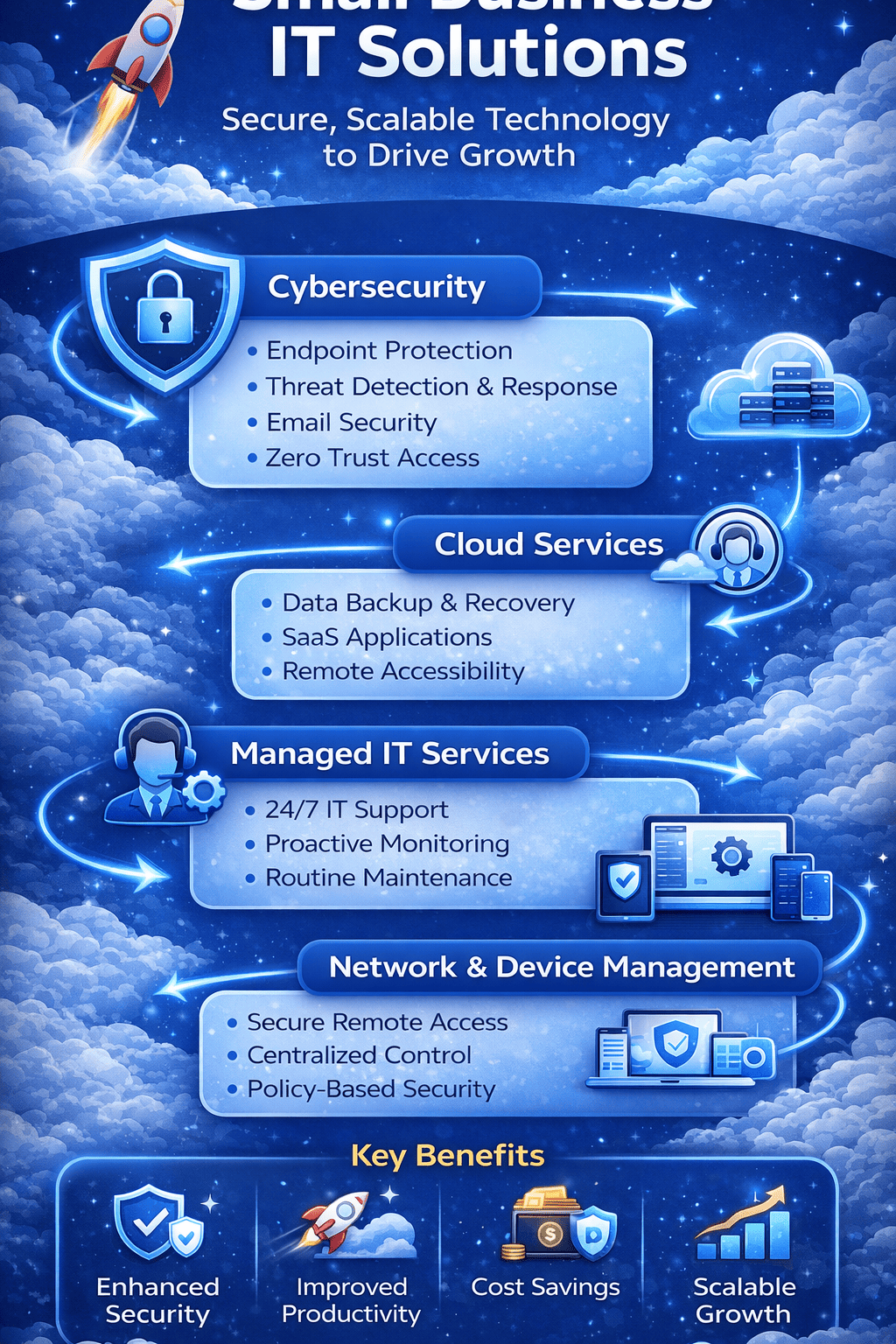
Core Components of Modern Small Business IT Solutions
1. Cybersecurity Solutions for Small Businesses
Cybersecurity is no longer a luxury. It’s a requirement.
Effective small business IT solutions include:
Endpoint detection and response (EDR)
Threat prevention and remediation
Email security and phishing protection
Zero Trust access controls
These tools help protect sensitive data, customer trust, and business continuity.
2. Cloud-Based IT Infrastructure
Cloud technology plays a central role in small business IT solutions.
Benefits include:
Lower upfront costs
Remote accessibility
Automatic updates
Built-in scalability
Common cloud services include cloud storage, SaaS applications, and cloud-based security platforms.
3. Managed IT Services
Many organizations rely on managed providers as part of their small business IT solutions.
Managed IT services typically cover:
24/7 monitoring
Patch management
Help desk support
Incident response
This approach reduces operational burden while improving reliability.
4. Data Backup and Disaster Recovery
Data loss can cripple a small business.
Smart small business IT solutions include:
Automated backups
Cloud-based recovery
Ransomware protection
Business continuity planning
This ensures operations can recover quickly from disruptions.
5. Network and Endpoint Management
Endpoints are everywhere—laptops, desktops, mobile devices.
Strong small business IT solutions provide:
Centralized device management
Secure network configurations
VPN and remote access security
Policy-based controls
This keeps users productive without compromising security.
How Small Business IT Solutions Improve Productivity
Technology should make work easier—not harder.
When implemented correctly, small business IT solutions:
Reduce manual processes
Improve collaboration
Minimize downtime
Support remote and hybrid teams
Employees spend less time fixing issues and more time delivering value.
Cybersecurity and Compliance for Small Businesses
Many industries face strict compliance requirements. Small business IT solutions help meet standards such as:
HIPAA
PCI DSS
GDPR
SOC 2
With built-in reporting, access controls, and monitoring, compliance becomes manageable instead of overwhelming.
How to Choose the Right Small Business IT Solutions
Not all solutions are created equal. Choosing wisely is critical.
Key Factors to Consider
Business size and growth plans
Industry-specific risks
Regulatory requirements
Budget constraints
Internal technical skills
The best small business IT solutions align with both current needs and future goals.
Common Mistakes Small Businesses Make with IT Solutions
Avoid these pitfalls when selecting small business IT solutions:
Choosing tools without integration
Ignoring cybersecurity until after an incident
Overpaying for unused features
Underestimating scalability needs
Lacking visibility into IT performance
A strategic approach prevents wasted spend and security gaps.
Small Business IT Solutions by Industry
Different industries have different needs.
Retail & eCommerce
Secure payment systems
Inventory and POS integration
Fraud prevention
Healthcare
HIPAA-compliant data security
Secure remote access
Reliable backups
Professional Services
Secure document sharing
Endpoint protection
Client data confidentiality
Manufacturing
Network segmentation
OT and IT visibility
Downtime prevention
Industry-aware small business IT solutions provide better outcomes.
Actionable Tips to Maximize Your IT Investment
Here’s how to get the most value from small business IT solutions:
Prioritize cybersecurity from day one
Automate updates and patching
Standardize devices and policies
Monitor performance metrics
Review your IT strategy annually
These steps help future-proof your business.
The Future of Small Business IT Solutions
Technology is evolving fast—and small businesses must keep up.
Emerging Trends
AI-driven threat detection
Zero Trust security models
Cloud-native IT platforms
Automated response and remediation
The future of small business IT solutions is smarter, faster, and more resilient.
Frequently Asked Questions (FAQ)
1. What are the most important small business IT solutions?
Cybersecurity, cloud services, backup, endpoint management, and IT support are essential.
2. Are small business IT solutions affordable?
Yes. Many solutions are subscription-based and scale with business size.
3. Do small businesses really need cybersecurity tools?
Absolutely. Small businesses are frequent targets of cyberattacks.
4. Can IT solutions support remote work?
Yes. Modern small business IT solutions are designed for remote and hybrid teams.
5. How often should IT solutions be reviewed?
At least once a year—or anytime your business changes significantly.
Final Thoughts: Technology That Works for You
The right small business IT solutions don’t just solve problems—they unlock growth, security, and confidence. In a competitive and threat-filled digital landscape, investing in smart, scalable IT is one of the best decisions a business leader can make.
Ready to Strengthen Your IT and Security Posture?
Protect your business with powerful, automated, and easy-to-manage security solutions.
👉 Get started today:
https://openedr.platform.xcitium.com/register/

 Loading...