Updated on August 5, 2026, by OpenEDR
Cyberattacks are growing in frequency and sophistication. From ransomware and phishing to insider threats and data breaches, organizations face constant pressure to protect their systems, employees, and customers. If your business relies on digital technology—and almost every business does—you need secure solutions that can adapt to evolving threats.
Modern secure solutions go beyond traditional antivirus software. They combine advanced technologies such as endpoint protection, Zero Trust security, identity management, cloud security, and threat intelligence to safeguard your organization from every angle. Whether you’re an IT manager, cybersecurity professional, CEO, or founder, investing in comprehensive secure solutions is essential for reducing cyber risk and ensuring business continuity.
What Are Secure Solutions?
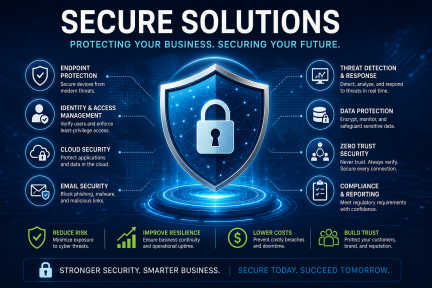
Secure solutions are technologies, services, and cybersecurity strategies designed to protect organizations from cyber threats, unauthorized access, data loss, and operational disruption. They provide multiple layers of defense across users, devices, applications, networks, and cloud environments.
Instead of relying on a single security tool, secure solutions work together to detect, prevent, and respond to attacks in real time.
A modern secure solution typically includes:
- Endpoint security
- Identity and Access Management (IAM)
- Multi-Factor Authentication (MFA)
- Zero Trust security
- Cloud security
- Email protection
- Threat detection and response
- Data encryption
- Security monitoring
Together, these capabilities help organizations maintain a strong security posture while supporting business growth.
Why Secure Solutions Matter
Today’s businesses operate in a connected world where employees work remotely, applications run in the cloud, and sensitive data moves across multiple environments.
Without effective secure solutions, organizations face risks such as:
- Ransomware attacks
- Phishing campaigns
- Data breaches
- Credential theft
- Insider threats
- Compliance violations
- Financial losses
- Business downtime
Implementing layered security helps organizations detect threats early and respond before they cause significant damage.
Protect Critical Business Data
Secure solutions help safeguard:
- Customer information
- Financial records
- Intellectual property
- Employee data
- Operational systems
Reduce Cyber Risk
Continuous monitoring and proactive defenses reduce the likelihood of successful cyberattacks.
Support Regulatory Compliance
Many organizations must comply with regulations including:
- GDPR
- HIPAA
- PCI DSS
- ISO 27001
- SOC 2
Secure solutions help meet these compliance requirements through strong security controls and audit capabilities.
Improve Business Continuity
Preventing cyber incidents reduces downtime and keeps operations running smoothly.
Core Components of Secure Solutions
A comprehensive secure solution typically includes:
- Endpoint protection
- Extended Detection and Response (XDR)
- Endpoint Detection and Response (EDR)
- Network security
- Firewall protection
- Cloud security
- Identity and Access Management (IAM)
- Multi-Factor Authentication (MFA)
- Data Loss Prevention (DLP)
- Email security
- Vulnerability management
- Threat intelligence
- Security monitoring
- Incident response
- Backup and disaster recovery
Together, these technologies provide layered protection against modern cyber threats.
Key Components of Secure Solutions
A comprehensive cybersecurity strategy combines multiple technologies to protect every part of the organization.
Endpoint Security
Endpoints such as laptops, desktops, servers, and mobile devices are common targets for attackers.
Endpoint security provides:
- Malware protection
- Ransomware prevention
- Behavioral threat detection
- Automated threat response
- Device monitoring
Modern endpoint security solutions help stop attacks before they spread across the organization.
Identity and Access Management (IAM)
Identity is the new security perimeter.
IAM solutions help organizations:
- Verify user identities
- Enforce least-privilege access
- Manage user permissions
- Enable Single Sign-On (SSO)
- Strengthen authentication
Adding Multi-Factor Authentication (MFA) further reduces the risk of credential theft.
Zero Trust Security
Zero Trust follows one guiding principle:
Never Trust, Always Verify.
Instead of automatically trusting users inside the network, Zero Trust continuously verifies identities, device health, and risk levels before granting access.
Cloud Security
As organizations move applications and data to the cloud, cloud security becomes essential.
Cloud security solutions help:
- Protect cloud workloads
- Secure SaaS applications
- Monitor cloud activity
- Prevent unauthorized access
- Encrypt sensitive information
Threat Detection and Response
Modern secure solutions use AI, behavioral analytics, and threat intelligence to detect suspicious activity quickly.
Technologies include:
- Endpoint Detection and Response (EDR)
- Extended Detection and Response (XDR)
- Security Information and Event Management (SIEM)
- Security Orchestration, Automation, and Response (SOAR)
These technologies improve visibility and accelerate incident response.
How Secure Solutions Protect Organizations
How Secure Solutions Work
- Identify critical assets and sensitive data.
- Assess vulnerabilities and potential risks.
- Deploy preventive security controls.
- Continuously monitor endpoints, networks, and cloud workloads.
- Detect suspicious activity using behavioral analytics and threat intelligence.
- Investigate and contain security incidents.
- Recover affected systems and restore operations.
- Continuously improve defenses based on lessons learned.
This lifecycle enables organizations to move from reactive security to proactive cyber resilience.
Common Types of Secure Solutions
| Solution Type | Primary Purpose |
|---|---|
| Endpoint Security | Protect laptops, desktops, and servers |
| Network Security | Secure network traffic and infrastructure |
| Cloud Security | Protect cloud applications and workloads |
| Identity Security | Control and verify user access |
| Email Security | Block phishing and malicious attachments |
| Data Protection | Prevent unauthorized access and data loss |
| Vulnerability Management | Identify and remediate security weaknesses |
| Incident Response | Detect, contain, and recover from cyber incidents |
Common Cyber Threats Secure Solutions Address
Understanding today’s threat landscape helps organizations prioritize security investments.
Ransomware
Ransomware encrypts files and demands payment for their release. Advanced secure solutions detect suspicious encryption activity and isolate infected devices before attacks spread.
Phishing
Phishing attacks trick users into revealing passwords or downloading malicious files. Email security and user awareness training help reduce this risk.
Insider Threats
Employees, contractors, or compromised accounts can accidentally or intentionally expose sensitive information. Secure solutions monitor user activity and enforce access controls.
Malware
Malware includes viruses, worms, trojans, spyware, adware, and other malicious software designed to disrupt systems or steal data.
Credential Theft
Weak passwords and stolen credentials remain common attack vectors. MFA and identity protection reduce unauthorized access.
Benefits of Secure Solutions
Secure solutions help organizations:
- Reduce cyber risk
- Prevent ransomware attacks
- Protect sensitive business data
- Improve regulatory compliance
- Strengthen cloud security
- Enhance endpoint visibility
- Detect threats faster
- Minimize downtime
- Improve business continuity
- Build customer trust
These benefits contribute to stronger operational resilience and long-term growth.
How Secure Solutions Support Zero Trust
Zero Trust security depends on strong, integrated protection across users, devices, and applications.
Secure solutions support Zero Trust by:
- Continuously verifying user identities
- Assessing device health
- Enforcing least-privilege access
- Monitoring endpoint behavior
- Protecting cloud applications
- Detecting suspicious activity in real time
Together, these controls reduce attack surfaces and limit lateral movement within the network.
Zero Trust as the Foundation of Secure Solutions
Many organizations now build secure solutions around the Zero Trust security model.
Key principles include:
- Verify every user and device continuously.
- Grant least-privilege access.
- Segment networks to limit lateral movement.
- Continuously monitor user and device behavior.
- Authenticate every request regardless of location.
Zero Trust reduces the impact of compromised credentials and insider threats.
AI and Automation in Modern Security
Artificial intelligence improves secure solutions by helping organizations:
- Detect unknown threats
- Analyze large volumes of security events
- Reduce false positives
- Automate incident investigation
- Prioritize high-risk alerts
- Accelerate threat response
- Improve threat intelligence
AI complements human analysts by increasing speed and efficiency in security operations.
Best Practices for Implementing Secure Solutions
Technology alone is not enough. Organizations should combine tools with effective security processes.
Conduct Regular Risk Assessments
Evaluate systems, applications, and users to identify vulnerabilities before attackers do.
Enable Multi-Factor Authentication
Require MFA for privileged accounts and remote access to reduce credential-based attacks.
Keep Software Updated
Apply security patches promptly to close known vulnerabilities.
Train Employees
Security awareness training should cover:
- Phishing emails
- Social engineering
- Safe password practices
- Secure browsing habits
Employees are often the first line of defense.
Back Up Critical Data
Maintain regular, secure, and immutable backups to improve recovery from ransomware or accidental data loss.
Monitor Continuously
Use centralized monitoring and automated alerts to identify unusual activity quickly.
What to Consider Before Selecting a Secure Solution
Evaluate solutions based on:
- Scalability
- Cloud and hybrid environment support
- Integration with existing tools
- Threat detection capabilities
- Ease of management
- Automation features
- Compliance support
- Reporting and visibility
- Vendor expertise
- Total cost of ownership
Selecting a solution that aligns with your organization’s size, risk profile, and business goals will improve long-term security outcomes.
Choosing the Right Secure Solutions
Every organization has unique security requirements.
When evaluating providers, consider:
Scalability
Can the solution grow with your business?
Integration
Does it work with existing infrastructure, cloud services, and security tools?
Automation
Look for capabilities such as:
- Automated threat detection
- Incident response
- Patch management
- Policy enforcement
Visibility
Choose solutions that provide centralized dashboards, reporting, and real-time insights.
Vendor Expertise
Evaluate customer support, threat intelligence capabilities, and industry experience before making a decision.
Best Practices for Implementing Secure Solutions
Secure Solutions Checklist
✔ Conduct regular risk assessments.
✔ Maintain an accurate inventory of devices and applications.
✔ Enable Multi-Factor Authentication (MFA).
✔ Apply software and operating system updates promptly.
✔ Encrypt sensitive information.
✔ Continuously monitor endpoints and networks.
✔ Back up critical business data.
✔ Train employees to recognize phishing attacks.
✔ Test incident response plans regularly.
✔ Review security policies and access permissions on a routine basis.
Following these practices helps maximize the effectiveness of your security investments.
Industry Use Cases for Secure Solutions
Different industries face different cybersecurity challenges.
Healthcare
Protect electronic health records, connected medical devices, and patient privacy while supporting HIPAA compliance.
Financial Services
Secure banking applications, payment systems, and customer financial data while preventing fraud.
Manufacturing
Protect operational technology (OT), industrial control systems, and connected production environments.
Retail
Safeguard payment systems, customer information, and e-commerce platforms while meeting PCI DSS requirements.
Government
Secure critical infrastructure, citizen services, and sensitive government information against advanced cyber threats.
Education
Protect student records, faculty devices, research data, and remote learning platforms.
Future Trends in Secure Solutions
Cybersecurity continues to evolve as organizations adopt new technologies.
Key trends include:
AI-Powered Security
Artificial intelligence enables faster threat detection, automated analysis, and reduced false positives.
Extended Detection and Response (XDR)
XDR combines telemetry from endpoints, networks, cloud services, and email systems to improve visibility and response.
Passwordless Authentication
Biometrics, security keys, and passkeys reduce reliance on traditional passwords.
Secure Access Service Edge (SASE)
SASE combines networking and security into a unified cloud-delivered architecture, supporting secure hybrid work.
Continuous Security Validation
Organizations increasingly assess security continuously rather than relying on annual reviews.
Conclusion
Cyber threats are constantly changing, but organizations can stay ahead by adopting comprehensive secure solutions that protect users, devices, applications, and data. A layered security strategy built on endpoint protection, Zero Trust principles, identity management, cloud security, and continuous monitoring helps reduce risk while supporting business growth.
Whether you’re protecting a small business or a global enterprise, investing in modern secure solutions strengthens resilience, improves compliance, and builds customer trust.
Ready to strengthen your cybersecurity posture with advanced protection?
Start today with a powerful security platform designed to detect, prevent, and respond to modern cyber threats:
https://openedr.platform.xcitium.com/register/
Frequently Asked Questions
1. What are secure solutions?
Secure solutions are cybersecurity technologies and services that protect organizations from cyber threats by securing users, devices, applications, networks, and data.
2. Why are secure solutions important?
They help prevent cyberattacks, reduce business risk, protect sensitive information, improve compliance, and support business continuity.
3. What technologies are included in secure solutions?
Common technologies include endpoint security, Zero Trust, Identity and Access Management (IAM), Multi-Factor Authentication (MFA), cloud security, EDR, XDR, SIEM, and data encryption.
4. How do secure solutions protect against ransomware?
They use behavioral analysis, AI-powered detection, endpoint protection, automated isolation, and continuous monitoring to stop ransomware before it encrypts files.
5. How do I choose the right secure solution for my business?
Evaluate your organization’s security needs, compliance requirements, scalability, integration capabilities, automation features, and vendor support to select the most appropriate solution.

 Loading...