Updated on May 29, 2026, by OpenEDR
OT Cyber Security: Why It Matters More Than Ever
Imagine a cyberattack shutting down a manufacturing plant, disrupting a power grid, or halting a water treatment facility. These are no longer hypothetical scenarios. As industrial systems become increasingly connected, OT cyber security has become a top priority for organizations that rely on operational technology.
Unlike traditional IT environments, operational technology (OT) controls physical processes and industrial equipment. A successful attack on OT systems can lead to production downtime, financial losses, safety incidents, and even threats to public infrastructure. That’s why organizations across manufacturing, energy, transportation, healthcare, and utilities are investing heavily in OT cyber security strategies.
In this guide, we’ll explore what OT cyber security is, why it matters, the most common threats facing industrial environments, and how organizations can strengthen their defenses.
What Is OT Cyber Security?
OT cyber security refers to the protection of operational technology systems, industrial control systems (ICS), supervisory control and data acquisition (SCADA) systems, programmable logic controllers (PLCs), and other devices that monitor or control physical processes.
Unlike IT systems, which focus on data processing and business operations, OT systems directly interact with machinery, equipment, and critical infrastructure.
Examples of OT environments include:
- Manufacturing facilities
- Power plants
- Oil and gas operations
- Water treatment facilities
- Transportation networks
- Healthcare equipment systems
The primary goal of OT cyber security is to ensure the availability, integrity, and safety of operational systems while protecting them from cyber threats.
Why OT Cyber Security Is Critical for Modern Businesses
Many industrial organizations were designed with reliability and productivity in mind rather than cybersecurity. As a result, many legacy OT systems were not built to withstand modern cyber threats.
Today, organizations face several challenges:
- Increased connectivity between IT and OT networks
- Remote access requirements
- Industrial IoT (IIoT) adoption
- Legacy equipment vulnerabilities
- Sophisticated ransomware attacks
- Supply chain threats
A successful cyberattack can disrupt operations for days or weeks. In critical industries, downtime can affect public safety, customer trust, and regulatory compliance.
This growing threat landscape makes OT cyber security essential for maintaining business continuity and operational resilience.
Key Differences Between IT Security and OT Cyber Security
Although IT and OT environments often work together, their security priorities differ significantly.
| IT Security | OT Cyber Security |
|---|---|
| Protects data | Protects physical processes |
| Focuses on confidentiality | Focuses on availability and safety |
| Frequent updates and patches | Limited maintenance windows |
| User-centric systems | Machine-centric systems |
| Data breaches are primary concern | Operational disruption is primary concern |
Organizations must understand these differences when building an effective OT cyber security program.
Common Threats Facing OT Environments
Industrial environments face unique cybersecurity risks. Understanding these threats is the first step toward building stronger defenses.
Ransomware Attacks
Ransomware remains one of the most significant threats to industrial organizations. Attackers can encrypt critical systems, disrupt production, and demand large ransom payments.
Common impacts include:
- Production downtime
- Revenue loss
- Supply chain disruption
- Safety risks
- Regulatory penalties
Strong OT cyber security controls help reduce ransomware exposure and improve recovery capabilities.
Insider Threats
Employees, contractors, and vendors often have access to operational systems. Whether intentional or accidental, insider actions can introduce significant risk.
Examples include:
- Unauthorized system changes
- Weak password practices
- Accidental malware infections
- Misconfigured devices
Supply Chain Attacks
Third-party vendors and service providers often connect directly to OT environments. Attackers increasingly exploit these relationships to gain access to industrial systems.
Legacy System Vulnerabilities
Many industrial environments rely on equipment that has been operating for years or even decades.
Common challenges include:
- Unsupported operating systems
- Limited patch availability
- Insecure protocols
- Weak authentication mechanisms
These vulnerabilities make comprehensive OT cyber security essential.
Core Components of an Effective OT Cyber Security Strategy
A successful security program requires a layered approach.
1. Asset Discovery and Visibility
Organizations cannot protect what they cannot see.
Asset discovery helps identify:
- Connected devices
- Industrial controllers
- Network communications
- Unauthorized equipment
Visibility is the foundation of effective OT cyber security.
2. Network Segmentation
Separating IT and OT environments reduces the risk of attackers moving laterally through networks.
Best practices include:
- Dedicated OT zones
- Secure gateways
- Restricted access pathways
- Industrial firewalls
3. Continuous Monitoring
Real-time monitoring helps organizations detect threats before they cause significant damage.
Monitoring capabilities should include:
- Behavioral analysis
- Anomaly detection
- Threat intelligence integration
- Security event logging
4. Access Control
Strong access controls reduce the likelihood of unauthorized access.
Key measures include:
- Multi-factor authentication (MFA)
- Role-based access control (RBAC)
- Privileged access management
- Least-privilege policies
5. Incident Response Planning
Every organization should have a documented OT incident response plan.
Plans should define:
- Detection procedures
- Escalation paths
- Recovery processes
- Communication protocols
Best Practices for Improving OT Cyber Security
Organizations can significantly strengthen security by following proven best practices.
Conduct Regular Risk Assessments
Risk assessments help identify vulnerabilities before attackers exploit them.
Assessments should evaluate:
- Network architecture
- Device inventory
- Third-party access
- Existing security controls
Implement Zero Trust Principles
Zero Trust follows the principle of:
“Never trust, always verify.”
Applying Zero Trust to OT cyber security helps prevent unauthorized access and limits attacker movement.
Secure Remote Access
Remote access has become essential for many industrial operations.
Security measures should include:
- VPN protection
- MFA
- Session monitoring
- Access logging
Keep Systems Updated
Although patching OT environments can be challenging, organizations should establish structured maintenance programs to reduce vulnerability exposure.
Train Employees
Human error remains one of the leading causes of security incidents.
Training programs should cover:
- Phishing awareness
- Password hygiene
- Device security
- Incident reporting procedures
The Role of EDR and XDR in OT Cyber Security
Modern Endpoint Detection and Response (EDR) and Extended Detection and Response (XDR) solutions provide valuable protection for industrial environments.
Benefits include:
- Real-time threat detection
- Behavioral analytics
- Threat hunting
- Automated response
- Incident investigation
Advanced EDR platforms can identify suspicious activity before attackers compromise critical operational systems.
Organizations increasingly deploy EDR as part of their overall OT cyber security strategy.
Regulatory Compliance and OT Cyber Security
Many industries face strict regulatory requirements designed to protect critical infrastructure.
Common frameworks include:
- NIST Cybersecurity Framework
- IEC 62443
- NERC CIP
- ISO 27001
- CISA guidance
Strong OT cyber security programs help organizations meet compliance obligations while improving overall resilience.
Future Trends in OT Cyber Security
The OT landscape continues to evolve rapidly.
Key trends include:
Industrial IoT Expansion
Connected devices create new opportunities but also introduce additional attack surfaces.
AI-Powered Threat Detection
Artificial intelligence helps identify threats faster and improve incident response.
Increased Regulatory Oversight
Governments worldwide are strengthening cybersecurity requirements for critical infrastructure operators.
Convergence of IT and OT Security
Organizations increasingly integrate IT and OT security teams to improve visibility and coordination.
These developments will continue shaping the future of OT cyber security.
Building a Resilient OT Security Program
Effective OT cyber security requires more than technology alone. Organizations must combine people, processes, and security tools to build resilient industrial environments.
Successful programs typically include:
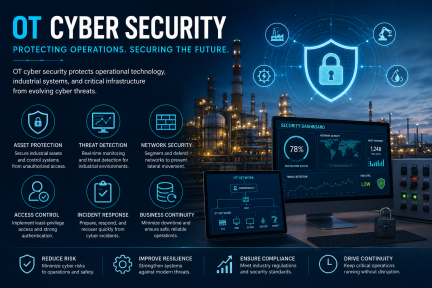
- Asset visibility
- Network segmentation
- Continuous monitoring
- Strong access controls
- Employee training
- Incident response planning
- Threat intelligence integration
By adopting these practices, organizations can reduce risk and improve operational resilience.
Frequently Asked Questions
What is OT cyber security?
OT cyber security protects operational technology systems such as industrial control systems, SCADA environments, and critical infrastructure from cyber threats and unauthorized access.
Why is OT cyber security important?
OT cyber security helps protect critical operations, reduce downtime, improve safety, and prevent cyberattacks that could disrupt industrial processes.
What industries need OT cyber security?
Manufacturing, energy, oil and gas, transportation, healthcare, water treatment, and utilities all rely heavily on OT cyber security.
What is the difference between IT and OT security?
IT security focuses on protecting data and business systems, while OT security focuses on protecting industrial processes, equipment, and operational availability.
How can organizations improve OT cyber security?
Organizations can improve OT cyber security through asset visibility, network segmentation, continuous monitoring, Zero Trust security, employee training, and incident response planning.
Conclusion
As industrial environments become more connected, cyber threats continue to grow in complexity and impact. Organizations can no longer rely on traditional security approaches to protect critical operations.
A strong OT cyber security strategy helps safeguard industrial systems, improve operational resilience, reduce downtime, and defend against evolving threats. By implementing layered security controls and modern detection technologies, businesses can protect both their operations and their future.
Ready to strengthen your security posture with advanced threat detection and response?
Get started today: https://openedr.platform.xcitium.com/register/

 Loading...