Updated on February 11, 2026, by OpenEDR
Technology is no longer just a support function—it drives revenue, productivity, security, and innovation. Yet many organizations struggle to align their technology with business goals. That’s why IT solutions for businesses have become a strategic priority for companies of all sizes.
From cybersecurity and cloud computing to managed services and automation, the right IT solutions for businesses help organizations operate efficiently, stay secure, and scale confidently. For IT managers and executives, choosing the right technology strategy can mean the difference between growth and disruption.
In this guide, we’ll explore what IT solutions for businesses include, why they matter, key categories, industry use cases, implementation strategies, and how to select the right partner.
What Are IT Solutions for Businesses?
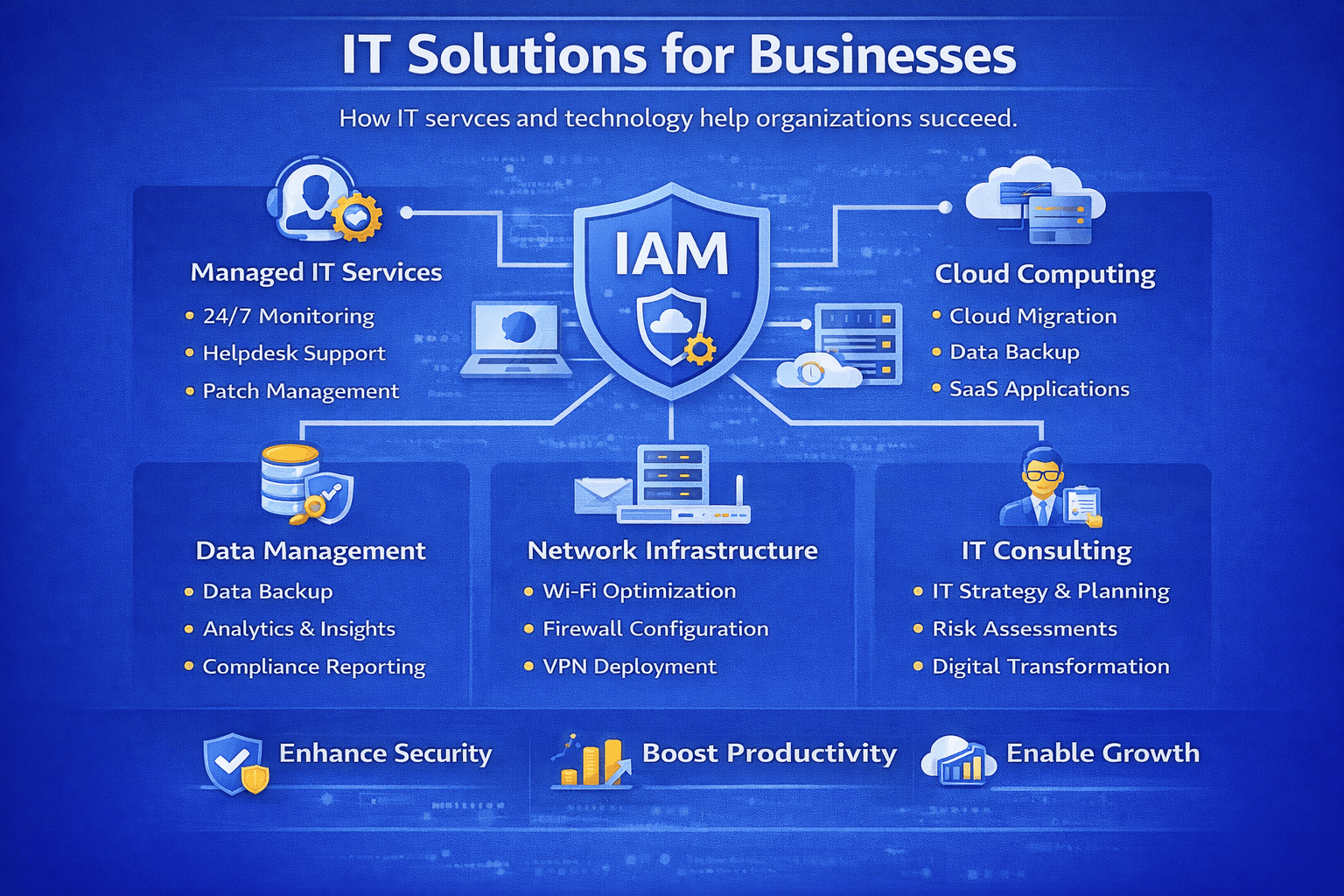
IT solutions for businesses refer to technology services, systems, and strategies designed to support operational efficiency, cybersecurity, communication, and digital transformation.
These solutions may include:
Managed IT services
Cybersecurity services
Cloud computing
Data management
Network infrastructure
Software development
IT consulting
In simple terms, IT solutions for businesses ensure that technology works securely and efficiently to support business objectives.
Why IT Solutions for Businesses Are Critical Today
Modern organizations rely on interconnected systems.
Without strong IT solutions for businesses, companies face:
Downtime and productivity loss
Cybersecurity threats
Compliance failures
Data breaches
Poor customer experiences
Technology complexity has increased. So has risk. Strategic IT planning is essential.
Core Categories of IT Solutions for Businesses
IT solutions for businesses span multiple technology domains. Let’s break down the most important ones.
1. Managed IT Services
Managed IT services allow businesses to outsource IT operations to experts.
Typical managed services include:
24/7 monitoring
Helpdesk support
Patch management
System updates
Performance optimization
Managed IT reduces operational strain on internal teams.
2. Cybersecurity Solutions
Cybersecurity is a core pillar of IT solutions for businesses.
Key cybersecurity services include:
Endpoint protection
Network security
Email security
Threat detection and response
Vulnerability management
With ransomware and phishing attacks increasing, security is no longer optional.
3. Cloud Computing Solutions
Cloud adoption has transformed business operations.
Cloud-based IT solutions for businesses include:
Infrastructure as a Service (IaaS)
Software as a Service (SaaS)
Cloud migration services
Cloud backup and disaster recovery
Cloud solutions improve scalability and flexibility.
4. Data Management and Analytics
Data drives modern decision-making.
IT solutions for businesses often focus on:
Data storage
Backup solutions
Business intelligence tools
Analytics platforms
Compliance reporting
Proper data governance protects sensitive information.
5. Network Infrastructure
Reliable networks are the backbone of digital operations.
Network-focused IT solutions for businesses include:
LAN and WAN setup
Wi-Fi optimization
Firewall configuration
Network monitoring
VPN deployment
Strong infrastructure supports performance and security.
6. IT Consulting and Digital Transformation
Technology must align with strategy.
IT consulting services help businesses:
Develop IT roadmaps
Assess risk exposure
Optimize budgets
Implement automation
Support innovation initiatives
Consulting ensures technology investments drive ROI.
Benefits of IT Solutions for Businesses
Organizations that implement structured IT solutions for businesses experience measurable improvements.
Key benefits include:
Reduced downtime
Stronger cybersecurity posture
Improved employee productivity
Scalable infrastructure
Better regulatory compliance
Predictable IT costs
For CEOs, these outcomes translate into sustainable growth.
IT Solutions for Small vs Large Businesses
Technology needs vary by company size.
Small and Mid-Sized Businesses (SMBs)
SMBs often require:
Cost-effective managed IT
Basic cybersecurity protection
Cloud-first strategies
Scalable support
Outsourced IT solutions for businesses are especially valuable for SMBs.
Enterprises
Enterprises typically need:
Advanced cybersecurity frameworks
Dedicated SOC monitoring
Hybrid cloud architecture
Compliance-driven controls
Identity and access management
Enterprise IT solutions must scale globally.
Industry-Specific IT Solutions for Businesses
Different industries require tailored solutions.
Healthcare
Focus areas:
HIPAA compliance
Secure patient data
Telemedicine infrastructure
Endpoint protection
Financial Services
Priority areas:
Fraud prevention
Secure transactions
Encryption standards
Regulatory compliance
Retail and E-Commerce
Critical needs:
Payment system security
Inventory management systems
Customer data protection
Scalable cloud hosting
Manufacturing
Important solutions:
Industrial network security
Operational technology (OT) protection
Supply chain visibility
Downtime prevention
IT solutions for businesses must adapt to sector-specific risks.
Cybersecurity as the Foundation of IT Strategy
Security should not be an afterthought.
Modern IT solutions for businesses integrate:
Zero Trust architecture
Multi-factor authentication (MFA)
Endpoint detection and response (EDR)
Continuous monitoring
Cyber resilience protects brand reputation.
Cloud vs On-Premises IT Solutions
Businesses must choose deployment models carefully.
Cloud Advantages:
Scalability
Lower upfront costs
Automatic updates
On-Premises Advantages:
Full control
Customization
Regulatory constraints
Hybrid IT solutions for businesses often provide the best balance.
Common Challenges in Implementing IT Solutions
Technology transformation can present obstacles.
Common challenges include:
Budget limitations
Legacy system integration
Employee resistance
Cybersecurity gaps
Vendor overload
Strategic planning reduces implementation risk.
How to Choose the Right IT Solutions Provider
Selecting the right partner is crucial.
Evaluation criteria:
Industry expertise
Security certifications
24/7 support capability
Scalability options
Transparent pricing
Proven track record
Not all providers offer comprehensive IT solutions for businesses.
ROI of IT Solutions for Businesses
Investing in IT delivers long-term value.
ROI comes from:
Reduced incident response costs
Lower downtime expenses
Improved operational efficiency
Enhanced customer satisfaction
Stronger competitive advantage
Technology is an enabler of revenue—not just a cost center.
Future Trends in IT Solutions for Businesses
Technology continues to evolve.
Emerging trends include:
AI-powered threat detection
Automation-driven IT operations
Cloud-native infrastructure
Integrated identity security
Autonomous endpoint protection
Future-ready IT solutions will be proactive, not reactive.
Best Practices for IT Strategy
To maximize results:
Conduct regular risk assessments
Prioritize cybersecurity investments
Automate routine IT tasks
Maintain clear documentation
Implement disaster recovery plans
Monitor continuously
Proactive management prevents costly disruptions.
FAQs: IT Solutions for Businesses
1. What are IT solutions for businesses?
They are technology services and systems that support operations, security, and growth.
2. Why are IT solutions important?
They reduce risk, improve efficiency, and support digital transformation.
3. Do small businesses need IT solutions?
Yes. Even small organizations require cybersecurity and infrastructure support.
4. What is included in managed IT services?
Monitoring, support, patching, system maintenance, and troubleshooting.
5. How do IT solutions improve cybersecurity?
They implement layered defenses, monitoring, and risk management strategies.
Final Thoughts: Building a Strong Technology Foundation
Modern organizations cannot afford weak infrastructure or reactive IT strategies. The right IT solutions for businesses strengthen security, improve efficiency, and support long-term scalability.
For IT leaders, it means greater visibility and control.
For executives, it means reduced operational risk.
For employees, it means smoother workflows.
Technology should empower growth—not create obstacles.
Strategic IT solutions for businesses ensure your organization stays competitive, secure, and resilient in a rapidly evolving digital landscape.
Take the Next Step Toward Smarter IT and Stronger Security
Ready to transform your IT environment with intelligent, proactive protection?
👉 Register today:
https://openedr.platform.xcitium.com/register/
Discover how advanced endpoint and cybersecurity-driven IT solutions help businesses reduce risk, improve visibility, and stay ahead of modern threats.

 Loading...