Updated on June 23, 2026, by OpenEDR
Cyberattacks are becoming more sophisticated every year, and organizations are struggling to keep up. According to industry reports, compromised credentials remain one of the leading causes of data breaches worldwide. So, how can businesses protect sensitive information while ensuring employees, partners, and customers have seamless access to critical resources? The answer lies in implementing robust identity and access management solutions.
Modern organizations operate across cloud platforms, remote work environments, mobile devices, and third-party applications. Managing who has access to what—and when—has become a major security challenge. Effective identity and access management solutions help businesses strengthen security, improve compliance, and streamline user experiences without sacrificing productivity.
In this guide, we’ll explore what identity and access management is, why it matters, key features to look for, implementation best practices, and how organizations can benefit from adopting modern IAM strategies.
What Are Identity and Access Management Solutions?
Identity and access management solutions are security frameworks, technologies, and policies that ensure only authorized users can access specific systems, applications, and data.
At their core, IAM solutions perform two critical functions:
- Identity Management: Verifying who users are.
- Access Management: Determining what users are allowed to access.
These systems authenticate users through methods such as passwords, biometrics, security tokens, or multi-factor authentication (MFA). Once authenticated, users receive permissions based on predefined roles and security policies.
Without effective identity and access management solutions, organizations face increased risks of unauthorized access, insider threats, and costly data breaches.
Why Identity and Access Management Solutions Matter
As organizations expand their digital ecosystems, managing user identities becomes increasingly complex.
Consider these challenges:
- Remote employees accessing corporate resources
- Contractors requiring temporary access
- Cloud applications spread across multiple providers
- Regulatory compliance requirements
- Increasing credential-based attacks
Modern identity and access management solutions address these challenges by providing centralized control over user access.
Key benefits include:
Enhanced Security
IAM systems reduce the risk of unauthorized access by verifying user identities and enforcing strict access policies.
Improved Compliance
Many regulations require organizations to control and monitor access to sensitive information, including:
- GDPR
- HIPAA
- PCI DSS
- SOX
- ISO 27001
Identity and access management solutions help organizations meet these compliance requirements efficiently.
Better User Experience
Single Sign-On (SSO) capabilities allow users to access multiple applications with one set of credentials, reducing password fatigue and improving productivity.
Reduced Administrative Burden
Automated user provisioning and deprovisioning minimize manual workloads for IT teams.
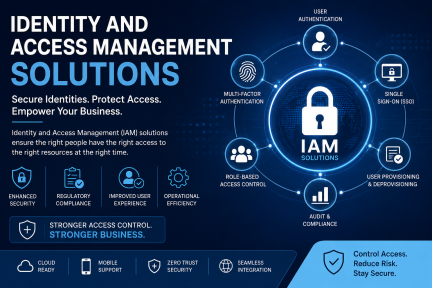
Core Components of Identity and Access Management Solutions
Understanding the essential components of IAM helps organizations select the right platform.
Authentication
Authentication verifies a user’s identity before granting access.
Common authentication methods include:
- Passwords
- Biometrics
- Smart cards
- Security tokens
- Multi-factor authentication (MFA)
MFA has become a critical component of modern identity and access management solutions because it adds an extra layer of security beyond passwords.
Authorization
Once users are authenticated, authorization determines their level of access.
Organizations often implement:
- Role-Based Access Control (RBAC)
- Attribute-Based Access Control (ABAC)
- Policy-Based Access Control
These approaches ensure users access only the resources necessary for their roles.
Single Sign-On (SSO)
SSO enables users to authenticate once and access multiple applications without repeated logins.
Benefits include:
- Improved user experience
- Reduced password-related help desk requests
- Stronger security controls
User Provisioning and Deprovisioning
Identity and access management solutions automate account creation, modification, and removal.
This process helps:
- Accelerate onboarding
- Reduce human error
- Prevent orphaned accounts
Identity Governance
Identity governance provides visibility into who has access to what resources.
It includes:
- Access reviews
- Role management
- Audit reporting
- Policy enforcement
Key Features to Look for in Identity and Access Management Solutions
Not all IAM platforms offer the same capabilities. Organizations should evaluate solutions based on current and future security requirements.
Multi-Factor Authentication
MFA significantly reduces the risk of credential theft.
Look for support for:
- Push notifications
- Hardware tokens
- Biometrics
- Adaptive authentication
Privileged Access Management (PAM)
Privileged accounts present high-value targets for attackers.
Modern identity and access management solutions often integrate PAM capabilities to secure:
- Administrator accounts
- Service accounts
- Root credentials
Cloud Integration
Today’s organizations rely heavily on cloud applications.
Effective IAM solutions should integrate seamlessly with:
- Microsoft 365
- Google Workspace
- AWS
- Azure
- Salesforce
Risk-Based Authentication
Advanced IAM platforms use contextual information such as:
- Device type
- Location
- User behavior
- Time of access
This enables dynamic security decisions based on risk levels.
Reporting and Auditing
Comprehensive reporting supports compliance efforts and security investigations.
Organizations should prioritize solutions that provide:
- Real-time monitoring
- Audit trails
- Access reports
- Compliance dashboards
How Identity and Access Management Solutions Strengthen Cybersecurity
Cybercriminals frequently target user credentials because they provide direct access to corporate resources.
Identity and access management solutions reduce this risk by implementing multiple layers of protection.
Preventing Credential-Based Attacks
Attackers often use:
- Phishing
- Credential stuffing
- Password spraying
- Social engineering
IAM solutions mitigate these threats through MFA, adaptive authentication, and continuous monitoring.
Limiting Insider Threats
Not all security risks originate externally.
Identity and access management solutions help organizations:
- Enforce least-privilege access
- Monitor user activities
- Detect unusual behavior
- Revoke access promptly
Supporting Zero Trust Security
Zero Trust assumes no user or device should be trusted automatically.
IAM serves as a cornerstone of Zero Trust by continuously verifying:
- User identity
- Device health
- Access permissions
This significantly improves organizational resilience against cyberattacks.
Common Challenges When Implementing Identity and Access Management Solutions
Despite their benefits, IAM deployments can present challenges.
Complex Legacy Environments
Older systems may lack modern authentication capabilities.
Organizations often need:
- Custom integrations
- Middleware solutions
- Phased migration strategies
User Resistance
Employees may initially resist changes such as MFA requirements.
Successful adoption requires:
- User education
- Clear communication
- Executive support
Role Definition Complexity
Establishing accurate roles and permissions can be time-consuming.
Organizations should conduct thorough access reviews before deployment.
Scalability Concerns
As businesses grow, IAM systems must accommodate:
- New employees
- Additional applications
- Cloud environments
- Business acquisitions
Choosing scalable identity and access management solutions is essential for long-term success.
Best Practices for Successful IAM Implementation
Organizations can maximize IAM effectiveness by following proven best practices.
Conduct an Identity Audit
Begin by identifying:
- Users
- Devices
- Applications
- Existing permissions
A comprehensive audit provides a foundation for implementation.
Adopt Least Privilege Access
Users should receive only the access necessary to perform their responsibilities.
Benefits include:
- Reduced attack surface
- Improved compliance
- Lower insider risk
Enable Multi-Factor Authentication Everywhere
MFA should be mandatory for:
- Remote access
- Administrative accounts
- Cloud applications
- Sensitive systems
Automate User Lifecycle Management
Automation ensures users receive appropriate access throughout their employment lifecycle.
Automated workflows reduce errors and improve efficiency.
Regularly Review Access Rights
Periodic reviews help identify:
- Excessive permissions
- Dormant accounts
- Policy violations
Continuous monitoring strengthens security posture.
The Future of Identity and Access Management Solutions
The IAM landscape continues to evolve rapidly.
Several emerging trends are shaping the future:
Passwordless Authentication
Organizations are increasingly replacing passwords with:
- Biometrics
- Security keys
- Device-based authentication
AI-Powered Access Controls
Artificial intelligence enables:
- Behavioral analytics
- Threat detection
- Risk assessment
- Adaptive authentication
Decentralized Identity
Decentralized identity frameworks give users greater control over personal credentials while improving privacy and security.
Expanded Zero Trust Adoption
As cyber threats grow more sophisticated, identity and access management solutions will play an even larger role in Zero Trust architectures.
Organizations that invest in modern IAM capabilities today will be better positioned to defend against future threats.
Choosing the Right Identity and Access Management Solution
When evaluating identity and access management solutions, decision-makers should consider:
- Security requirements
- Compliance obligations
- Scalability needs
- Cloud compatibility
- Integration capabilities
- User experience
- Total cost of ownership
A successful IAM strategy balances security, usability, and operational efficiency.
Organizations should also assess vendor support, implementation services, and future product roadmaps before making a final decision.
Conclusion
Identity is now the primary security perimeter. With users accessing applications from multiple devices and locations, traditional security models are no longer enough. Modern identity and access management solutions provide the visibility, control, and protection organizations need to secure critical resources while maintaining productivity.
By implementing robust authentication, enforcing least-privilege access, automating identity governance, and supporting Zero Trust initiatives, businesses can significantly reduce cyber risks and strengthen their overall cybersecurity posture.
Ready to enhance your organization’s security with advanced identity and access management capabilities? Get started today and explore enterprise-grade cybersecurity solutions at:
👉 https://openedr.platform.xcitium.com/register/
Frequently Asked Questions (FAQ)
1. What are identity and access management solutions?
Identity and access management solutions are technologies and processes that authenticate users and control access to systems, applications, and data based on predefined security policies.
2. Why are identity and access management solutions important?
They help prevent unauthorized access, improve compliance, reduce insider threats, and provide centralized control over user identities across an organization.
3. What is the difference between authentication and authorization?
Authentication verifies a user’s identity, while authorization determines what resources the user is permitted to access after authentication.
4. How does multi-factor authentication improve IAM security?
Multi-factor authentication requires users to provide multiple forms of verification, making it significantly harder for attackers to gain access using stolen credentials.
5. Can identity and access management solutions support Zero Trust security?
Yes. Identity and access management solutions are a foundational component of Zero Trust architectures because they continuously verify user identities and access permissions before granting access to resources.

 Loading...