Updated on May 20, 2026, by OpenEDR
What happens when your business experiences a cyberattack? Would your team know what to do in the first hour? For many organizations, the answer is no—and that delay can be extremely costly. Cybercriminals move quickly, and businesses without a clear cybersecurity incident response strategy often suffer financial losses, reputational damage, and operational downtime.
Today’s threat landscape is more aggressive than ever. Ransomware, phishing attacks, insider threats, and data breaches continue to target businesses across every industry. That’s why having a strong cybersecurity incident response plan is no longer optional. It’s a critical part of modern business security.
In this guide, you’ll learn what cybersecurity incident response means, why it matters, how it works, and how organizations can improve their response capabilities before disaster strikes.
What Is Cybersecurity Incident Response?
Cybersecurity incident response refers to the process organizations use to identify, manage, contain, and recover from cyber threats or security breaches. The goal is to minimize damage, reduce recovery time, and prevent future incidents.
An incident response strategy helps businesses react quickly when security events occur, including:
- Malware infections
- Ransomware attacks
- Data breaches
- Phishing attacks
- Insider threats
- Unauthorized access
- Distributed Denial-of-Service (DDoS) attacks
Without a structured response plan, even a small incident can escalate into a major crisis.
Why Cybersecurity Incident Response Matters
Cyberattacks are expensive. According to industry research, the average cost of a data breach continues to rise every year. Beyond financial losses, businesses also risk losing customer trust and facing legal or regulatory penalties.
A well-designed cybersecurity incident response framework helps organizations:
- Detect threats faster
- Reduce downtime
- Protect sensitive data
- Maintain business continuity
- Improve regulatory compliance
- Minimize reputational damage
The faster an organization responds to threats, the lower the overall impact.
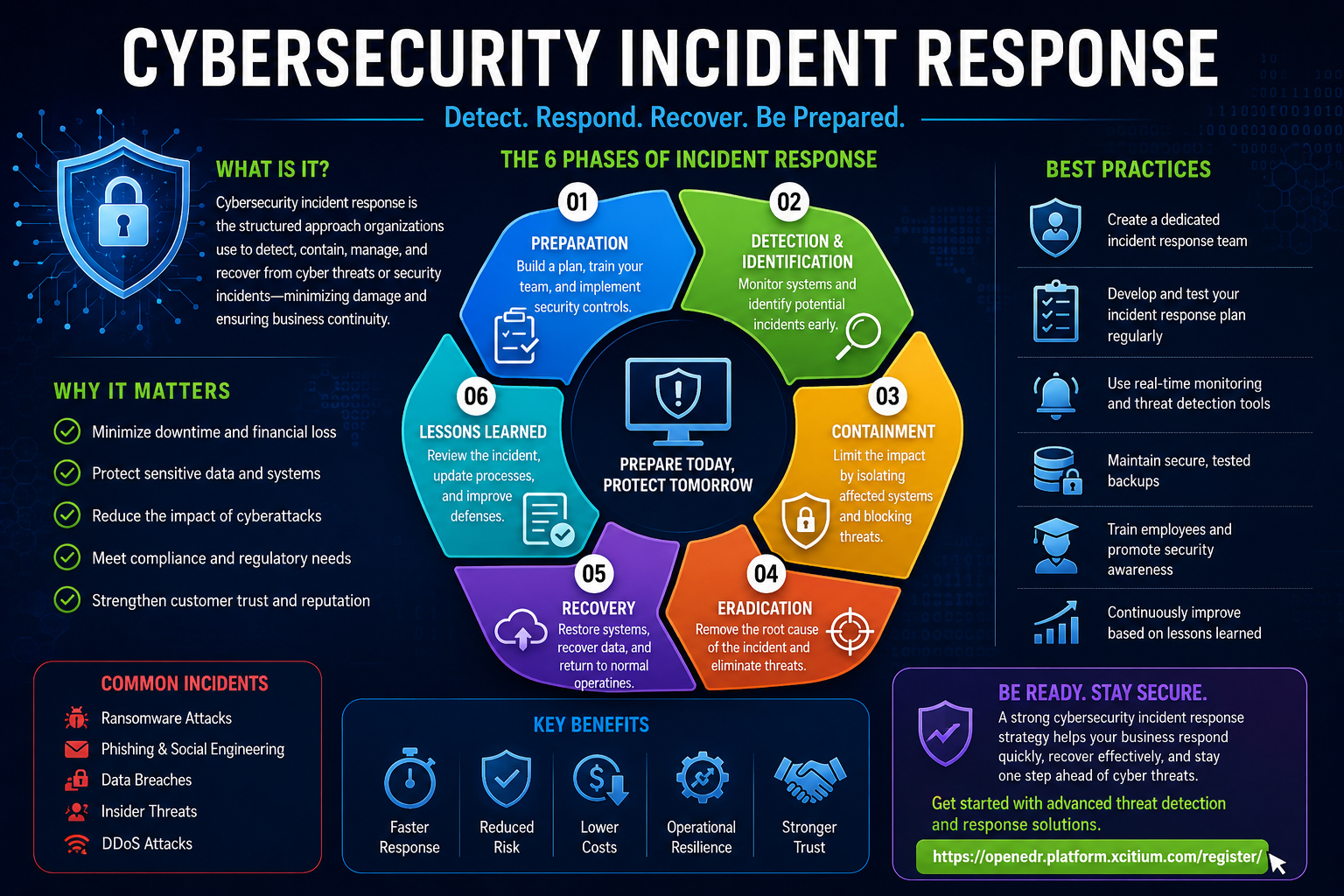
The Six Phases of Cybersecurity Incident Response
Most organizations follow a structured incident response lifecycle. Each phase plays a critical role in reducing damage and restoring operations quickly.
1. Preparation
Preparation is the foundation of successful cybersecurity incident response. Businesses must build strong security policies, deploy monitoring tools, and train employees before an incident happens.
Important Preparation Steps
- Develop an incident response plan
- Define security roles and responsibilities
- Conduct employee security training
- Implement endpoint protection tools
- Establish backup and recovery systems
- Create communication protocols
Organizations that prepare in advance recover much faster during real-world attacks.
2. Detection and Identification
The next step involves identifying suspicious activity and determining whether a real security incident exists.
Security teams use monitoring tools to detect:
- Unusual login behavior
- Malware activity
- Unauthorized file access
- Network anomalies
- Failed login attempts
- Suspicious email traffic
Common Detection Tools
- SIEM platforms
- Endpoint Detection and Response (EDR)
- Intrusion Detection Systems (IDS)
- Threat intelligence platforms
Early detection is one of the most important parts of effective cybersecurity incident response.
3. Containment
Once an incident is confirmed, the organization must contain the threat quickly to prevent further damage.
Containment strategies may include:
- Disconnecting infected devices
- Blocking malicious IP addresses
- Disabling compromised accounts
- Isolating affected systems
- Restricting network access
Short-Term vs Long-Term Containment
Short-term containment focuses on stopping the immediate threat, while long-term containment ensures systems remain secure during investigation and recovery.
Quick containment can prevent attackers from moving deeper into the network.
4. Eradication
After containment, security teams remove the root cause of the incident.
This phase may involve:
- Deleting malware
- Removing unauthorized accounts
- Patching vulnerabilities
- Rebuilding compromised systems
- Updating security controls
During eradication, businesses must ensure no traces of the attack remain within the environment.
A weak eradication process may allow attackers to regain access later.
5. Recovery
Recovery focuses on restoring systems and returning business operations to normal.
Recovery activities may include:
- Restoring backups
- Reconnecting systems
- Monitoring for recurring threats
- Validating system integrity
- Resuming normal operations
Why Recovery Planning Is Critical
Some businesses rush recovery and accidentally restore infected systems too early. A careful recovery process reduces the risk of repeated compromise.
Effective cybersecurity incident response requires patience and thorough validation during recovery.
6. Lessons Learned
After the incident is resolved, organizations should review what happened and identify areas for improvement.
This phase helps businesses:
- Improve security controls
- Update response procedures
- Strengthen employee training
- Identify security gaps
- Enhance future preparedness
Post-incident analysis is one of the most valuable parts of the response lifecycle.
Common Types of Cybersecurity Incidents
Understanding common attack types helps organizations improve preparedness.
Ransomware Attacks
Ransomware encrypts company data and demands payment for recovery. These attacks often spread rapidly across networks.
Phishing Attacks
Phishing emails trick employees into revealing credentials or downloading malicious files.
Insider Threats
Employees or contractors with internal access may intentionally or accidentally compromise systems.
Data Breaches
Sensitive information may be stolen through compromised systems, weak passwords, or cloud vulnerabilities.
DDoS Attacks
Distributed Denial-of-Service attacks overwhelm systems with traffic, causing outages and downtime.
Each of these threats requires a strong cybersecurity incident response strategy to minimize damage.
Key Components of an Incident Response Plan
A strong incident response plan provides clear guidance during emergencies.
Essential Components Include
Incident Classification
Define different types of incidents and their severity levels.
Roles and Responsibilities
Identify who handles technical response, communication, legal concerns, and executive decisions.
Communication Procedures
Create clear internal and external communication guidelines.
Escalation Paths
Determine when incidents should be escalated to leadership or external authorities.
Recovery Procedures
Document backup restoration and system recovery steps.
A detailed plan helps teams respond confidently during high-pressure situations.
How Automation Improves Cybersecurity Incident Response
Modern organizations increasingly use automation to speed up security operations.
Automation helps security teams:
- Detect threats faster
- Reduce manual workload
- Accelerate containment
- Improve response consistency
- Minimize human error
Popular Automated Security Technologies
- SOAR platforms
- AI-powered threat detection
- Automated endpoint isolation
- Threat intelligence integration
Automated cybersecurity incident response allows businesses to respond to attacks in real time.
The Role of Employee Training in Incident Response
Technology alone cannot stop cyber threats. Employees remain one of the biggest security risks and strongest defenses.
Security awareness training should teach employees how to:
- Recognize phishing emails
- Report suspicious activity
- Use strong passwords
- Protect sensitive data
- Follow incident reporting procedures
Regular training helps reduce human error and improves response speed during incidents.
Challenges Businesses Face During Incident Response
Even organizations with security tools may struggle during real attacks.
Common Incident Response Challenges
Lack of Skilled Personnel
Many businesses face cybersecurity talent shortages.
Delayed Detection
Undetected attacks can remain active for weeks or months.
Poor Communication
Confusion during incidents often delays recovery efforts.
Incomplete Visibility
Disconnected security tools may create monitoring gaps.
Inadequate Testing
Untested incident response plans often fail during real emergencies.
Recognizing these challenges helps businesses strengthen their response capabilities.
Best Practices for Effective Cybersecurity Incident Response
Businesses can improve security readiness by following proven best practices.
1. Create a Dedicated Incident Response Team
Assign clear responsibilities to security personnel, IT teams, legal advisors, and executives.
2. Regularly Test Incident Response Plans
Conduct tabletop exercises and simulated cyberattacks to evaluate readiness.
3. Use Multi-Layered Security
Combine firewalls, endpoint protection, monitoring tools, and access controls.
4. Maintain Secure Backups
Offline and encrypted backups are critical for ransomware recovery.
5. Continuously Monitor Systems
Real-time visibility helps organizations identify threats early.
Strong cybersecurity incident response requires continuous improvement, not one-time setup.
Cybersecurity Incident Response for Small Businesses
Many small businesses believe cybercriminals only target large enterprises. Unfortunately, that is not true.
Small businesses often become targets because they may lack advanced security controls.
Small Businesses Should Prioritize
- Employee training
- Endpoint protection
- Backup systems
- MFA implementation
- Cloud security
- Incident response planning
Even basic cybersecurity improvements can significantly reduce risk.
The Future of Cybersecurity Incident Response
Cybersecurity threats continue to evolve rapidly. Businesses must adapt to emerging attack techniques and changing technologies.
Trends Shaping Incident Response
- AI-driven threat detection
- Extended Detection and Response (XDR)
- Zero-trust security frameworks
- Cloud-native incident response
- Automated remediation
- Threat intelligence sharing
Organizations that invest in proactive security strategies will remain more resilient against future threats.
Final Thoughts
Cyberattacks are no longer a matter of “if” but “when.” Businesses of every size must prepare for security incidents before they happen. A strong cybersecurity incident response strategy helps organizations detect threats quickly, contain attacks efficiently, and recover with minimal disruption.
From preparation and detection to recovery and lessons learned, every stage of incident response plays an important role in protecting business operations and customer trust.
Organizations that combine advanced security tools, employee training, automation, and proactive planning will be far better equipped to handle today’s evolving cyber threats.
Ready to strengthen your cybersecurity defenses and improve your incident response strategy?
👉 https://openedr.platform.xcitium.com/register/
Frequently Asked Questions (FAQ)
1. What is cybersecurity incident response?
Cybersecurity incident response is the process of detecting, managing, containing, and recovering from cyber threats or security breaches to minimize damage and restore operations.
2. Why is cybersecurity incident response important?
A strong cybersecurity incident response strategy helps businesses reduce downtime, protect sensitive data, maintain compliance, and minimize financial losses after cyberattacks.
3. What are the main phases of incident response?
The six main phases are preparation, detection, containment, eradication, recovery, and lessons learned.
4. How can businesses improve incident response readiness?
Businesses can improve readiness through employee training, regular security testing, automated monitoring tools, backup systems, and documented response plans.
5. What tools support cybersecurity incident response?
Common tools include SIEM platforms, endpoint detection solutions, firewalls, intrusion detection systems, threat intelligence platforms, and SOAR solutions.

 Loading...