Updated on January 22, 2026, by OpenEDR
How confident are you in your organization’s ability to withstand a cyberattack? With ransomware, data breaches, and supply-chain attacks making headlines daily, relying on ad-hoc security controls is no longer enough. This is where a cybersecurity framework becomes essential.
A cybersecurity framework provides a structured, repeatable approach to managing cyber risk. For IT managers, CISOs, CEOs, and founders, it acts as a roadmap—helping teams align security efforts with business goals while improving resilience and compliance.
What Is a Cybersecurity Framework?
A cybersecurity framework is a set of guidelines, best practices, and standards designed to help organizations identify, manage, and reduce cybersecurity risks. Instead of reacting to threats, businesses can proactively build defenses using a proven structure.
At its core, a cybersecurity framework helps answer three key questions:
What assets need protection?
What threats and risks exist?
How should security controls be implemented and measured?
By following a cybersecurity framework, organizations gain clarity, consistency, and accountability across their security programs.
Why a Cybersecurity Framework Matters More Than Ever
Cyber threats are growing in volume and complexity. At the same time, regulatory pressure and customer expectations continue to rise. A cybersecurity framework bridges the gap between technical security measures and business outcomes.
Key Benefits of Using a Cybersecurity Framework
Establishes a common security language across teams
Reduces risk through structured controls
Improves incident response and recovery
Supports regulatory and industry compliance
Enables smarter security investments
Without a cybersecurity framework, security efforts often become fragmented, reactive, and difficult to scale.
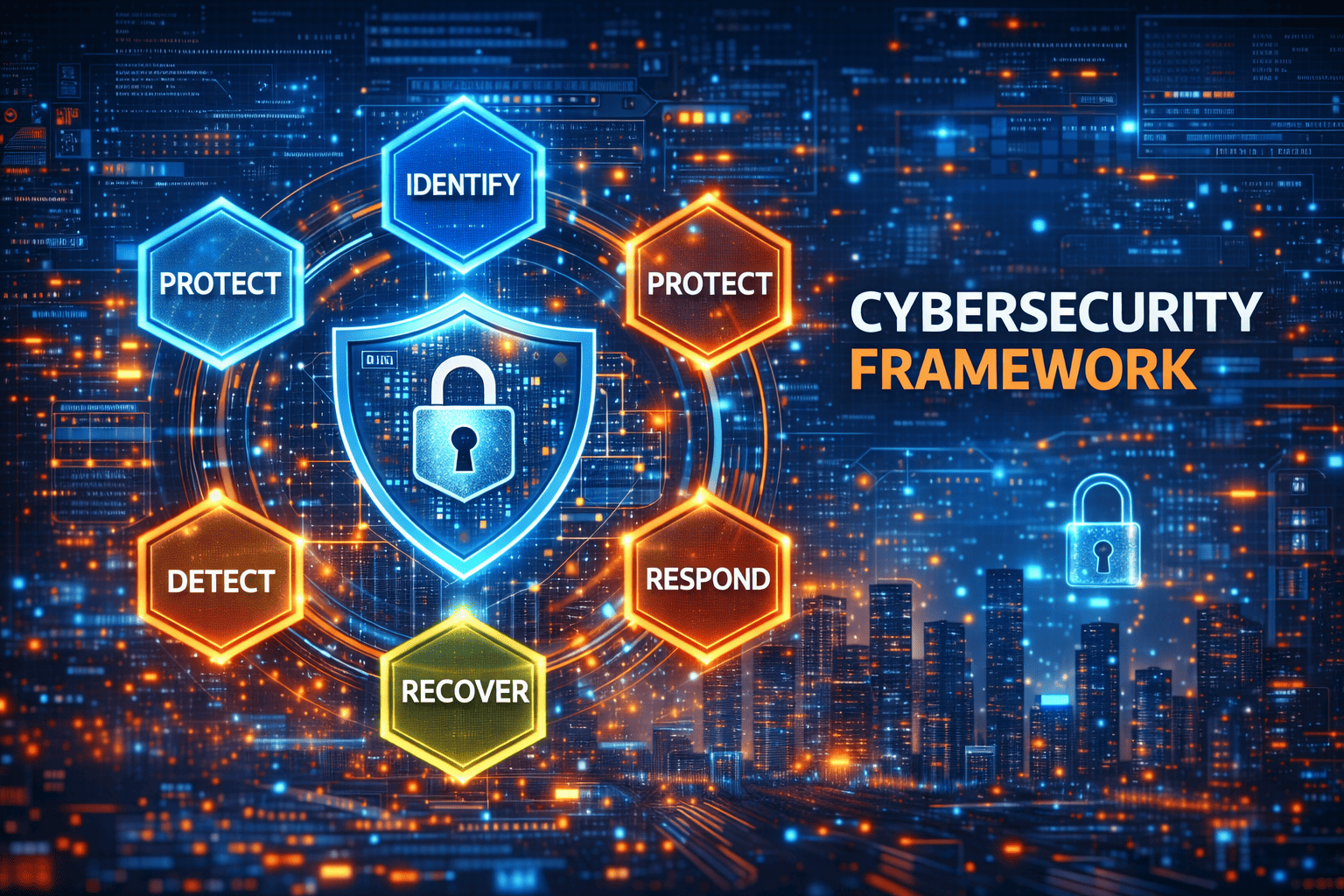
Core Components of a Cybersecurity Framework
Most cybersecurity frameworks share similar foundational elements, even if terminology differs.
1. Identify
This phase focuses on understanding your environment. It includes:
Asset inventory
Risk assessment
Business context analysis
Governance and policies
Clear visibility is the foundation of any effective cybersecurity framework.
2. Protect
Protection involves implementing safeguards to limit the impact of threats:
Access control and identity management
Endpoint and mobile security
Data encryption
Security awareness training
A strong cybersecurity framework emphasizes prevention without sacrificing usability.
3. Detect
Early detection reduces damage and downtime. This includes:
Continuous monitoring
Threat intelligence
Log analysis and alerts
Behavioral analytics
Detection capabilities are critical in modern cybersecurity frameworks.
4. Respond
When incidents occur, response speed matters:
Incident response plans
Communication workflows
Containment strategies
Forensic analysis
A mature cybersecurity framework ensures teams know exactly what to do during a crisis.
5. Recover
Recovery restores trust and operations:
System restoration
Business continuity planning
Lessons learned
Framework improvements
Recovery turns incidents into opportunities for stronger defenses.
Popular Cybersecurity Frameworks Explained
Several widely adopted cybersecurity frameworks serve different organizational needs.
NIST Cybersecurity Framework
The NIST cybersecurity framework is one of the most recognized globally. It is flexible, risk-based, and suitable for organizations of all sizes.
Best for:
Enterprises, government agencies, regulated industries
ISO/IEC 27001
This cybersecurity framework focuses on information security management systems (ISMS).
Best for:
Organizations seeking international certification and compliance
CIS Critical Security Controls
This framework prioritizes actionable, technical controls.
Best for:
IT teams looking for practical implementation guidance
COBIT
COBIT aligns cybersecurity with governance and business objectives.
Best for:
Executives and boards overseeing enterprise risk
How to Choose the Right Cybersecurity Framework
Not every cybersecurity framework fits every organization. The right choice depends on size, industry, risk tolerance, and regulatory needs.
Key Selection Criteria
Industry regulations and compliance requirements
Organizational maturity and resources
Business goals and risk appetite
Existing security tools and processes
Many organizations blend multiple frameworks to create a tailored cybersecurity strategy.
Cybersecurity Framework Implementation: Step-by-Step
Implementing a cybersecurity framework doesn’t require perfection on day one. It’s an iterative process.
Step 1: Assess Your Current State
Conduct a gap analysis against your chosen cybersecurity framework. Identify weaknesses and priorities.
Step 2: Define Security Objectives
Align security goals with business objectives. This ensures executive buy-in and budget support.
Step 3: Prioritize Controls
Focus on high-impact risks first. A phased approach reduces disruption and improves adoption.
Step 4: Deploy and Monitor
Implement controls, track metrics, and continuously monitor effectiveness.
Step 5: Review and Improve
Cybersecurity frameworks evolve. Regular reviews ensure continued relevance and resilience.
Cybersecurity Frameworks for IT Managers
For IT managers, a cybersecurity framework provides operational clarity.
Key Advantages
Clear security benchmarks
Improved visibility into risks
Easier reporting to leadership
Faster incident response
Instead of juggling disconnected tools, IT teams can operate within a unified framework.
Why CEOs and Founders Should Care About Cybersecurity Frameworks
Cybersecurity is no longer just a technical issue—it’s a business risk.
A cybersecurity framework helps executives:
Reduce financial and reputational damage
Demonstrate due diligence to stakeholders
Support digital transformation securely
Build customer trust
Investors and customers increasingly expect organizations to follow recognized cybersecurity frameworks.
Cybersecurity Frameworks by Industry
Different industries face different threats and compliance pressures.
Healthcare
Protects patient data
Supports HIPAA compliance
Reduces ransomware risks
Finance
Secures transactions and customer data
Aligns with regulatory mandates
Enhances fraud detection
Manufacturing
Protects operational technology (OT)
Reduces downtime from cyber incidents
SaaS and Technology
Secures cloud environments
Protects intellectual property
Builds customer confidence
A cybersecurity framework adapts to each industry’s risk profile.
Common Mistakes When Adopting a Cybersecurity Framework
Even well-intentioned efforts can fail without proper planning.
Mistakes to Avoid
Treating the framework as a checklist
Ignoring employee training
Failing to measure progress
Lack of executive involvement
Not updating the framework over time
A cybersecurity framework succeeds when it becomes part of daily operations.
Future of the Cybersecurity Framework
Cybersecurity frameworks continue to evolve alongside threats.
Emerging Trends
AI-driven threat detection
Zero Trust integration
Cloud-native security models
Automation and continuous compliance
Modern cybersecurity frameworks emphasize adaptability and intelligence.
Frequently Asked Questions (FAQ)
1. What is the main purpose of a cybersecurity framework?
The main purpose of a cybersecurity framework is to help organizations manage and reduce cyber risk using a structured, repeatable approach.
2. Is a cybersecurity framework only for large enterprises?
No. A cybersecurity framework can be scaled to fit small businesses, startups, and enterprises alike.
3. How long does it take to implement a cybersecurity framework?
Implementation time varies, but most organizations see meaningful improvements within 3–6 months.
4. Can we use more than one cybersecurity framework?
Yes. Many organizations combine frameworks to address governance, technical controls, and compliance needs.
5. Does a cybersecurity framework guarantee security?
No framework guarantees complete security, but it significantly reduces risk and improves response readiness.
Final Thoughts: Make Cybersecurity a Business Enabler
A cybersecurity framework is not about slowing innovation—it’s about enabling growth with confidence. By adopting a structured approach, organizations gain visibility, resilience, and trust in an increasingly hostile digital landscape.
Cyber threats will continue to evolve. Your defenses should too.
Take the Next Step Toward Stronger Cybersecurity
If you’re ready to modernize your security strategy and align with a proven cybersecurity framework, now is the time to act.
👉 Get started today:
🔗 https://openedr.platform.xcitium.com/register/

 Loading...