Updated on January 12, 2026, by OpenEDR
Cyber threats are no longer a future concern—they are a daily business reality. From ransomware and phishing to zero-day attacks, organizations of all sizes face constant digital risk. This is why cyber security managed services have become essential for companies that want strong, continuous protection without overwhelming internal teams.
In today’s fast-moving digital world, managing cybersecurity in-house is expensive, complex, and often unsustainable. Cyber security managed services provide expert-led protection, 24/7 monitoring, and advanced threat detection—allowing businesses to stay secure while focusing on growth.
This guide explains what cyber security managed services are, why they matter, and how they help organizations build resilient security programs.
What Are Cyber Security Managed Services?
Cyber security managed services refer to outsourced security solutions delivered by specialized providers known as Managed Security Service Providers (MSSPs). These services cover the design, deployment, monitoring, and management of an organization’s cybersecurity infrastructure.
Instead of relying solely on internal teams, businesses leverage cyber security managed services to gain access to experienced security professionals, advanced tools, and continuous protection.
Core Components of Cyber Security Managed Services
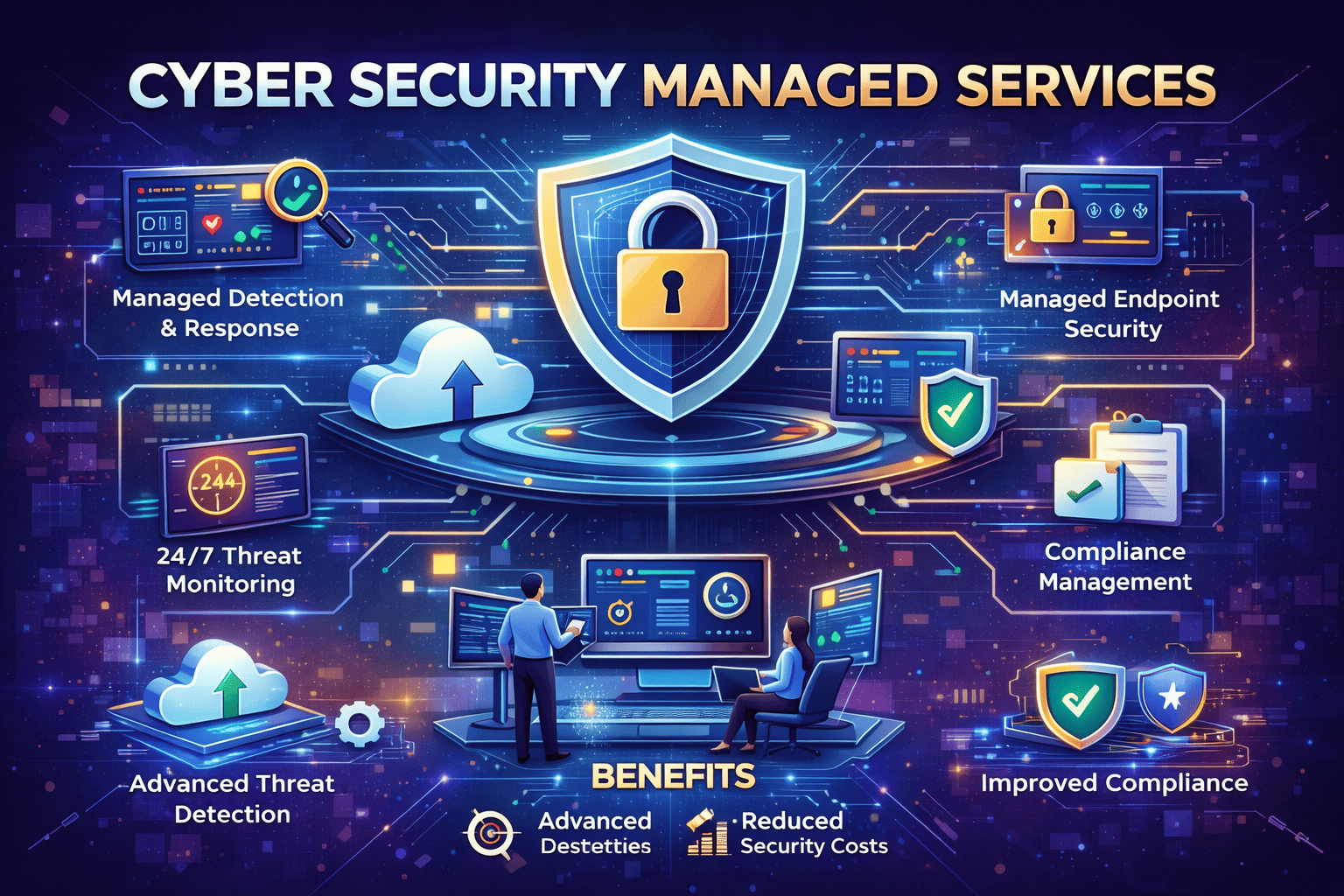
24/7 security monitoring and alerting
Threat detection and incident response
Endpoint, network, and cloud security
Vulnerability management and patching
Compliance and risk management
By using cyber security managed services, organizations gain enterprise-grade security without enterprise-level costs.
Why Cyber Security Managed Services Are Critical Today
The cyber threat landscape is evolving faster than most internal IT teams can handle. Attackers use automation, AI, and advanced tactics to exploit vulnerabilities in minutes.
Here’s why cyber security managed services are now mission-critical:
1. Increasing Cyber Attacks
Ransomware, credential theft, and supply chain attacks continue to rise across all industries.
2. Security Talent Shortage
Hiring and retaining skilled cybersecurity professionals is expensive and difficult.
3. Expanding Digital Environments
Cloud adoption, remote work, and SaaS tools increase the attack surface.
4. Regulatory and Compliance Pressure
Organizations must meet strict standards such as GDPR, HIPAA, PCI DSS, and ISO 27001.
Cyber security managed services address these challenges with scalable, always-on protection.
How Cyber Security Managed Services Work
Cyber security managed services operate as an extension of your internal IT or security team. Providers use advanced tools and processes to continuously monitor, detect, and respond to threats.
Typical Managed Security Workflow
Assessment and onboarding of existing infrastructure
Deployment of security tools (endpoint, network, cloud)
Continuous monitoring for threats and anomalies
Incident response and remediation
Reporting and optimization
This proactive approach ensures threats are detected early—before they cause damage.
Key Benefits of Cyber Security Managed Services
Organizations choose cyber security managed services for both security and business advantages.
Security Benefits
Faster threat detection and response
Reduced risk of data breaches
Protection against zero-day and advanced threats
Improved visibility across IT environments
Business Benefits
Lower operational costs
Predictable security spending
Reduced downtime and disruption
Increased customer and stakeholder trust
By outsourcing security operations, cyber security managed services free internal teams to focus on strategic initiatives.
Types of Cyber Security Managed Services
Not all managed services are the same. Businesses can choose services based on risk profile and industry needs.
1. Managed Detection and Response (MDR)
Provides real-time threat detection and active response.
2. Managed Endpoint Security
Protects laptops, servers, and mobile devices from malware and ransomware.
3. Managed Network Security
Monitors firewalls, intrusion detection systems, and network traffic.
4. Managed Cloud Security
Secures cloud workloads, containers, and SaaS platforms.
5. Managed Compliance Services
Supports audits, reporting, and regulatory requirements.
A comprehensive cyber security managed services strategy combines multiple service types.
Cyber Security Managed Services vs In-House Security
Many organizations struggle to decide between internal security teams and outsourced services.
| Feature | In-House Security | Cyber Security Managed Services |
|---|---|---|
| Cost | High | Predictable |
| Coverage | Limited hours | 24/7/365 |
| Expertise | Varies | Specialized |
| Scalability | Slow | Fast |
| Threat Intelligence | Limited | Global |
For most businesses, cyber security managed services deliver stronger protection with lower complexity.
Who Should Use Cyber Security Managed Services?
Cyber security managed services are ideal for organizations of all sizes.
Common Users Include:
IT managers needing round-the-clock coverage
CISOs seeking advanced threat detection
CEOs and founders protecting business continuity
Mid-sized businesses without large security teams
Highly regulated industries such as finance, healthcare, and retail
If cybersecurity is critical to your operations, managed services provide peace of mind.
Best Practices for Choosing Cyber Security Managed Services
Selecting the right provider is essential for success.
1. Look for Proven Expertise
Choose providers with experience across industries and threat types.
2. Ensure 24/7 Monitoring
Cyber threats don’t follow business hours.
3. Demand Transparent Reporting
Clear dashboards and regular reports improve visibility.
4. Prioritize Automation and AI
Modern cyber security managed services rely on automation for speed and accuracy.
5. Align Services with Business Goals
Security should support—not slow—business growth.
Industries That Benefit Most from Cyber Security Managed Services
Some industries face higher risk due to sensitive data and compliance demands.
High-Risk Industries Include:
Healthcare
Financial services
eCommerce and retail
Manufacturing
SaaS and technology
For these sectors, cyber security managed services reduce exposure while improving resilience.
The Future of Cyber Security Managed Services
The managed security model continues to evolve with technology.
Emerging Trends
AI-driven threat detection
Zero Trust architecture integration
Extended Detection and Response (XDR)
Automated remediation
Unified security platforms
As threats grow more complex, cyber security managed services will become smarter and more autonomous.
Frequently Asked Questions (FAQ)
1. What are cyber security managed services?
Cyber security managed services are outsourced security solutions that provide continuous monitoring, threat detection, and incident response.
2. Are cyber security managed services cost-effective?
Yes. They reduce the need for large in-house teams while delivering enterprise-level protection.
3. Can managed services prevent ransomware attacks?
Modern cyber security managed services detect ransomware behavior early and respond before systems are encrypted.
4. Do small businesses need managed security services?
Absolutely. Small businesses are frequent targets and benefit greatly from managed protection.
5. How do managed services support compliance?
They help maintain security controls, logging, and reporting required by regulatory frameworks.
Final Thoughts: Strengthen Your Defense with Cyber Security Managed Services
Cybersecurity is no longer optional—it’s a core business requirement. With threats increasing in speed and sophistication, relying on limited internal resources puts organizations at risk. Cyber security managed services provide the expertise, technology, and continuous protection needed to stay ahead of attackers.
If you’re ready to improve your security posture without added complexity, now is the time to act.
👉 Get started with enterprise-grade cyber protection today:
https://openedr.platform.xcitium.com/register/

 Loading...