Updated on August 11, 2025, by OpenEDR
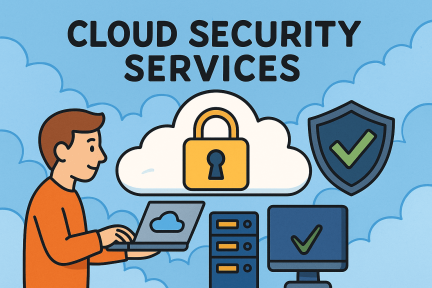
Cloud security services are technologies, managed services, and security practices designed to protect cloud applications, infrastructure, workloads, identities, and data from cyber threats. They help organizations prevent misconfigurations, control access, detect malware and suspicious activity, secure cloud workloads, maintain compliance, and respond to security incidents across public, private, hybrid, and multi-cloud environments.
Modern cloud security services may include Cloud Security Posture Management (CSPM), Cloud Workload Protection Platforms (CWPP), Cloud-Native Application Protection Platforms (CNAPP), Identity and Access Management (IAM), Cloud Infrastructure Entitlement Management (CIEM), Data Loss Prevention (DLP), threat detection, and managed security monitoring.
Did you know that over 94% of enterprises use cloud services today? From storing customer data to running mission-critical applications, the cloud has become the backbone of modern business operations. But with this shift comes an equally significant challenge—cybersecurity risks.
Introduction: Why Cloud Security Services Matter
That’s where cloud security services step in. These solutions safeguard your data, networks, and workloads against ever-evolving cyber threats. For IT managers, CEOs, and cybersecurity leaders, understanding cloud security is no longer optional—it’s essential for protecting both business continuity and customer trust.
What Are Cloud Security Services?
Cloud security services are a combination of technologies, processes, and practices designed to protect cloud-based systems, applications, and data. They ensure secure access, prevent data breaches, and help organizations remain compliant with industry regulations.
Key aspects of cloud security include:
Data protection through encryption.
Identity and access management (IAM) to control user privileges.
Network security tools such as firewalls and intrusion detection systems.
Threat detection and response powered by AI and machine learning.
In essence, cloud security services provide the defense shield businesses need as they migrate more of their operations online.
Why Businesses Need Cloud Security Services
Cloud environments are prime targets for hackers. Here’s why companies must prioritize cloud security services:
Rising Cyberattacks – Cloud-related breaches rose by 27% in 2023.
Data Privacy Regulations – Laws like GDPR, HIPAA, and CCPA require strict protection.
Remote Workforce – Employees accessing data from anywhere introduces vulnerabilities.
Shared Responsibility Model – Cloud providers secure infrastructure, but businesses must protect their own data.
Reputation and Trust – A single data breach can erode years of customer loyalty.
Types of Cloud Security Services
Cloud security is not one-size-fits-all. Here are the main categories:
1. Cloud Access Security Brokers (CASB)
Act as a gatekeeper between users and cloud applications, enforcing security policies.
2. Identity and Access Management (IAM)
Ensures only authorized users can access sensitive data, often with multi-factor authentication (MFA).
3. Cloud Data Encryption
Protects stored and transmitted data with advanced encryption methods.
4. Web Application Firewalls (WAFs)
Safeguard applications hosted in the cloud from SQL injection, cross-site scripting, and DDoS attacks.
5. Threat Intelligence & Monitoring
Uses AI-driven analytics to detect and respond to unusual activities in real-time.
6. Compliance & Risk Management
Helps organizations meet industry standards and avoid costly penalties.
7. Backup and Disaster Recovery
Ensures business continuity with data replication and recovery options.
Benefits of Cloud Security Services
Investing in cloud security offers multiple advantages:
Data Protection – Encryption ensures sensitive information stays safe.
Business Continuity – Disaster recovery solutions minimize downtime.
Scalability – Security grows with your business and cloud usage.
Cost Efficiency – Preventing breaches saves millions in potential losses.
Enhanced Trust – Customers feel safer knowing their data is protected.
CNAPP vs CSPM vs CWPP vs CIEM
| Technology | Primary Focus | Main Security Question |
|---|---|---|
| CNAPP | Unified cloud-native application security | How can we manage cloud risk across applications, workloads, identities, and configurations? |
| CSPM | Cloud configuration and compliance | Are our cloud resources configured securely? |
| CWPP | Workload and runtime security | Are our cloud workloads vulnerable or under attack? |
| CIEM | Cloud identities and permissions | Does any user, service, or workload have excessive access? |
| CASB | SaaS usage and cloud access | Are users accessing and sharing cloud data safely? |
| DLP | Sensitive data movement | Is protected information leaving approved locations? |
These technologies address different layers of cloud risk and are increasingly combined within broader cloud-native security platforms.
Challenges in Cloud Security
While cloud security services are powerful, organizations must still navigate challenges:
Misconfigured Settings – Human error is a leading cause of breaches.
Shadow IT – Employees using unauthorized apps without IT’s knowledge.
Shared Responsibility Confusion – Businesses mistakenly think providers handle all security.
Insider Threats – Disgruntled employees misusing access rights.
Evolving Threats – Attackers use automation and AI to scale attacks.
How the Shared Responsibility Model Affects Cloud Security
Using a cloud provider does not mean the provider is responsible for every aspect of cybersecurity.
Cloud security follows a shared responsibility model. While responsibilities vary depending on the provider and service model, the cloud provider generally secures the underlying infrastructure while the customer remains responsible for important areas such as identities, permissions, applications, workloads, configurations, and data.
Cloud Provider Responsibilities
Common responsibilities include:
- Physical data centers
- Underlying hardware
- Core cloud infrastructure
- Provider-managed networking
- Availability of infrastructure services
Customer Responsibilities
Organizations typically remain responsible for:
- User identities
- IAM policies
- Data protection
- Workload configuration
- Application security
- Encryption choices
- Cloud security monitoring
- Backup policies
- Compliance configuration
The balance changes between IaaS, PaaS, and SaaS, so organizations should document exactly which controls remain their responsibility.
Cloud Security Services for Different Industries
Different industries face unique threats, and cloud security must adapt:
1. Healthcare
Protecting patient health information (PHI) and complying with HIPAA.
2. Finance
Preventing fraud, identity theft, and transaction tampering while staying compliant with PCI DSS.
3. Retail & E-commerce
Securing payment systems and customer databases from breaches.
4. Education
Safeguarding student records and remote learning platforms.
5. Government & Defense
Advanced encryption and threat intelligence to defend against state-sponsored attacks.
Securing Hybrid and Multi-Cloud Environments
Many organizations now use more than one cloud provider while maintaining some workloads on-premises.
This creates challenges such as:
- Inconsistent policies
- Fragmented security tools
- Different IAM models
- Duplicate alerts
- Limited asset visibility
- Configuration drift
- Compliance complexity
Cloud security services should provide centralized visibility across environments such as:
- Amazon Web Services
- Microsoft Azure
- Google Cloud
- Private clouds
- SaaS applications
- On-premises infrastructure
A unified security model helps teams apply consistent policies, prioritize risk, and reduce gaps between platforms.
Best Practices for Cloud Security Services
To maximize protection, organizations should adopt these best practices:
Enable Multi-Factor Authentication (MFA) for all users.
Encrypt Data both at rest and in transit.
Regularly Update Security Policies to reflect new threats.
Conduct Vulnerability Scans and penetration testing.
Implement Zero Trust Security – never assume any connection is safe.
Train Employees to recognize phishing and social engineering attacks.
Cloud Threat Detection and Incident Response
Cloud environments generate large volumes of authentication, workload, API, application, and network activity.
Effective cloud security services should continuously monitor this activity for indicators such as:
- Suspicious administrator logins
- Impossible travel
- Unauthorized API calls
- Unusual privilege changes
- Public exposure of sensitive resources
- Malware execution
- Cryptomining activity
- Unusual data transfers
- Credential misuse
- Container compromise
- Ransomware behavior
When a threat is identified, cloud incident response may involve:
- Confirming the alert.
- Identifying affected identities and workloads.
- Restricting compromised credentials.
- Isolating affected resources.
- Preserving logs and forensic evidence.
- Removing malicious activity.
- Correcting insecure configurations.
- Restoring trusted workloads.
- Monitoring for recurrence.
Cloud incident response should be tested before a serious attack occurs.
Future Trends in Cloud Security Services
The cybersecurity landscape is evolving, and so is cloud protection. Trends to watch include:
Zero Trust Security Models – “Never trust, always verify.”
AI-Powered Threat Detection – Machine learning identifies anomalies faster.
Cloud-Native Security – Built-in tools designed for hybrid and multi-cloud environments.
Secure Access Service Edge (SASE) – Combining networking and security into one framework.
Quantum-Resistant Encryption – Preparing for the next generation of cyber threats.
Continuous Cloud Compliance
Cloud environments change too quickly for compliance to rely only on annual assessments.
Continuous compliance helps organizations monitor cloud resources against required policies and frameworks in near real time.
Cloud security services may help evaluate requirements related to:
- GDPR
- HIPAA
- PCI DSS
- ISO/IEC 27001
- SOC 2
- NIST Cybersecurity Framework
- CIS Benchmarks
Automated compliance monitoring can identify configuration drift, missing controls, insecure permissions, and other issues before the next formal audit.
Compliance does not automatically equal security, but continuous monitoring helps reduce both regulatory and cybersecurity risk.
Common Cloud Security Risks and Recommended Controls
| Risk | Example | Recommended Control |
|---|---|---|
| Misconfiguration | Public cloud storage | CSPM |
| Excessive permissions | Overprivileged service account | CIEM |
| Malware | Compromised cloud workload | CWPP |
| Shadow IT | Unapproved SaaS application | CASB |
| Data leakage | Sensitive file shared externally | DLP |
| Insecure application | Vulnerable cloud API | WAF and API security |
| Stolen credentials | Compromised administrator account | MFA and IAM |
| Configuration drift | Secure settings change over time | Continuous posture monitoring |
| Compliance violation | Encryption disabled | CSPM and policy automation |
| Ransomware | Cloud workload or synchronized files encrypted | Runtime protection and resilient backups |
Cloud Security Services and DevSecOps
Cloud security should begin before an application reaches production.
DevSecOps integrates security into software development and cloud deployment workflows.
Cloud security services can help development teams:
- Scan Infrastructure-as-Code templates
- Detect exposed secrets
- Scan container images
- Identify vulnerable software packages
- Review permissions before deployment
- Validate cloud configurations
- Enforce security policies in CI/CD pipelines
- Block high-risk deployments
This “shift-left” approach prevents security weaknesses from reaching production and reduces the cost of fixing cloud vulnerabilities later.
How to Choose a Cloud Security Service Provider
Before selecting a provider, evaluate whether it can support your actual cloud architecture and risk profile.
Look for:
Multi-Cloud Coverage
Confirm support for AWS, Azure, Google Cloud, private cloud, SaaS, and hybrid infrastructure where required.
CNAPP Capabilities
Evaluate whether the provider offers or integrates CSPM, CWPP, CIEM, vulnerability management, and runtime security.
24/7 Monitoring
Organizations with critical cloud workloads may require continuous monitoring and response.
Identity Security
The provider should help identify excessive permissions, risky accounts, and compromised identities.
Compliance Support
Confirm support for the frameworks and regulations relevant to your organization.
Automation and Remediation
Look for automated prioritization and remediation where appropriate.
Incident Response
Determine what happens when a genuine cloud breach occurs and how quickly specialists can respond.
Integration
The service should integrate with existing SIEM, EDR, identity, ticketing, DevOps, and cloud-native tools.
Reporting
Security teams and executives should receive clear risk, compliance, and incident reporting.
FAQs on Cloud Security Services
1. What are cloud security services?
They are technologies and practices that protect cloud data, applications, and infrastructure from cyber threats.
2. How do cloud security services differ from traditional security?
Traditional security protects on-premises systems, while cloud security addresses remote, distributed, and virtualized environments.
3. Are cloud security services expensive?
Costs vary but are typically scalable—paying only for what you need.
4. Can small businesses benefit from cloud security services?
Yes, small businesses are frequent targets of cyberattacks and need protection just as much as enterprises.
5. Who is responsible for cloud security?
It’s a shared responsibility—the provider secures the infrastructure, but the business secures data and user access.
Conclusion: Strengthen Your Business with Cloud Security Services
The cloud unlocks agility, innovation, and scalability, but without proper protection, it also exposes businesses to unprecedented risks. Cloud security services provide the comprehensive defense organizations need to safeguard sensitive data, ensure compliance, and maintain customer trust.
Whether you’re in healthcare, finance, or retail, adopting a proactive cloud security strategy is no longer optional—it’s a necessity.
👉 Ready to secure your cloud environment? Register here to explore Xcitium’s advanced cloud security solutions today.

 Loading...