
Updated on April 10, 2026, by OpenEDR
As businesses move rapidly to the cloud, one question becomes critical: Is your cloud environment truly secure?
Cloud security architecture is the foundation that protects your data, applications, and systems in the cloud. Without a well-designed architecture, organizations risk breaches, data loss, and compliance failures.
In today’s threat landscape, IT managers, cybersecurity professionals, and business leaders must understand how to build and maintain a strong cloud security framework. This guide breaks it down in simple terms—so you can secure your cloud infrastructure with confidence.
What is Cloud Security Architecture?
Cloud security architecture refers to the structured framework of technologies, policies, controls, and processes designed to protect cloud-based systems, data, and infrastructure.
It ensures:
- Data confidentiality, integrity, and availability
- Secure access to cloud resources
- Protection against cyber threats
In simple terms, it’s the blueprint that defines how security is implemented in cloud environments.
Key Components of Cloud Security Architecture
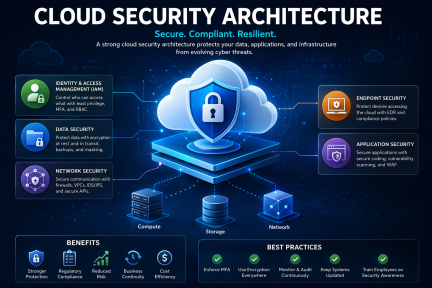
A strong cloud security architecture is built on several critical components:
1. Identity and Access Management (IAM)
Controls who can access what in your cloud environment.
- Role-based access control (RBAC)
- Multi-factor authentication (MFA)
- Least privilege principle
2. Data Security
Protects sensitive information at all stages.
- Encryption (at rest & in transit)
- Data masking and tokenization
- Backup and recovery systems
3. Network Security
Secures communication between cloud resources.
- Firewalls and virtual private clouds (VPCs)
- Intrusion detection and prevention systems (IDS/IPS)
- Secure APIs
4. Endpoint Security
Ensures devices accessing the cloud are secure.
- Endpoint detection and response (EDR)
- Device compliance policies
5. Application Security
Protects cloud-hosted applications.
- Secure coding practices
- Vulnerability scanning
- Web application firewalls (WAF)
Why Cloud Security Architecture is Important
A well-designed cloud security architecture helps organizations:
- Prevent data breaches and cyberattacks
- Ensure regulatory compliance (GDPR, HIPAA, etc.)
- Maintain business continuity
- Protect brand reputation
👉 Without proper architecture, even advanced tools fail to provide complete protection.
Types of Cloud Security Architecture
Different deployment models require different approaches:
Public Cloud Security
- Managed by providers like AWS, Azure, Google Cloud
- Shared responsibility model
Private Cloud Security
- Dedicated environment
- Higher control and customization
Hybrid Cloud Security
- Combines public and private cloud
- Requires unified security strategy
Multi-Cloud Security
- Multiple cloud providers
- Needs centralized visibility and control
How to Design a Strong Cloud Security Architecture
Follow these steps to build an effective cloud security architecture:
1. Assess Risks and Requirements
Identify:
- Sensitive data
- Compliance needs
- Potential vulnerabilities
2. Implement Zero Trust Model
Never trust, always verify.
- Continuous authentication
- Strict access controls
3. Use Layered Security (Defense in Depth)
Combine multiple security measures:
- Network + endpoint + application security
- Reduces single points of failure
4. Automate Security Processes
Automation improves response time.
- Automated threat detection
- Real-time monitoring
5. Continuous Monitoring & Auditing
Regularly review your cloud environment.
- Log analysis
- Security audits
- Threat intelligence
Best Practices for Cloud Security Architecture
To strengthen your cloud security architecture, follow these best practices:
- Enforce strong password policies
- Enable multi-factor authentication (MFA)
- Regularly update and patch systems
- Use encryption for all sensitive data
- Monitor user activity and access logs
- Train employees on cybersecurity awareness
Common Cloud Security Challenges
Even with a solid cloud security architecture, organizations face challenges:
- Misconfigured cloud settings
- Lack of visibility across environments
- Insider threats
- Compliance complexity
- Rapidly evolving cyber threats
👉 Addressing these proactively is key to maintaining security.
Benefits of a Strong Cloud Security Architecture
| Benefit | Impact |
|---|---|
| Improved Data Protection | Prevents unauthorized access |
| Regulatory Compliance | Meets industry standards |
| Reduced Risk | Minimizes attack surface |
| Business Continuity | Ensures uptime and recovery |
| Cost Efficiency | Avoids breach-related expenses |
Future Trends in Cloud Security Architecture
The future of cloud security architecture is evolving rapidly:
- AI-driven threat detection
- Zero Trust becoming standard
- Increased automation
- Cloud-native security tools
- Integration with DevSecOps
Organizations that adapt early gain a competitive advantage.
FAQ: Cloud Security Architecture
1. What is cloud security architecture in simple terms?
It is a framework of tools and policies used to protect cloud systems, data, and applications from cyber threats.
2. Why is cloud security architecture important?
It prevents data breaches, ensures compliance, and protects business operations in cloud environments.
3. What are the main components of cloud security architecture?
Key components include IAM, data security, network security, endpoint security, and application security.
4. How do you implement cloud security architecture?
Start with risk assessment, apply Zero Trust, use layered security, automate processes, and monitor continuously.
5. What are common cloud security risks?
Misconfigurations, weak access controls, insider threats, and lack of visibility are major risks.
Conclusion
A strong cloud security architecture is no longer optional—it’s essential. As cyber threats grow more sophisticated, businesses must adopt a proactive and structured approach to cloud security.
By implementing best practices, leveraging modern tools, and continuously monitoring your environment, you can build a secure and resilient cloud infrastructure.
Get Started with Advanced Cloud Protection
Ready to strengthen your cloud security?
👉 Start protecting your environment today with enterprise-grade security:
https://openedr.platform.xcitium.com/register/

 Loading...