Updated on November 18, 2025, by OpenEDR
Did you know that nearly 70% of businesses have already migrated their customer support operations to the cloud? With remote teams, growing customer expectations, and cybersecurity risks on the rise, having the right cloud contact center solutions has become essential—not optional.
Whether you’re a CEO aiming to modernize your customer experience, an IT manager overseeing system upgrades, or a cybersecurity professional ensuring safer digital interactions, this guide will walk you through everything you need to know.
Today, we’ll break down cloud contact center benefits, features, tools, migration strategies, cybersecurity essentials, and real-world best practices—all in an easy, conversational, business-friendly tone.
Let’s dive in!
⭐ What Are Cloud Contact Center Solutions?
Cloud contact center solutions are software platforms that allow businesses to manage customer communications—calls, chats, emails, SMS, and social media—entirely through the cloud rather than on physical hardware.
They provide customer service teams with all the tools they need to:
Handle inquiries
Track interactions
Automate workflows
Analyze customer data
Improve service quality
Some well-known platforms include:
Amazon Connect
Genesys Cloud
Five9
NICE CXone
RingCentral Contact Center
But there are dozens of competitive solutions depending on your industry and needs.
⭐ Why Cloud Contact Center Solutions Matter in 2025
Cloud contact centers offer a huge advantage over traditional systems.
Here’s why businesses are making the switch:
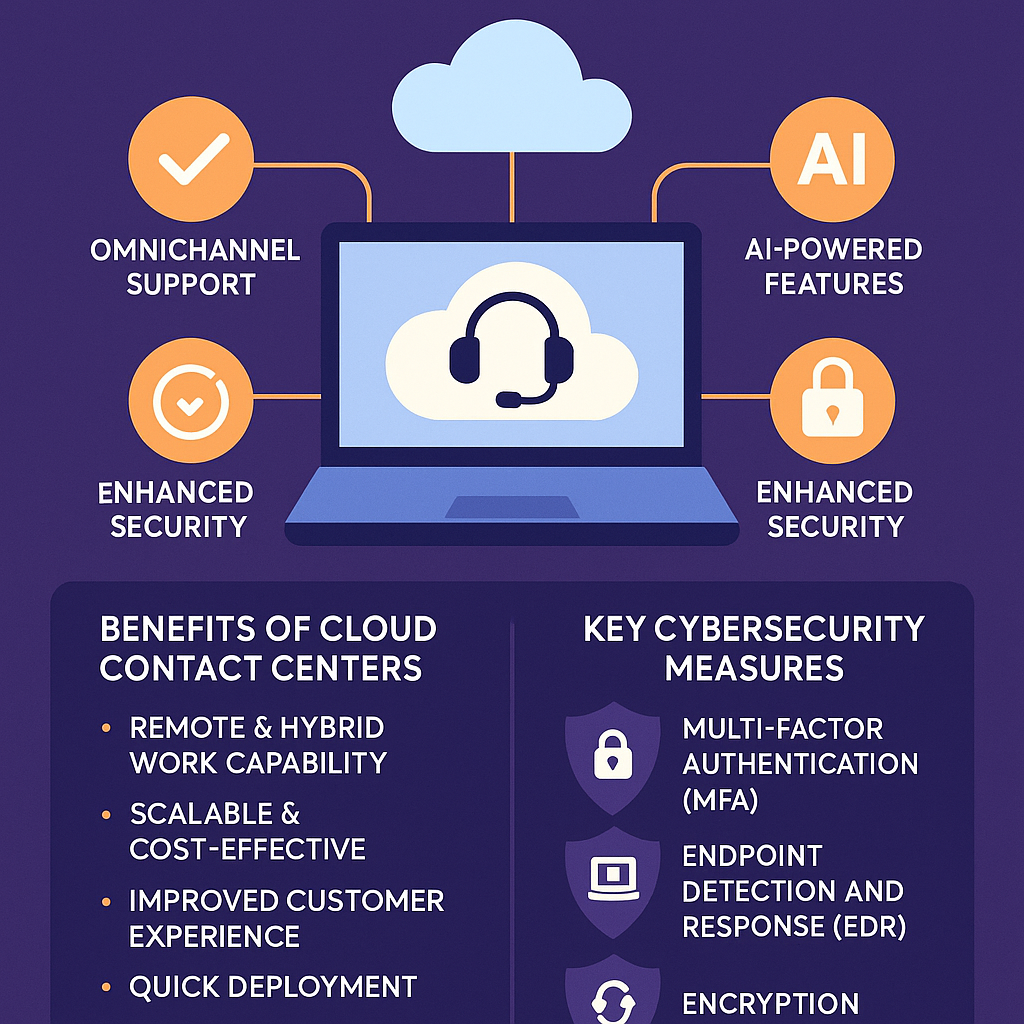
✔ Remote & Hybrid Work Ready
Agents can work from anywhere securely.
✔ Lower Costs
No expensive hardware, maintenance, or on-site servers.
✔ Endless Scalability
Add or remove agents instantly based on call volume.
✔ Better Customer Experience
Omnichannel support + personalization = happier customers.
✔ Built-in Cybersecurity
Encryption, identity management, and cloud protections dramatically reduce risks.
As customer interaction channels expand, cloud contact center solutions help businesses deliver fast, secure, and seamless support.
🧩 Core Features of Modern Cloud Contact Center Solutions
To understand how these systems help organizations grow, let’s break down the top features.
1. Omnichannel Communication
Customers want fast responses—no matter where they contact you.
Omnichannel support includes:
Voice calls
Live chat
SMS
Email
Social media
Video support
Cloud platforms unify every interaction into one dashboard.
2. Interactive Voice Response (IVR)
IVR routes customers to the right agent or department through automated menus.
Benefits:
Reduces wait time
Prioritizes important issues
Improves operational flow
3. AI-Powered Chatbots & Virtual Agents
AI-assisted support can:
Answer common questions
Reduce call volume
Automate simple tasks
Provide instant 24/7 support
AI helps even small teams operate like enterprise-level contact centers.
4. Agent Performance Tools
Cloud solutions offer:
Real-time call coaching
Monitoring and whisper mode
Auto-generated scripts
Sentiment analysis
Managers can track everything in one dashboard.
5. Analytics & Reporting
Data is the heart of customer experience.
Reports can track:
First response time
Resolution time
Customer satisfaction
Abandon rates
Agent performance
6. CRM Integrations
Cloud contact centers integrate with tools like:
Salesforce
HubSpot
Zendesk
Microsoft Dynamics
Every interaction syncs automatically.
🔐 Cybersecurity in Cloud Contact Center Solutions
With cybersecurity threats rising globally, contact centers must be tightly protected.
Here’s how cloud systems secure operations:
1. Encryption (In Transit & At Rest)
Protects calls, texts, and stored data.
2. Multi-Factor Authentication (MFA)
Reduces unauthorized access.
3. Role-Based Access Control (RBAC)
Ensures agents only see necessary customer data.
4. End-to-End Monitoring with EDR/XDR
Tools like Xcitium OpenEDR detect threats on agent devices.
5. Compliance-Ready Frameworks
Supports industry regulations:
HIPAA
GDPR
PCI-DSS
SOC 2
🎯 Why Businesses Are Shifting to Cloud Contact Center Solutions
Let’s explore the biggest advantages.
⭐ 1. Faster Deployment
Instead of waiting weeks for hardware setup, cloud platforms deploy in hours or days.
⭐ 2. Cost Efficiency
No more:
PBX hardware
Server rooms
On-site maintenance
Telecom contracts
Subscription pricing keeps costs predictable.
⭐ 3. Remote Workforce Compatibility
Cloud contact centers are perfect for hybrid and global teams.
⭐ 4. Better Business Continuity
Cloud systems ensure uptime even during:
Power outages
Hardware failures
Natural disasters
⭐ 5. Smarter Customer Experience
AI routing + CRM integration = delightful interactions.
🧭 How to Choose the Right Cloud Contact Center Solution
Here’s a simple framework.
1. Define Your Channels
Do you need:
Voice only?
Voice + Chat + Email?
Full omnichannel?
2. Evaluate AI Features
Look for:
Smart routing
Predictive analytics
Chatbots
Voice assistants
3. Check Integrations
Your platform should integrate with:
CRM
Ticketing systems
Security tools
Workforce management tools
4. Assess Security
Choose platforms with:
MFA
Zero-Trust
Encryption
Compliance certifications
5. Compare Pricing Models
Most vendors offer:
Per-agent
Per-minute
Flat monthly plans
Pick the one that fits your scale.
🏗️ Implementing Cloud Contact Center Solutions: Step-by-Step Guide
Let’s keep it simple.
Step 1: Assess Your Current System
Identify:
Challenges
Call volume
Customer expectations
Agent skill levels
Step 2: Choose the Right Cloud Model
Options include:
Public cloud
Private cloud
Hybrid cloud
Step 3: Plan Migration Strategy
Usually done in three phases:
1️⃣ Non-critical workloads
2️⃣ Main call groups
3️⃣ High-priority departments
Step 4: Train Your Team
Include:
Call handling
Security policies
Platform tools
Remote work guidelines
Step 5: Deploy Security Tools
Use solutions like:
MFA
Identity management
Network segmentation
Step 6: Monitor & Optimize
Use analytics to refine:
Staffing
Call routing
Agent workflows
💡 Best Practices for Cloud Contact Center Success
✔ Train agents regularly
✔ Monitor quality with analytics
✔ Automate repetitive tasks
✔ Standardize workflows
✔ Use real-time dashboards
✔ Apply zero-trust security
✔ Document processes
These ensure long-term performance and customer satisfaction.
🎉 Future Trends in Cloud Contact Center Solutions
Here’s what’s coming next:
⭐ AI-driven customer predictions
⭐ Hyper-personalized experiences
⭐ Voice biometrics security
⭐ Conversational AI everywhere
⭐ Unified agent workspaces
⭐ Cloud-native compliance automation
Businesses adopting these now will dominate customer experience in the future.
🧾 Conclusion: Cloud Contact Center Solutions Are Essential for Modern Business Growth
Cloud contact center solutions aren’t just a “nice-to-have”—they’re now the backbone of customer service operations. They improve customer satisfaction, strengthen security, reduce costs, and help organizations scale faster than ever before.
But as you modernize, one thing remains critical: endpoint security.
Your agents’ devices are the frontline of every customer interaction—and they must be protected.
🔐 Secure Your Contact Center With OpenEDR (FREE Registration)
Get enterprise-grade endpoint security while modernizing your contact center.
👉 https://openedr.platform.xcitium.com/register/
❓ FAQs About Cloud Contact Center Solutions
1. What are cloud contact center solutions?
They are cloud-based platforms that manage calls, chats, emails, and customer interactions without physical infrastructure.
2. Are cloud contact centers secure?
Yes—most offer encryption, MFA, role-based access, and compliance support. Pairing them with EDR tools provides full protection.
3. How much do cloud contact center platforms cost?
Costs vary from $50 to $150 per agent per month depending on features, channels, and support levels.
4. Can remote teams use cloud contact centers?
Absolutely! These platforms are built for remote and hybrid teams.
5. How long does migration take?
Typical deployments range from a few days to a few weeks depending on size and complexity.

 Loading...