Updated on August 19, 2026, by OpenEDR
Business security solutions are technologies, services, policies, and security processes that protect an organization’s people, devices, applications, networks, cloud environments, identities, and sensitive data from cyber threats.
Modern business security solutions can include endpoint protection, EDR, MDR, XDR, identity and access management, email security, network security, cloud security, data protection, vulnerability management, backup, and incident response.
The goal is not simply to stop malware. An effective business security strategy helps an organization prevent attacks, identify suspicious behavior, contain incidents, protect sensitive information, recover operations, and reduce business risk.
Cyber threats are no longer a problem reserved for large enterprises. Today, businesses of all sizes face ransomware attacks, phishing campaigns, data breaches, insider threats, and supply chain compromises. The question is no longer whether your organization will be targeted—but whether you’re prepared when it happens.
That’s why business security solutions have become a critical investment for organizations across every industry. From protecting sensitive customer information to ensuring regulatory compliance, modern security solutions help businesses reduce risk, improve visibility, and maintain operational continuity.
Whether you’re an IT manager, cybersecurity professional, CEO, or founder, understanding how to choose and implement the right business security solutions can significantly strengthen your organization’s security posture.
What Are Business Security Solutions?
Business security solutions are technologies, processes, and services designed to protect organizations from cyber threats, unauthorized access, data loss, and operational disruptions.
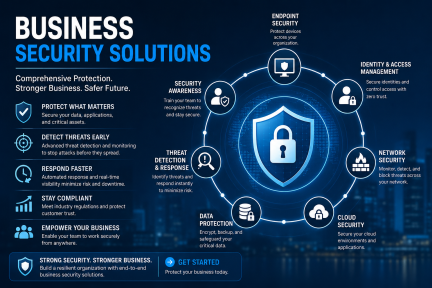
These solutions work together to secure:
- Endpoints and devices
- Networks and infrastructure
- Cloud environments
- Applications and workloads
- User identities and access
- Sensitive business data
Modern business security solutions provide organizations with the visibility, detection, prevention, and response capabilities needed to combat increasingly sophisticated cyberattacks.
What Security Solutions Does a Business Need?
The exact security stack depends on the organization’s size, industry, technology environment, data sensitivity, compliance requirements, and risk exposure.
Most organizations should consider several core layers.
| Security Solution | What It Protects | Primary Purpose |
|---|---|---|
| Endpoint Security | PCs, laptops, servers | Malware and endpoint attack prevention |
| EDR | Endpoints | Detection, investigation and response |
| IAM & MFA | User accounts | Identity and access protection |
| Email Security | Email users | Phishing and malicious message protection |
| Network Security | Networks | Unauthorized and malicious traffic |
| Cloud Security | SaaS/cloud workloads | Cloud assets and configurations |
| Data Security/DLP | Sensitive information | Data leakage and unauthorized access |
| Vulnerability Management | Systems/software | Vulnerability discovery and remediation |
| Backup & Recovery | Business data | Recovery from loss and ransomware |
| MDR | Security environment | Managed monitoring and response |
| XDR | Multiple security layers | Cross-domain detection and response |
| SIEM | Security telemetry | Centralized analysis and investigation |
The right combination matters more than simply purchasing the largest number of security tools.
Why Business Security Solutions Are Essential Today
The digital transformation of business has created new opportunities—and new risks.
Organizations now operate across:
- Remote work environments
- Cloud applications
- Mobile devices
- Third-party vendors
- Hybrid infrastructures
While these technologies improve efficiency, they also expand the attack surface.
Effective business security solutions help organizations:
Reduce Cyber Risk
Security tools identify and mitigate threats before they cause damage.
Protect Sensitive Data
Customer information, intellectual property, and financial records remain secure.
Improve Compliance
Organizations can meet requirements for:
- GDPR
- HIPAA
- PCI DSS
- ISO 27001
- SOC 2
Support Business Continuity
Strong security minimizes downtime and operational disruption during cyber incidents.
Core Types of Business Security Solutions
1. Endpoint Security
Endpoint security protects devices such as:
- Laptops
- Desktop computers
- Servers
- Mobile devices
- Remote workstations
Modern endpoint products go beyond traditional antivirus.
They may use:
- Behavioral analysis
- Machine learning
- Threat intelligence
- Exploit prevention
- Application controls
- Automated remediation
Current business endpoint platforms also increasingly combine malware prevention with EDR and centralized device management.
2. Endpoint Detection and Response (EDR)
EDR continuously collects and analyzes endpoint activity to help identify suspicious behavior and investigate attacks.
EDR can help security teams:
- Detect suspicious processes.
- Investigate endpoint activity.
- Trace attack behavior.
- Identify affected devices.
- Contain compromised endpoints.
- Remediate threats.
- Hunt for suspicious activity.
This is an important addition to the existing OpenEDR article because the current page discusses endpoint security but does not give EDR its own substantive section.
Antivirus vs. EDR
| Antivirus | EDR |
|---|---|
| Focuses heavily on malware prevention | Focuses on detection, investigation and response |
| Often file/threat oriented | Provides broader endpoint telemetry |
| Usually highly automated | Supports deeper investigation |
| Quarantines detected threats | Can help reconstruct attack activity |
| Baseline endpoint defense | Advanced endpoint visibility and response |
Businesses frequently use these capabilities together rather than treating them as competing technologies.
3. Identity and Access Management
Modern businesses need to protect identities as carefully as devices.
Identity and Access Management can help organizations:
- Authenticate users.
- Apply role-based access.
- Enforce least privilege.
- Manage privileged accounts.
- Remove unnecessary access.
- Review permissions.
- Control application access.
Why MFA Matters
Multi-factor authentication requires more than one form of verification before granting access.
Businesses should prioritize MFA for:
- Administrators
- Email accounts
- Cloud platforms
- Remote access
- Financial applications
- Sensitive business systems
Identity protection becomes especially important when attackers obtain valid usernames and passwords.
4. Email and Phishing Security
The current OpenEDR page discusses phishing as a threat but does not give email security a place in the core security stack.
That should change.
Business email security can help detect or block:
- Phishing
- Malicious attachments
- Dangerous URLs
- Spoofing
- Business email compromise
- Malware delivery
- Impersonation attempts
Organizations should combine technical email controls with employee security awareness and strong identity protection.
5. Network Security
Network security helps protect business communications and connected resources.
Common controls include:
- Firewalls
- Network segmentation
- IDS/IPS
- DNS security
- Secure web gateways
- VPN or secure remote access
- Network monitoring
Segmentation is especially important because it can limit how easily an attacker moves from one compromised resource to another.
6. Cloud Security
Cloud environments introduce different security requirements from traditional on-premises systems.
Business cloud security should consider:
- Cloud identities
- SaaS applications
- Workloads
- Storage
- APIs
- Configurations
- Permissions
- Sensitive information
- Logging
- Cloud backups
Organizations should also understand the shared responsibility model. Using a cloud provider does not mean the provider assumes responsibility for every identity, permission, application, configuration, and piece of customer data.
7. Data Protection and DLP
Sensitive business information may include:
- Customer records
- Financial information
- Intellectual property
- Credentials
- Employee information
- Payment data
- Business plans
- Source code
Data security solutions can use:
- Encryption
- Classification
- Access controls
- Data Loss Prevention
- Backup
- Retention policies
- Activity monitoring
The objective is to understand where sensitive information exists, who can access it, and how it moves.
8. Vulnerability Management
Security teams cannot fix weaknesses they do not know exist.
Vulnerability management helps businesses:
- Discover assets.
- Identify vulnerabilities.
- Assess severity.
- Evaluate business risk.
- Prioritize remediation.
- Deploy fixes.
- Verify remediation.
Current business-security platforms increasingly include vulnerability-management functionality alongside endpoint detection and response. Microsoft’s current Defender for Business offering, for example, includes vulnerability management in addition to next-generation antivirus, EDR, automated investigation, and remediation.
9. Managed Detection and Response (MDR)
Not every company has a 24/7 internal security operations team.
Managed Detection and Response provides external security expertise for monitoring, investigation, and response.
MDR may be useful when a business:
- Has a small IT team.
- Lacks dedicated SOC analysts.
- Needs continuous monitoring.
- Needs threat investigation expertise.
- Wants help responding to incidents.
- Cannot build a 24/7 SOC internally.
EDR vs. MDR
EDR is technology. MDR is a managed security service.
An organization can deploy EDR internally or use an MDR provider to help monitor and respond to endpoint and other security signals.
EDR vs. XDR vs. MDR
This comparison should be added prominently to capture commercial investigation queries.
| Capability | EDR | XDR | MDR |
|---|---|---|---|
| Endpoint visibility | Yes | Yes | Depends on service |
| Cross-security-layer visibility | Limited | Yes | Often |
| Investigation | Yes | Yes | Performed/helped by analysts |
| Automated response | Often | Often | May include managed response |
| Human security expertise | Internal team required | Internal team usually required | Included |
| Best suited for | Endpoint detection | Broader correlated detection | Organizations needing managed expertise |
Key Components of Modern Business Security Solutions
Building a strong security strategy requires multiple layers of protection.
Endpoint Security
Endpoints remain one of the most common attack vectors.
Endpoint security solutions protect:
- Laptops
- Desktops
- Mobile devices
- Servers
- Remote workstations
Advanced endpoint protection uses behavioral analytics, AI, and threat intelligence to detect suspicious activity before malware spreads.
Identity and Access Management (IAM)
User identities have become the new security perimeter.
IAM solutions help organizations:
- Verify user identities
- Control access permissions
- Implement Multi-Factor Authentication (MFA)
- Enforce least-privilege access
Strong identity controls are a cornerstone of effective business security solutions.
Network Security
Network security protects data and communications flowing across business environments.
Common technologies include:
- Firewalls
- Intrusion Detection Systems (IDS)
- Intrusion Prevention Systems (IPS)
- Secure Web Gateways
- Network segmentation
These controls help block unauthorized access and malicious traffic.
Cloud Security
As cloud adoption grows, organizations need dedicated cloud protection.
Cloud security solutions help secure:
- SaaS applications
- Public cloud platforms
- Hybrid cloud environments
- Cloud workloads
Visibility and continuous monitoring are essential for protecting cloud assets.
Data Security
Data is one of the most valuable assets an organization owns.
Data security solutions focus on:
- Encryption
- Data Loss Prevention (DLP)
- Backup and recovery
- Access control
- Data classification
Protecting data reduces the impact of breaches and compliance violations.
The Most Common Cyber Threats Facing Businesses
Understanding the threat landscape helps organizations prioritize investments in business security solutions.
Ransomware
Ransomware encrypts files and demands payment for recovery.
Modern ransomware attacks often include:
- Data theft
- Extortion
- Lateral movement
- Backup targeting
Phishing Attacks
Phishing remains one of the most successful attack methods.
Cybercriminals use deceptive emails, messages, and websites to steal:
- Credentials
- Financial information
- Sensitive business data
Insider Threats
Not all threats originate outside the organization.
Insider threats may result from:
- Malicious employees
- Negligence
- Compromised accounts
Supply Chain Attacks
Attackers increasingly target vendors and third parties to gain access to larger organizations.
Zero-Day Exploits
These attacks target previously unknown vulnerabilities before patches are available.
Comprehensive business security solutions help organizations defend against each of these threats.
How Business Security Solutions Support Zero Trust Security
Traditional security models assumed users inside the network could be trusted.
That approach no longer works.
Modern organizations increasingly adopt Zero Trust, which follows one simple principle:
Never Trust, Always Verify.
Business security solutions support Zero Trust by:
- Verifying user identities continuously
- Enforcing least-privilege access
- Monitoring device health
- Segmenting applications and networks
- Detecting abnormal behavior
Zero Trust reduces the risk of unauthorized access and limits attacker movement throughout the environment.
How to Choose the Right Business Security Solutions
Not all organizations have the same security needs.
Consider these factors when evaluating solutions.
Assess Your Risk Profile
Identify:
- Critical assets
- Threat exposure
- Compliance obligations
- Business priorities
Prioritize Scalability
Choose solutions that can grow with your organization.
Scalable business security solutions help avoid costly replacements in the future.
Look for Integration Capabilities
Security tools should work together seamlessly.
Integrated platforms provide:
- Better visibility
- Faster detection
- Improved operational efficiency
Evaluate Automation Features
Automation reduces response times and eases pressure on security teams.
Look for capabilities such as:
- Automated threat detection
- Incident response workflows
- Policy enforcement
Consider Total Cost of Ownership
The cheapest solution is not always the most cost-effective.
Evaluate:
- Licensing costs
- Deployment expenses
- Maintenance requirements
- Training needs
Best Practices for Implementing Business Security Solutions
Technology alone cannot solve every security challenge.
Organizations should follow these best practices:
Conduct Regular Risk Assessments
Evaluate vulnerabilities and emerging threats continuously.
Enable Multi-Factor Authentication
MFA significantly reduces account compromise risks.
Keep Systems Updated
Patch management remains one of the most effective security controls.
Train Employees
Security awareness training helps users recognize:
- Phishing attacks
- Social engineering
- Suspicious activity
Monitor Continuously
Continuous monitoring enables faster threat detection and response.
Maintain Reliable Backups
Backups remain critical for ransomware recovery and business continuity.
Industry-Specific Business Security Solutions
Different industries face unique security challenges.
Healthcare
Healthcare organizations prioritize:
- Patient data protection
- HIPAA compliance
- Medical device security
Financial Services
Financial institutions focus on:
- Fraud prevention
- Regulatory compliance
- Identity protection
Manufacturing
Manufacturers need:
- Operational technology (OT) security
- Supply chain protection
- Industrial control system security
Retail
Retail businesses emphasize:
- Payment security
- Customer data protection
- PCI DSS compliance
Education
Educational institutions require:
- User access management
- Student data protection
- Secure remote learning environments
Industry-specific business security solutions help address these specialized requirements.
The Future of Business Security Solutions
Cybersecurity continues to evolve rapidly.
Several trends are shaping the future:
AI-Powered Threat Detection
Artificial intelligence helps identify threats faster and reduce false positives.
Extended Detection and Response (XDR)
XDR provides visibility across:
- Endpoints
- Networks
- Cloud environments
- Email systems
Passwordless Authentication
Organizations are increasingly replacing passwords with:
- Biometrics
- Security keys
- Device-based authentication
Autonomous Security Operations
Automation and AI are transforming how security teams detect and respond to threats.
Organizations that embrace these innovations will be better positioned to defend against future attacks.
How to Measure Whether Business Security Is Working
The current OpenEDR article does not provide a meaningful security-metrics section.
Add metrics such as:
| Metric | What It Shows |
|---|---|
| Endpoint coverage | Percentage of devices protected |
| MFA adoption | Identity-protection coverage |
| Critical vulnerabilities | High-priority exposure |
| Patch compliance | Remediation effectiveness |
| Mean Time to Detect | Detection speed |
| Mean Time to Respond | Response speed |
| Phishing reporting rate | Employee awareness |
| Backup recovery success | Resilience |
| Security incidents | Threat frequency |
| Repeat incidents | Whether root causes are being addressed |
Do not judge security solely by the number of alerts blocked. Strong programs measure risk reduction, coverage, response, and resilience.
Common Business Security Mistakes
Avoid these common problems:
- Relying only on antivirus.
- Ignoring identity security.
- Giving users unnecessary administrator privileges.
- Failing to patch critical vulnerabilities.
- Using disconnected security tools without operational integration.
- Ignoring cloud and SaaS environments.
- Assuming backups automatically guarantee ransomware recovery.
- Not testing incident-response procedures.
- Ignoring third-party and supply-chain risks.
- Buying security technology without assigning people to operate it.
The last point is especially important.
A sophisticated detection platform has limited value if critical alerts remain unreviewed.
Conclusion
The cybersecurity landscape has never been more complex. As threats continue to evolve, organizations must adopt proactive strategies to protect users, devices, applications, and data.
Investing in comprehensive business security solutions helps reduce cyber risk, improve compliance, strengthen resilience, and support long-term business growth. Whether you’re securing a small business or a global enterprise, the right combination of technologies, processes, and expertise can make all the difference.
Ready to strengthen your organization’s cybersecurity posture?
Get started today and explore advanced security solutions designed to help businesses detect, prevent, and respond to cyber threats:
👉 https://openedr.platform.xcitium.com/register/
Frequently Asked Questions (FAQ)
1. What are business security solutions?
Business security solutions are technologies and services designed to protect organizations from cyber threats, data breaches, malware, ransomware, and unauthorized access.
2. Why are business security solutions important?
They help organizations reduce cyber risks, protect sensitive information, meet compliance requirements, and maintain business continuity.
3. What are the key components of business security solutions?
Core components include endpoint security, identity and access management, network security, cloud security, data protection, and threat detection.
4. How do business security solutions support remote work?
They secure devices, authenticate users, protect cloud applications, and monitor activity to ensure safe access from any location.
5. How can businesses choose the right security solution?
Organizations should evaluate risk levels, compliance requirements, scalability, integration capabilities, automation features, and overall cost before selecting a solution.

 Loading...