Updated on July 14, 2026, by OpenEDR
Cyberattacks continue to grow in frequency and sophistication, affecting organizations of every size and industry. From ransomware and phishing to supply chain attacks and insider threats, businesses face an expanding threat landscape every day. This is why implementing the NIST framework cybersecurity model has become one of the most effective ways to build a resilient cybersecurity program.
The NIST framework cybersecurity approach provides organizations with a structured, risk-based methodology for identifying security risks, protecting critical assets, detecting threats, responding to incidents, and recovering from cyberattacks. Whether you’re an IT manager, cybersecurity professional, CEO, or business owner, understanding this framework can help improve security, support compliance, and reduce business risk.
In this guide, you’ll learn how the NIST Cybersecurity Framework works, its core functions, implementation steps, benefits, and best practices for strengthening your organization’s cyber resilience.
What Is the NIST Cybersecurity Framework?
The NIST Cybersecurity Framework (CSF) is a set of voluntary guidelines developed by the National Institute of Standards and Technology (NIST) to help organizations manage and reduce cybersecurity risk.
Rather than prescribing specific technologies, the framework provides a flexible structure that organizations can adapt based on their size, industry, and risk profile.
The framework is widely used by:
- Government agencies
- Healthcare organizations
- Financial institutions
- Manufacturers
- Educational institutions
- Technology companies
- Critical infrastructure providers
Its flexibility makes it suitable for both small businesses and large enterprises.
Why the NIST Framework Cybersecurity Matters
Cybersecurity is no longer just an IT responsibility. It is a business priority.
Implementing the NIST framework cybersecurity approach helps organizations:
- Reduce cyber risk
- Improve security visibility
- Strengthen incident response
- Protect sensitive information
- Improve regulatory compliance
- Support business continuity
- Increase customer trust
- Improve security investments
The framework provides a common language that helps executives and technical teams align security objectives with business goals.
The Five Core Functions of the NIST Cybersecurity Framework
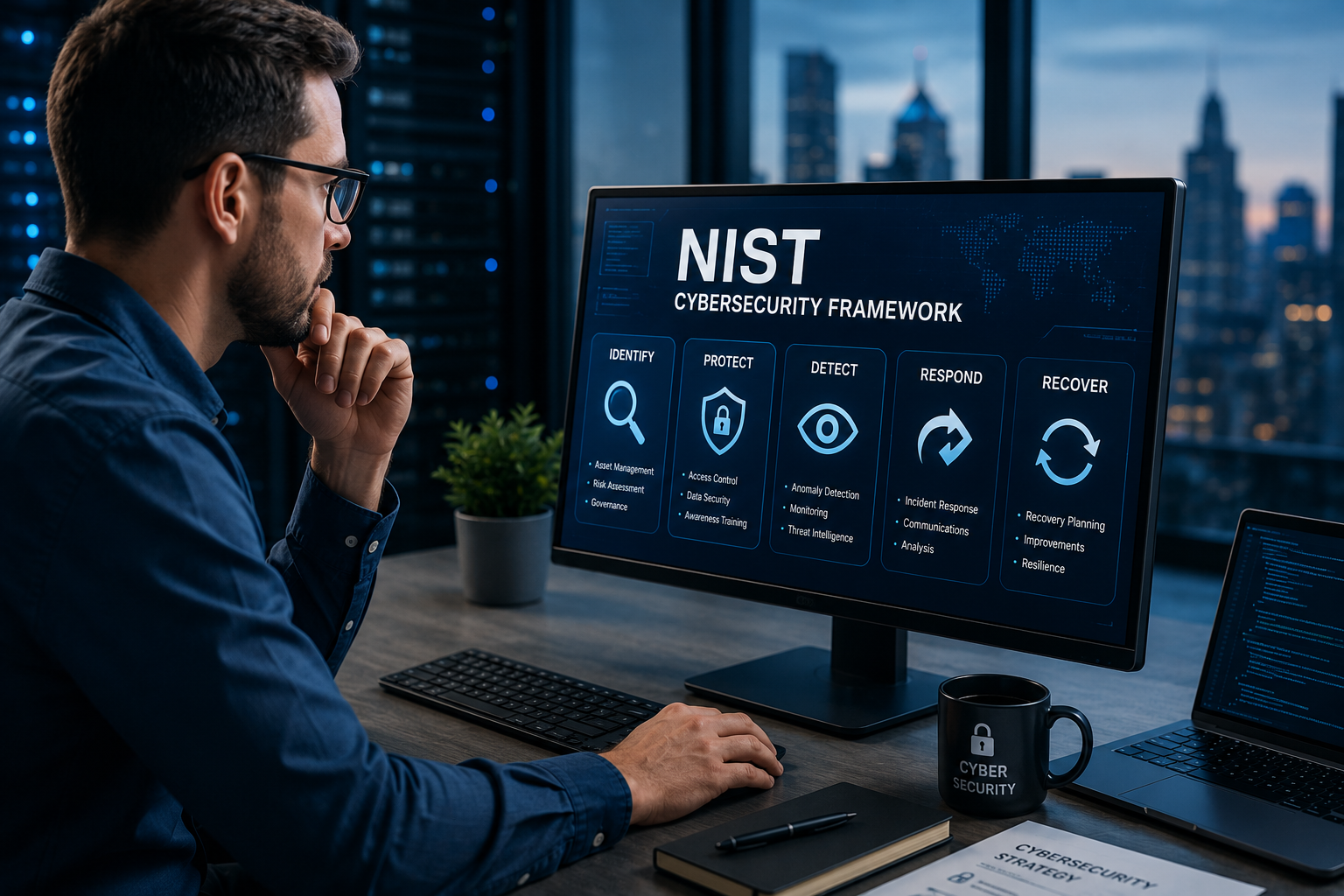
The framework is organized around five core functions that represent the lifecycle of effective cybersecurity management.
1. Identify
The Identify function helps organizations understand what needs protection.
Activities include:
- Asset inventory
- Business environment analysis
- Risk assessments
- Governance
- Third-party risk management
Understanding your environment is the foundation of effective cybersecurity.
2. Protect
The Protect function focuses on implementing safeguards that reduce the likelihood of successful attacks.
Examples include:
- Identity and access management
- Multi-Factor Authentication (MFA)
- Employee security awareness training
- Data encryption
- Endpoint protection
- Network security controls
- Secure configuration management
These safeguards reduce the organization’s attack surface.
3. Detect
Even the strongest preventive controls cannot stop every attack.
The Detect function helps organizations quickly identify security events through:
- Continuous monitoring
- Security Information and Event Management (SIEM)
- Endpoint Detection and Response (EDR)
- Log analysis
- Threat intelligence
- Behavioral analytics
Early detection minimizes the impact of security incidents.
4. Respond
The Respond function defines how organizations react when security incidents occur.
Response activities include:
- Incident response planning
- Threat containment
- Digital forensics
- Internal communications
- External notifications
- Root cause analysis
A well-defined response plan helps reduce downtime and business disruption.
5. Recover
Recovery focuses on restoring normal business operations after an incident.
Recovery activities include:
- System restoration
- Backup recovery
- Business continuity planning
- Disaster recovery
- Lessons learned
- Security improvements
Recovery planning helps organizations become more resilient after cyber incidents.
Understanding the NIST Framework Structure
Beyond the five core functions, the framework includes several components that help organizations measure and improve cybersecurity maturity.
Framework Core
The Core outlines cybersecurity activities organized into:
- Functions
- Categories
- Subcategories
This structure helps organizations prioritize security initiatives.
Implementation Tiers
Implementation Tiers describe how mature an organization’s cybersecurity practices are.
Typical tiers include:
- Tier 1 – Partial
- Tier 2 – Risk Informed
- Tier 3 – Repeatable
- Tier 4 – Adaptive
Organizations can use these tiers to identify improvement opportunities.
Framework Profiles
Profiles compare an organization’s:
- Current cybersecurity posture
- Desired future state
This comparison helps prioritize investments and develop practical improvement roadmaps.
Benefits of Implementing the NIST Framework Cybersecurity
Organizations that adopt the framework gain several important advantages.
Improved Risk Management
The framework enables organizations to identify, assess, and prioritize cyber risks based on business impact.
Stronger Regulatory Compliance
Many regulations align with NIST principles, making compliance easier.
Better Incident Response
Documented procedures improve coordination during cyber incidents.
Increased Cyber Resilience
Organizations recover faster after attacks and reduce operational disruption.
Improved Executive Communication
The framework provides a consistent language for discussing cybersecurity with leadership and stakeholders.
How to Implement the NIST Cybersecurity Framework
Organizations can follow a structured implementation process.
Step 1: Identify Critical Assets
Document systems, applications, users, data, and business processes.
Step 2: Assess Current Security
Evaluate existing controls and identify security gaps.
Step 3: Perform Risk Assessments
Determine which threats present the greatest business risk.
Step 4: Prioritize Improvements
Focus on high-risk vulnerabilities first.
Step 5: Deploy Security Controls
Implement safeguards such as endpoint protection, MFA, encryption, and continuous monitoring.
Step 6: Continuously Monitor
Review security events, update controls, and improve processes over time.
The NIST Cybersecurity Framework is designed to support continuous improvement rather than one-time implementation.
NIST Cybersecurity Framework Best Practices
Successfully implementing the NIST framework cybersecurity model requires more than deploying security tools. Organizations should build a culture of continuous improvement and risk management.
Conduct Regular Risk Assessments
Cyber threats change constantly. Regular risk assessments help identify new vulnerabilities, emerging attack techniques, and changing business risks.
Risk assessments should include:
- Critical assets
- Business processes
- Third-party vendors
- Cloud environments
- Remote workforce security
Reviewing risks on a routine basis helps organizations stay ahead of evolving threats.
Keep Asset Inventories Updated
You cannot protect assets you do not know about.
Maintain an accurate inventory of:
- Servers
- Endpoints
- Cloud workloads
- Applications
- User accounts
- Databases
- Network devices
- Internet of Things (IoT) devices
A complete inventory improves visibility and supports better risk management.
Strengthen Identity and Access Management
Access control is a core element of the NIST framework.
Organizations should:
- Enable Multi-Factor Authentication (MFA)
- Apply least-privilege access
- Review permissions regularly
- Remove inactive accounts
- Monitor privileged access
Strong identity management reduces the risk of unauthorized access.
Monitor Security Continuously
Continuous monitoring enables organizations to detect threats before they become major incidents.
Security teams should monitor:
- Endpoint activity
- Network traffic
- Authentication attempts
- Cloud workloads
- User behavior
- Security alerts
- System logs
Automated monitoring improves detection speed and response times.
Common Cybersecurity Risks Addressed by the NIST Framework
The framework helps organizations defend against a wide range of threats.
Ransomware
Ransomware encrypts critical files and disrupts business operations. The NIST framework encourages preventive controls, secure backups, and incident response planning.
Phishing
Security awareness training and email security controls help reduce phishing-related compromises.
Insider Threats
Least-privilege access, user monitoring, and access reviews help minimize insider risks.
Supply Chain Attacks
Vendor risk assessments and third-party security reviews reduce exposure to supply chain compromises.
Data Breaches
Encryption, access controls, and continuous monitoring help protect sensitive information from unauthorized access.
NIST Cybersecurity Framework vs. Other Security Frameworks
Organizations often compare the NIST Cybersecurity Framework with other popular standards.
| Framework | Primary Focus | Best For |
|---|---|---|
| NIST Cybersecurity Framework | Risk management and cybersecurity improvement | Organizations of all sizes |
| ISO/IEC 27001 | Information security management systems | Global compliance initiatives |
| CIS Controls | Prioritized technical security controls | Practical security implementation |
| COBIT | IT governance and business alignment | Enterprise governance |
| PCI DSS | Payment card data protection | Organizations handling payment card data |
Many organizations combine multiple frameworks to build a comprehensive cybersecurity program.
How the NIST Framework Supports Zero Trust
Zero Trust security complements the NIST framework by strengthening identity verification and limiting unauthorized access.
Zero Trust Principles
Organizations implementing Zero Trust should:
- Verify every user and device.
- Enforce least-privilege access.
- Continuously authenticate users.
- Segment networks.
- Monitor endpoint behavior.
- Protect cloud workloads.
- Detect suspicious activity quickly.
Combining the NIST framework with Zero Trust creates a stronger defense against modern cyber threats.
Common Implementation Mistakes
Organizations often struggle with implementation because of avoidable mistakes.
Mistakes to Avoid
- Treating cybersecurity as a one-time project
- Ignoring executive involvement
- Failing to inventory assets
- Using excessive user permissions
- Neglecting employee security training
- Ignoring third-party risk
- Not testing incident response plans
- Failing to review security metrics
Avoiding these mistakes improves long-term cybersecurity maturity.
NIST Cybersecurity Framework Implementation Checklist
Use this checklist to strengthen your security program.
✔ Identify critical assets
✔ Perform regular risk assessments
✔ Implement Multi-Factor Authentication
✔ Apply least-privilege access
✔ Encrypt sensitive data
✔ Deploy endpoint protection
✔ Monitor systems continuously
✔ Develop an incident response plan
✔ Test backup and recovery procedures
✔ Conduct employee security awareness training
✔ Review third-party security risks
✔ Audit cybersecurity controls regularly
Following this checklist supports continuous improvement and stronger resilience.
Future Trends in Cybersecurity Frameworks
Cybersecurity frameworks continue to evolve as organizations adopt new technologies and face increasingly sophisticated threats.
Emerging trends include:
- AI-powered threat detection
- Extended Detection and Response (XDR)
- Identity Threat Detection and Response (ITDR)
- Cloud-native security platforms
- Zero Trust Architecture
- Security automation
- Continuous compliance monitoring
- Risk-based vulnerability management
Organizations that embrace these innovations will be better prepared for the future threat landscape.
Conclusion
The NIST framework cybersecurity model provides organizations with a practical and flexible approach to managing cybersecurity risk. Its five core functions—Identify, Protect, Detect, Respond, and Recover—help organizations build stronger defenses, improve incident response, and support business continuity.
Whether your organization is beginning its cybersecurity journey or enhancing an existing program, the framework offers a scalable foundation for improving security maturity. By combining the NIST Cybersecurity Framework with continuous monitoring, Zero Trust principles, employee awareness training, and modern endpoint protection, businesses can significantly reduce cyber risk while strengthening resilience.
Cybersecurity is not a one-time effort. Regular assessments, ongoing improvements, and executive commitment are essential for maintaining a secure and resilient organization.
Strengthen Your Cybersecurity Strategy Today
Build a stronger cybersecurity posture with advanced endpoint protection, Zero Trust security, and continuous threat monitoring.
Get started today:
https://openedr.platform.xcitium.com/register/
Frequently Asked Questions
1. What is the NIST Cybersecurity Framework?
The NIST Cybersecurity Framework (CSF) is a voluntary set of guidelines developed by the National Institute of Standards and Technology to help organizations identify, manage, and reduce cybersecurity risks through a structured, risk-based approach.
2. What are the five core functions of the NIST Cybersecurity Framework?
The five core functions are:
- Identify – Understand assets, risks, and business context.
- Protect – Implement safeguards to reduce cyber risk.
- Detect – Identify cybersecurity events quickly.
- Respond – Contain and manage security incidents.
- Recover – Restore systems and improve resilience after an incident.
3. Who should use the NIST Cybersecurity Framework?
The framework is suitable for organizations of all sizes and industries, including government agencies, healthcare providers, financial institutions, manufacturers, educational organizations, and technology companies.
4. How does the NIST Cybersecurity Framework support compliance?
The framework aligns with many regulatory and industry standards by promoting structured risk management, security governance, continuous monitoring, incident response, and documented cybersecurity practices. While it is not a compliance standard itself, it helps organizations build programs that support compliance efforts.
5. How can organizations successfully implement the NIST Cybersecurity Framework?
Successful implementation includes identifying critical assets, performing risk assessments, applying strong identity and access controls, enabling continuous monitoring, developing incident response and recovery plans, training employees, reviewing third-party risks, and regularly improving security controls based on changing threats and business needs.

 Loading...