Updated on July 7, 2026, by OpenEDR
Cyberattacks are becoming more sophisticated every year, and businesses of every size face growing pressure to protect sensitive data, maintain compliance, and ensure uninterrupted operations. From ransomware and phishing attacks to insider threats and cloud vulnerabilities, organizations need professional solutions that provide comprehensive protection without adding unnecessary complexity.
Modern professional solutions combine advanced cybersecurity technologies, expert services, and intelligent automation to help organizations detect, prevent, and respond to cyber threats quickly. Whether you’re an IT manager, cybersecurity professional, CEO, or business owner, investing in the right professional solutions strengthens your security posture, reduces operational risks, and supports long-term business growth.
This guide explains what professional solutions are, why they matter, and how they help businesses build a resilient cybersecurity strategy.
What Are Professional Solutions?
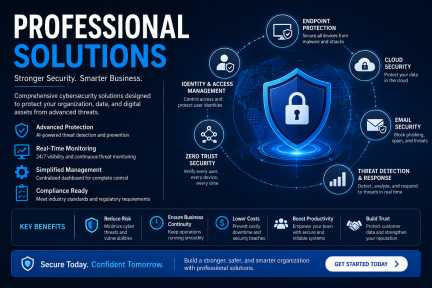
Professional solutions are integrated cybersecurity products and services designed to help organizations protect their IT infrastructure, users, applications, networks, and data. Rather than relying on individual security tools, professional solutions combine multiple layers of defense into a unified approach that improves visibility, simplifies management, and enhances protection.
A comprehensive professional solution typically includes:
- Endpoint protection
- Identity and Access Management (IAM)
- Zero Trust security
- Cloud security
- Threat detection and response
- Vulnerability management
- Email security
- Security monitoring and reporting
These technologies work together to reduce cyber risk while improving operational efficiency.
Why Professional Solutions Matter
Today’s business environment is more connected than ever. Employees work remotely, applications run in the cloud, and organizations manage thousands of connected devices. As the attack surface grows, traditional security approaches are no longer enough.
Professional solutions help organizations:
- Protect critical business assets
- Detect cyber threats earlier
- Reduce ransomware risk
- Improve compliance
- Simplify security management
- Minimize downtime
- Support business continuity
By adopting professional solutions, businesses can respond more effectively to evolving threats while enabling secure digital transformation.
Key Components of Professional Solutions
Endpoint Protection
Endpoints such as laptops, desktops, servers, and mobile devices are common entry points for attackers.
Modern endpoint protection provides:
- Malware prevention
- Anti-ransomware protection
- AI-powered threat detection
- Behavioral analysis
- Automated threat response
- Continuous monitoring
Protecting every endpoint helps reduce the overall attack surface.
Identity and Access Management (IAM)
Identity has become the new security perimeter.
IAM solutions enable organizations to:
- Verify user identities
- Manage user permissions
- Implement Single Sign-On (SSO)
- Enforce Multi-Factor Authentication (MFA)
- Control privileged access
Strong identity security helps prevent unauthorized access and credential-based attacks.
Zero Trust Security
Zero Trust follows one fundamental principle:
Never Trust, Always Verify.
Every user, device, and application is continuously validated before access is granted.
Zero Trust helps organizations:
- Limit lateral movement
- Reduce insider threats
- Secure hybrid work environments
- Protect cloud resources
Cloud Security
Cloud adoption continues to accelerate across industries.
Professional solutions protect:
- SaaS applications
- Cloud workloads
- Hybrid environments
- Cloud storage
- Sensitive business data
Cloud security ensures that organizations maintain visibility and control regardless of where their data resides.
Threat Detection and Response
Advanced detection capabilities include:
- Endpoint Detection and Response (EDR)
- Extended Detection and Response (XDR)
- AI-powered analytics
- Threat intelligence
- Automated incident response
These technologies help security teams identify and contain attacks before they cause significant damage.
Benefits of Professional Solutions
Organizations implementing professional solutions gain numerous advantages.
Enhanced Cybersecurity
Integrated security technologies work together to prevent malware, ransomware, phishing, and other advanced cyber threats.
Simplified Security Management
Centralized dashboards reduce administrative complexity by allowing IT teams to manage security policies from a single interface.
Faster Threat Response
Automation accelerates detection, investigation, and remediation, reducing the impact of cyber incidents.
Regulatory Compliance
Professional solutions support compliance with frameworks such as:
- GDPR
- HIPAA
- PCI DSS
- ISO 27001
- SOC 2
Built-in reporting simplifies audits and demonstrates security readiness.
Improved Business Continuity
Proactive protection reduces downtime, helping organizations maintain operations during security incidents.
Best Practices for Implementing Professional Solutions
To maximize the effectiveness of your cybersecurity strategy:
- Conduct regular cybersecurity risk assessments.
- Inventory all users, devices, and applications.
- Deploy advanced endpoint protection.
- Enable Multi-Factor Authentication.
- Implement Zero Trust access controls.
- Secure cloud workloads.
- Monitor security events continuously.
- Train employees to recognize phishing attacks.
- Keep systems and applications updated.
- Test incident response plans regularly.
A layered security approach provides stronger protection than relying on a single security tool.
Industry Applications
Healthcare
Protect patient records, connected medical devices, and healthcare applications while supporting HIPAA compliance.
Financial Services
Secure financial transactions, customer information, and online banking platforms against fraud and cybercrime.
Manufacturing
Protect operational technology (OT), industrial control systems, and connected production environments.
Retail
Secure payment systems, customer information, and e-commerce platforms while maintaining PCI DSS compliance.
Government
Safeguard critical infrastructure, citizen services, and sensitive government data from sophisticated threats.
Education
Protect student records, faculty devices, and research data across campuses and remote learning environments.
Future Trends in Professional Solutions
Cybersecurity continues to evolve rapidly.
Emerging trends include:
- Artificial intelligence for threat detection
- Extended Detection and Response (XDR)
- Zero Trust by default
- Cloud-native security platforms
- Automated compliance monitoring
- Identity-first security
- Security orchestration and automation
- Predictive threat intelligence
Organizations that embrace these innovations will be better equipped to manage future cyber risks.
Conclusion
Cyber threats continue to evolve, but organizations can stay protected by investing in comprehensive professional solutions that combine technology, automation, and best practices. From endpoint protection and Zero Trust security to cloud security and advanced threat detection, these integrated solutions help reduce risk, improve compliance, and support business continuity.
Whether you’re protecting a growing business or a global enterprise, adopting professional solutions creates a stronger cybersecurity foundation and enables your organization to operate with confidence.
Ready to strengthen your cybersecurity strategy?
Start protecting your organization with a modern security platform today:
https://openedr.platform.xcitium.com/register/
Frequently Asked Questions
1. What are professional solutions in cybersecurity?
Professional solutions are integrated cybersecurity products and services that protect users, devices, applications, networks, and data through advanced security technologies and expert management.
2. Why are professional solutions important?
They help organizations prevent cyberattacks, improve security visibility, simplify management, support compliance, and reduce operational risk.
3. What technologies are included in professional solutions?
Common technologies include endpoint protection, Identity and Access Management (IAM), Multi-Factor Authentication (MFA), Zero Trust security, cloud security, EDR, XDR, threat intelligence, and automated incident response.
4. How do professional solutions improve business security?
They provide continuous monitoring, automated threat detection, centralized management, and layered protection that helps organizations respond quickly to evolving cyber threats.
5. How do I choose the right professional solution?
Look for a solution that offers scalability, integration with existing systems, AI-powered threat detection, centralized management, strong compliance support, and reliable customer assistance.

 Loading...