Updated on July 6, 2026, by OpenEDR
Cyber threats continue to grow in both volume and complexity. Businesses today must secure endpoints, networks, cloud environments, identities, and data—all while keeping operations running smoothly. Managing multiple security vendors can increase costs, create security gaps, and overwhelm IT teams. That’s why many organizations are turning to a turnkey solution to simplify cybersecurity.
A turnkey solution provides a ready-to-deploy security platform that combines essential technologies into one integrated system. Instead of purchasing, configuring, and managing multiple products separately, businesses receive a complete solution that is designed to work together from day one.
Whether you’re an IT manager, cybersecurity professional, CEO, or business owner, understanding how a turnkey solution improves security can help you make smarter technology investments.
What Is a Turnkey Solution?
A turnkey solution is a fully integrated product or service that is ready for immediate deployment and use. In cybersecurity, a turnkey solution combines multiple security technologies into a single platform, allowing organizations to protect users, endpoints, networks, cloud workloads, and sensitive data without complex integration projects.
Unlike standalone security tools, a turnkey solution offers centralized management, automated protection, and faster implementation.
Why Businesses Choose a Turnkey Solution
Organizations adopt a turnkey solution because it helps them:
- Reduce deployment time
- Simplify security management
- Lower operational costs
- Improve visibility across environments
- Strengthen compliance
- Reduce security gaps
- Accelerate threat detection and response
By consolidating security functions into one platform, businesses spend less time managing tools and more time improving their overall security posture.
Key Components of a Cybersecurity Turnkey Solution
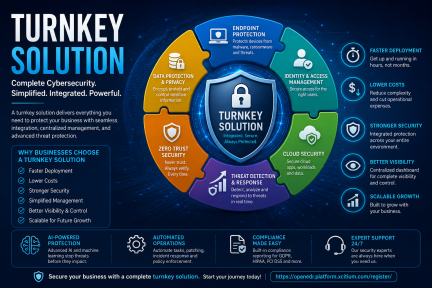
A modern turnkey solution typically includes:
Endpoint Protection
Protects laptops, desktops, servers, and mobile devices from malware, ransomware, and advanced cyber threats.
Identity and Access Management (IAM)
Ensures only authorized users can access business resources through strong authentication and access controls.
Zero Trust Security
Continuously verifies every user, device, and application before granting access, reducing the risk of unauthorized activity.
Cloud Security
Protects cloud workloads, SaaS applications, and hybrid environments with centralized security policies.
Threat Detection and Response
Uses AI, behavioral analytics, and threat intelligence to detect suspicious activity and automate incident response.
Benefits of a Turnkey Solution
Implementing a turnkey solution provides organizations with several advantages:
- Faster deployment
- Simplified administration
- Lower total cost of ownership
- Improved operational efficiency
- Stronger cybersecurity
- Better compliance readiness
- Centralized monitoring and reporting
- Scalability for future growth
Instead of managing multiple disconnected products, organizations gain a unified security platform that is easier to operate and maintain.
Common Cyber Threats Addressed by a Turnkey Solution
A modern platform protects against:
- Ransomware
- Malware
- Phishing attacks
- Business Email Compromise (BEC)
- Insider threats
- Credential theft
- Zero-day exploits
- Fileless malware
- Advanced Persistent Threats (APTs)
Layered security significantly reduces the likelihood of successful attacks.
How to Choose the Right Turnkey Solution
Selecting the right platform requires careful evaluation.
Consider these factors:
Scalability
Can the platform grow with your organization?
Integration
Does it integrate with existing infrastructure, cloud platforms, and business applications?
Automation
Look for:
- Automated threat detection
- Automated remediation
- Patch management
- Policy enforcement
Automation reduces response times and eases the burden on IT teams.
Visibility
Choose solutions offering:
- Centralized dashboards
- Real-time alerts
- Security analytics
- Compliance reporting
Complete visibility improves decision-making.
Turnkey Solution vs Multiple Security Products
| Turnkey Solution | Multiple Standalone Products |
|---|---|
| Single integrated platform | Multiple vendors |
| Faster deployment | Complex integration |
| Centralized management | Separate management consoles |
| Unified security policies | Inconsistent configurations |
| Lower maintenance costs | Higher administrative overhead |
| Better visibility | Fragmented reporting |
Organizations adopting integrated platforms often improve operational efficiency while reducing complexity.
Best Practices for Implementing a Turnkey Solution
Follow these recommendations:
- Perform a cybersecurity risk assessment.
- Inventory all users, endpoints, and applications.
- Define security policies.
- Enable Multi-Factor Authentication.
- Deploy endpoint protection.
- Implement Zero Trust access controls.
- Secure cloud workloads.
- Continuously monitor security events.
- Test incident response procedures.
- Review policies regularly.
A structured deployment approach improves long-term success.
Industry Use Cases
Healthcare
Protect patient records while supporting HIPAA compliance.
Financial Services
Secure transactions, customer information, and banking applications.
Manufacturing
Protect operational technology (OT) and connected production systems.
Retail
Secure payment systems and customer information.
Government
Protect critical infrastructure and sensitive government data.
Education
Safeguard student records, faculty devices, and research environments.
Future Trends in Turnkey Cybersecurity
Several innovations are shaping the future:
- AI-powered threat detection
- Extended Detection and Response (XDR)
- Zero Trust by default
- Cloud-native security platforms
- Automated compliance reporting
- Security orchestration and automation
- Identity-first security
- Predictive threat intelligence
Organizations adopting these technologies will be better positioned to defend against emerging cyber threats.
Conclusion
As cyber threats continue to evolve, organizations need security that is simple to deploy, easy to manage, and powerful enough to defend against modern attacks. A turnkey solution provides an integrated cybersecurity platform that combines endpoint protection, Zero Trust, cloud security, identity management, and automated threat response into one comprehensive system.
Instead of juggling multiple vendors and disconnected tools, businesses can streamline operations, improve visibility, strengthen compliance, and reduce cyber risk with a single, unified platform.
Ready to simplify your cybersecurity strategy and protect your organization with a modern turnkey solution?
Get started today:
https://openedr.platform.xcitium.com/register/
Frequently Asked Questions
1. What is a turnkey solution?
A turnkey solution is a fully integrated product or service that is ready to deploy and use immediately. In cybersecurity, it combines multiple security technologies into one platform.
2. Why should businesses use a turnkey cybersecurity solution?
It simplifies deployment, reduces operational complexity, improves security, lowers costs, and provides centralized management.
3. What technologies are included in a turnkey solution?
Typical components include endpoint protection, Identity and Access Management (IAM), Multi-Factor Authentication (MFA), Zero Trust security, cloud security, EDR, XDR, threat intelligence, and automated incident response.
4. Is a turnkey solution suitable for small businesses?
Yes. Turnkey solutions are available for organizations of all sizes and help smaller businesses strengthen security without managing multiple security products.
5. How does a turnkey solution improve cybersecurity?
It provides integrated protection across users, devices, applications, and cloud environments while using AI, automation, and continuous monitoring to detect and respond to cyber threats faster.

 Loading...