Updated on June 12, 2026, by OpenEDR
Imagine preparing for a regulatory audit and discovering that critical financial controls were never documented, access permissions were outdated, and compliance evidence was scattered across multiple systems. For many organizations, this scenario is a real challenge. That’s why SOX software has become an essential tool for companies seeking to maintain compliance, improve governance, and reduce operational risk.
As regulations continue to evolve and cyber threats become more sophisticated, organizations need more than spreadsheets and manual processes. Modern SOX software helps businesses automate compliance workflows, monitor controls, streamline audits, and maintain visibility across complex IT environments.
This guide explores what SOX software is, how it works, key features, benefits, implementation best practices, and why cybersecurity teams increasingly play a critical role in SOX compliance.
What Is SOX Software?
SOX software refers to compliance management platforms designed to help organizations meet the requirements of the Sarbanes-Oxley Act (SOX). Enacted in 2002, SOX was created to improve corporate governance, strengthen financial reporting accuracy, and increase accountability among public companies.
SOX software helps organizations:
- Document internal controls
- Monitor compliance activities
- Track risk assessments
- Automate testing procedures
- Manage audit evidence
- Generate compliance reports
- Support external audits
By centralizing compliance activities, SOX software reduces administrative burden while improving audit readiness.
Why SOX Compliance Matters
The Sarbanes-Oxley Act was introduced after several high-profile corporate accounting scandals exposed weaknesses in financial oversight.
Today, SOX compliance remains critical because it helps organizations:
- Protect shareholder interests
- Improve financial transparency
- Strengthen internal controls
- Reduce fraud risks
- Enhance corporate accountability
- Maintain regulatory compliance
For publicly traded companies, failure to comply with SOX requirements can result in significant penalties, legal consequences, and reputational damage.
How SOX Software Works
Modern SOX software automates many tasks traditionally performed manually by compliance teams.
A typical SOX compliance workflow includes:
- Identifying key controls
- Mapping risks to controls
- Assigning ownership responsibilities
- Collecting compliance evidence
- Testing control effectiveness
- Documenting findings
- Managing remediation efforts
- Generating audit reports
This structured approach helps organizations maintain continuous compliance rather than scrambling before audits.
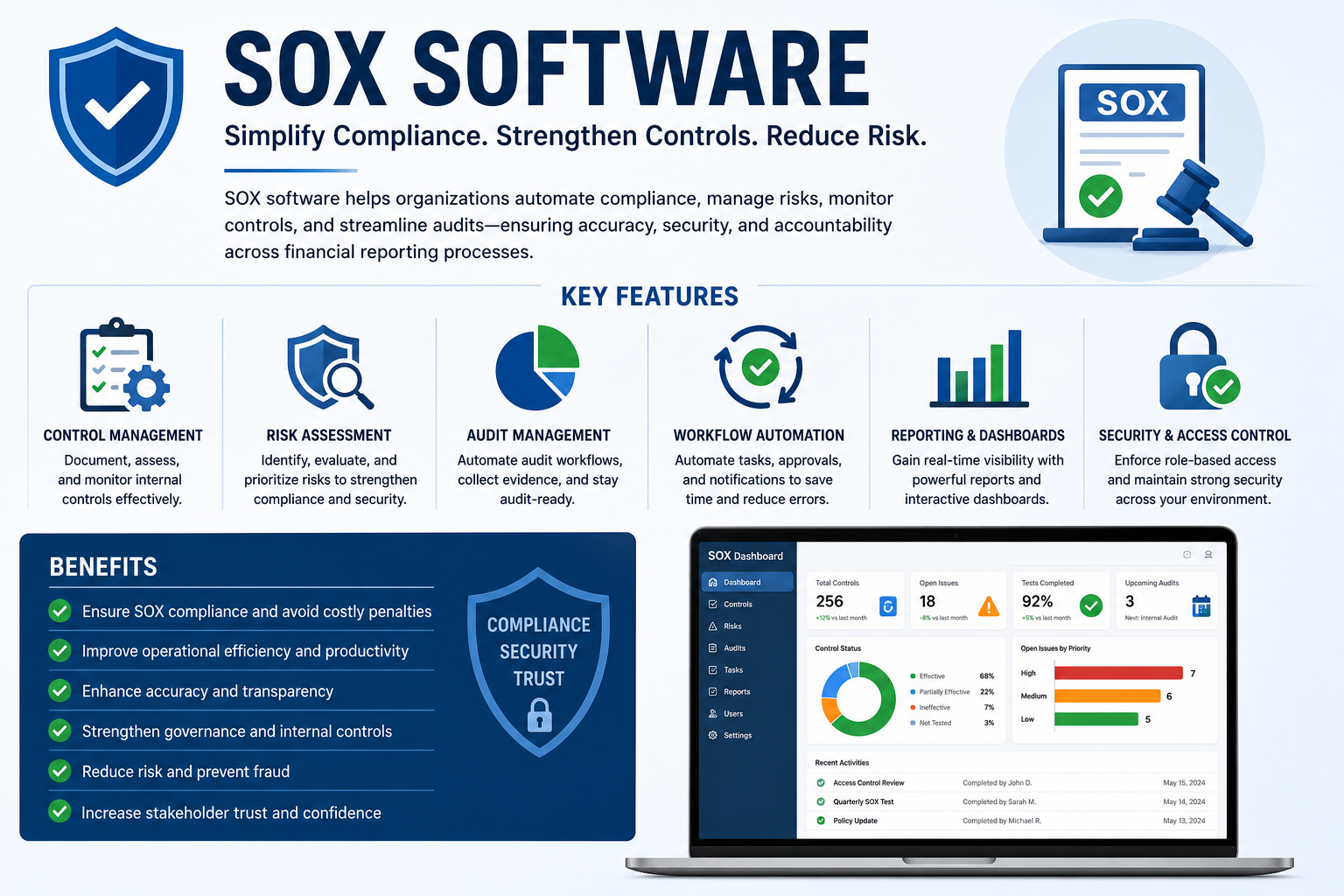
Key Features of SOX Software
The best SOX software solutions provide a combination of compliance, governance, and security capabilities.
Control Management
Organizations must document and maintain internal controls that support financial reporting accuracy.
SOX software enables teams to:
- Create control libraries
- Assign control owners
- Monitor control effectiveness
- Track control changes
This improves visibility and accountability.
Risk Assessment and Management
Effective compliance begins with identifying risks.
Modern SOX software helps organizations:
- Assess financial risks
- Evaluate operational risks
- Monitor cybersecurity risks
- Prioritize remediation efforts
This risk-based approach allows teams to focus resources where they are needed most.
Audit Management
Preparing for audits can be time-consuming.
SOX software simplifies audit processes through:
- Automated evidence collection
- Centralized documentation
- Audit trails
- Task tracking
- Reporting dashboards
This reduces preparation time and improves audit efficiency.
Workflow Automation
Manual compliance processes often create bottlenecks.
Workflow automation allows organizations to:
- Route approvals automatically
- Assign tasks
- Track deadlines
- Escalate issues
- Monitor progress
Automation helps reduce human error while improving consistency.
Reporting and Dashboards
Executives need visibility into compliance performance.
Most SOX software platforms provide dashboards that display:
- Control status
- Open findings
- Risk exposure
- Audit progress
- Remediation activities
These insights support better decision-making.
The Role of Cybersecurity in SOX Compliance
While SOX is often associated with financial controls, cybersecurity plays an increasingly important role in compliance efforts.
Financial reporting systems rely heavily on technology infrastructure. As a result, weak cybersecurity controls can create compliance risks.
Access Control Management
Unauthorized access to financial systems can compromise data integrity.
Organizations should implement:
- Role-based access controls
- Least privilege principles
- Multi-factor authentication
- Access reviews
SOX software often helps track and document these controls.
Change Management
Unauthorized system changes may impact financial reporting accuracy.
Effective change management includes:
- Approval workflows
- Change documentation
- Testing procedures
- Audit trails
Many SOX software platforms integrate directly with IT change management systems.
Security Monitoring
Continuous monitoring helps identify potential compliance violations before they become significant issues.
Organizations increasingly combine SOX software with:
- SIEM solutions
- Endpoint detection and response (EDR)
- Threat intelligence platforms
- Security analytics tools
This strengthens both compliance and security programs.
Benefits of Implementing SOX Software
Organizations that adopt SOX software often experience significant operational improvements.
Improved Compliance Efficiency
Automation reduces repetitive tasks and administrative overhead.
Teams spend less time collecting evidence and more time managing risk.
Better Audit Readiness
Audit documentation remains centralized and easily accessible.
This simplifies audit preparation and reduces stress during review periods.
Reduced Compliance Costs
Manual compliance processes can be expensive.
SOX software helps reduce costs by:
- Eliminating redundant work
- Improving productivity
- Reducing audit preparation time
- Streamlining testing procedures
Enhanced Visibility
Executives gain real-time insight into compliance performance.
This enables faster decision-making and more effective governance.
Stronger Risk Management
Organizations can identify and address compliance gaps before they lead to audit findings or regulatory penalties.
SOX Software vs Manual Compliance Management
| Capability | Manual Process | SOX Software |
|---|---|---|
| Control Tracking | Limited | Automated |
| Evidence Collection | Manual | Automated |
| Audit Readiness | Time-Consuming | Continuous |
| Risk Monitoring | Reactive | Proactive |
| Reporting | Manual | Real-Time |
| Workflow Management | Limited | Automated |
| Scalability | Difficult | High |
As organizations grow, manual compliance management becomes increasingly difficult to sustain.
How to Choose the Right SOX Software
Selecting the right SOX software requires evaluating several factors.
Compliance Coverage
The platform should support:
- SOX requirements
- Internal controls
- Audit workflows
- Risk assessments
- Reporting obligations
Integration Capabilities
Modern organizations use multiple systems.
Look for integration with:
- ERP platforms
- Identity management systems
- Ticketing solutions
- Security tools
- Document repositories
Ease of Use
A complex interface can slow adoption.
Choose SOX software that provides:
- Intuitive navigation
- User-friendly dashboards
- Automated workflows
- Clear reporting
Scalability
Compliance requirements often grow with the business.
Ensure the platform can support future expansion.
Security Controls
Compliance software should meet strong security standards.
Key requirements include:
- Encryption
- MFA
- Audit logging
- Role-based access controls
- Data protection measures
Best Practices for Successful SOX Software Implementation
Organizations can maximize value by following these recommendations:
- Define compliance objectives clearly.
- Establish control ownership.
- Automate repetitive processes.
- Integrate compliance and cybersecurity teams.
- Conduct regular control testing.
- Maintain accurate documentation.
- Continuously monitor risks.
- Train employees regularly.
These practices improve long-term compliance success.
The Future of SOX Software
Compliance technology continues to evolve.
Emerging trends include:
- Artificial intelligence for risk analysis
- Continuous compliance monitoring
- Predictive analytics
- Automated control testing
- Cloud-native compliance platforms
- Integrated cybersecurity and governance solutions
Organizations that embrace these innovations can improve efficiency while reducing risk.
Frequently Asked Questions
What is SOX software?
SOX software is a compliance management platform that helps organizations meet Sarbanes-Oxley requirements through control monitoring, risk management, audit automation, and reporting.
Who uses SOX software?
SOX software is commonly used by public companies, compliance teams, auditors, finance departments, IT managers, risk professionals, and cybersecurity teams.
Why is SOX software important?
SOX software helps organizations automate compliance activities, improve audit readiness, strengthen internal controls, and reduce regulatory risk.
Can SOX software improve cybersecurity?
Yes. Many SOX software platforms support access control management, audit logging, risk assessments, and compliance monitoring that strengthen cybersecurity programs.
What features should organizations look for in SOX software?
Key features include control management, risk assessments, workflow automation, evidence collection, audit management, reporting dashboards, and security integrations.
Strengthen Compliance and Security Together
Modern compliance requires more than documentation. Organizations need continuous visibility into risks, controls, and security threats to maintain both regulatory compliance and operational resilience.
Discover how OpenEDR helps organizations improve security monitoring, strengthen control environments, and support compliance initiatives through advanced endpoint detection and response.
Get started today:

 Loading...