Updated on June 3, 2026, by OpenEDR
Perimeter Security: Why It Still Matters in a Zero Trust World
Cyberattacks continue to increase in frequency and sophistication. From ransomware campaigns and phishing attacks to advanced persistent threats, organizations face constant pressure to protect their digital assets. While modern security frameworks have evolved, perimeter security remains a critical component of a strong cybersecurity strategy.
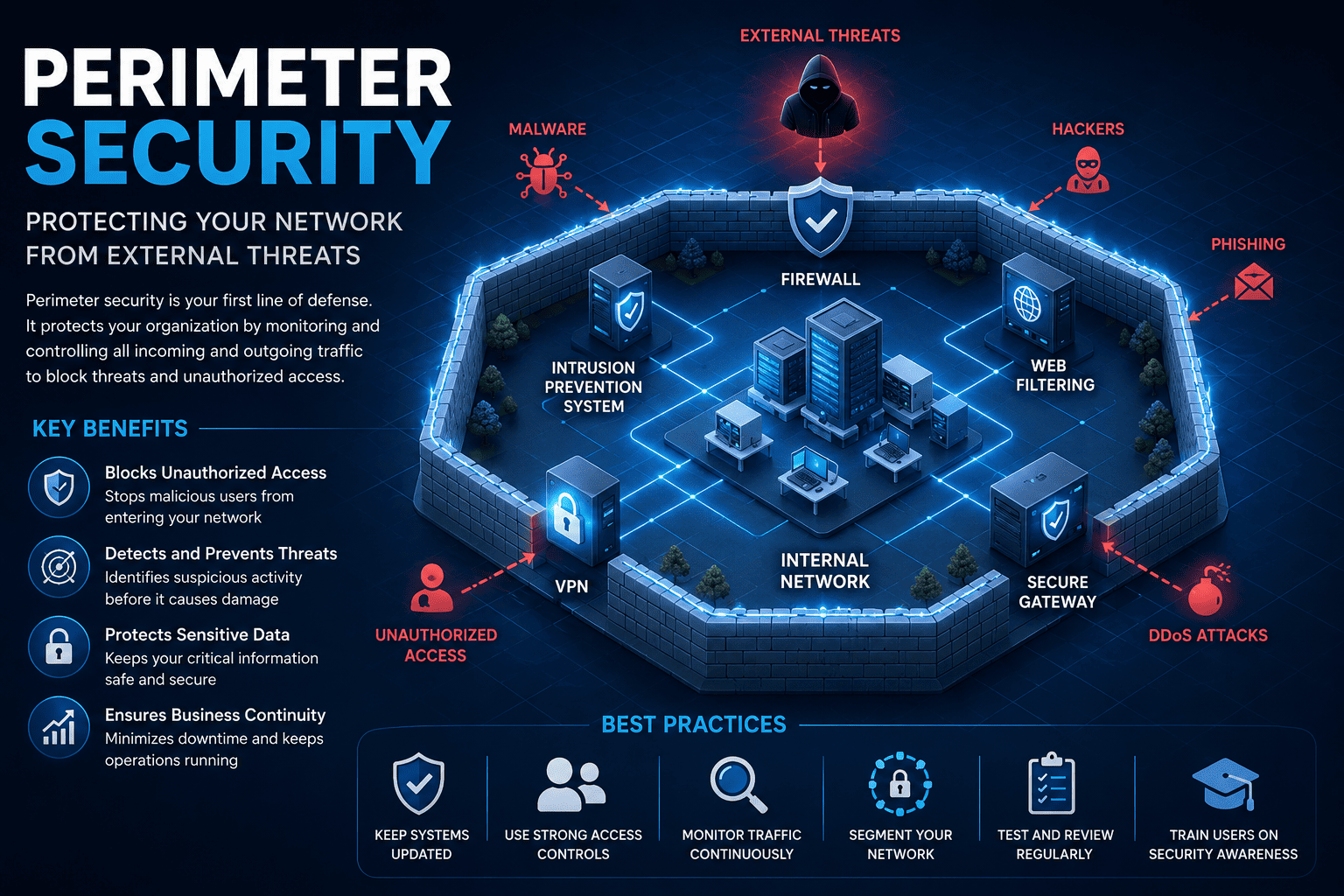
Think of perimeter security as the protective wall surrounding your organization’s digital environment. It serves as the first line of defense against unauthorized access, malicious traffic, and external threats. Although cloud computing, remote work, and mobile devices have expanded attack surfaces, businesses still rely on perimeter security to detect, block, and manage incoming threats.
Whether you’re an IT manager, security professional, or business executive, understanding perimeter security can help strengthen your organization’s overall security posture and reduce cyber risk.
What Is Perimeter Security?
Perimeter security refers to the collection of technologies, policies, and controls designed to protect the boundary between an organization’s internal network and external environments such as the internet.
The goal of perimeter security is to:
- Prevent unauthorized access
- Block malicious traffic
- Monitor network activity
- Protect sensitive data
- Reduce attack surfaces
- Support compliance requirements
Traditionally, perimeter security focused on securing corporate networks. Today, it extends to cloud environments, remote users, IoT devices, and hybrid infrastructures.
Why Perimeter Security Is Important
Every organization has valuable assets that attackers want to access. These assets may include:
- Customer information
- Financial data
- Intellectual property
- Employee records
- Business applications
- Operational systems
Without effective perimeter security, attackers may gain access to networks, deploy malware, steal data, or disrupt business operations.
Protecting Against External Threats
Perimeter security helps organizations defend against:
- Malware attacks
- Ransomware infections
- Unauthorized access attempts
- Distributed Denial-of-Service (DDoS) attacks
- Botnet activity
- Network intrusions
Strong perimeter controls significantly reduce exposure to cyber threats.
Core Components of Perimeter Security
Modern perimeter security relies on multiple layers of protection.
Firewalls
Firewalls are one of the most important perimeter security technologies.
They monitor and control network traffic based on predefined security rules.
Firewalls can:
- Block unauthorized connections
- Filter malicious traffic
- Restrict access to sensitive resources
- Monitor inbound and outbound communications
Next-generation firewalls (NGFWs) provide advanced inspection and threat detection capabilities.
Intrusion Detection and Prevention Systems (IDS/IPS)
IDS and IPS technologies monitor network traffic for suspicious activity.
They help organizations:
- Detect threats
- Identify attack attempts
- Prevent unauthorized access
- Generate security alerts
These systems provide valuable visibility into network activity.
Virtual Private Networks (VPNs)
VPNs create encrypted connections between users and corporate resources.
Benefits include:
- Secure remote access
- Data encryption
- Protection on public networks
- Improved privacy
VPNs remain an important component of perimeter security for remote work environments.
Secure Web Gateways
Secure web gateways protect users from web-based threats.
They can:
- Block malicious websites
- Filter web traffic
- Prevent malware downloads
- Enforce browsing policies
This helps reduce the risk of internet-based attacks.
How Perimeter Security Works
Effective perimeter security operates by monitoring, filtering, and controlling traffic entering or leaving a network.
The process typically includes:
Traffic Inspection
Security controls inspect:
- Source IP addresses
- Destination addresses
- Protocols
- Applications
- Content
This helps identify potentially malicious activity.
Access Control
Organizations establish rules that determine:
- Who can access resources
- Which devices are allowed
- What services are available
Access controls reduce unauthorized access risks.
Threat Detection
Perimeter security tools continuously analyze traffic patterns to identify:
- Malware
- Suspicious behavior
- Intrusion attempts
- Data exfiltration
Early detection helps organizations respond quickly to threats.
Traditional Perimeter Security vs Modern Perimeter Security
The cybersecurity landscape has changed significantly.
Traditional Perimeter Security
Focused on:
- On-premises networks
- Centralized data centers
- Office-based employees
- Fixed network boundaries
This model assumed everything inside the network was trusted.
Modern Perimeter Security
Today’s environments include:
- Cloud services
- Remote workers
- Mobile devices
- Third-party integrations
- Hybrid infrastructures
As a result, perimeter security now incorporates identity verification, cloud protection, and continuous monitoring.
| Traditional Perimeter | Modern Perimeter |
|---|---|
| Fixed network boundary | Dynamic and distributed |
| On-premises systems | Cloud and hybrid environments |
| Internal trust model | Zero Trust approach |
| Limited remote access | Remote-first workforce |
| Device-focused security | Identity-focused security |
Common Challenges in Perimeter Security
Organizations face several challenges when implementing perimeter security.
Expanding Attack Surfaces
Digital transformation introduces:
- Cloud applications
- Remote access points
- IoT devices
- Mobile endpoints
Each connection creates a potential attack vector.
Sophisticated Threats
Modern attackers use:
- Fileless malware
- AI-assisted attacks
- Credential theft
- Social engineering
Traditional defenses alone may not stop advanced threats.
Managing Complexity
Many organizations struggle with:
- Multiple security tools
- Policy inconsistencies
- Visibility gaps
- Resource limitations
A layered security strategy helps address these challenges.
Best Practices for Strengthening Perimeter Security
Organizations should adopt a proactive approach.
Implement Multi-Factor Authentication (MFA)
MFA adds an extra layer of identity verification.
Benefits include:
- Reduced credential theft risk
- Improved access security
- Better compliance support
Keep Systems Updated
Patch management helps eliminate vulnerabilities that attackers exploit.
Update:
- Operating systems
- Applications
- Firewalls
- Network devices
Regular updates reduce security gaps.
Segment Networks
Network segmentation limits attacker movement.
Benefits include:
- Improved containment
- Reduced attack surfaces
- Better visibility
Segmentation is especially valuable for protecting critical assets.
Monitor Traffic Continuously
Continuous monitoring helps detect:
- Unauthorized access attempts
- Malware activity
- Suspicious communications
Real-time visibility strengthens perimeter security effectiveness.
Perimeter Security and Zero Trust
Many organizations ask whether perimeter security still matters in a Zero Trust environment.
The answer is yes.
Zero Trust follows the principle:
“Never trust, always verify.”
Rather than replacing perimeter security, Zero Trust enhances it.
Organizations combine:
- Identity verification
- Device validation
- Continuous monitoring
- Least-privilege access
This approach strengthens security both inside and outside the network perimeter.
The Role of Perimeter Security in Compliance
Many regulations require organizations to implement perimeter controls.
Examples include:
- PCI DSS
- HIPAA
- GDPR
- ISO 27001
- NIST Cybersecurity Framework
- SOC 2
Strong perimeter security supports:
- Data protection
- Audit readiness
- Risk management
- Regulatory compliance
Compliance requirements continue to drive investment in perimeter defenses.
Emerging Trends in Perimeter Security
The future of perimeter security continues to evolve.
AI-Powered Threat Detection
Artificial intelligence improves:
- Threat identification
- Behavioral analytics
- Automated response
Secure Access Service Edge (SASE)
SASE combines:
- Networking
- Security services
- Cloud protection
This model supports modern distributed workforces.
Extended Detection and Response (XDR)
XDR provides visibility across:
- Endpoints
- Networks
- Cloud environments
- User identities
This improves threat detection and incident response.
Cloud-Native Security
As organizations migrate to the cloud, perimeter security increasingly includes:
- Cloud firewalls
- API security
- Identity-based controls
- Cloud workload protection
Building an Effective Perimeter Security Strategy
A successful perimeter security program should include:
- Asset inventory
- Risk assessments
- Firewall management
- Access controls
- Network segmentation
- Threat monitoring
- Incident response planning
- Employee security training
Combining these elements creates a stronger and more resilient security posture.
Frequently Asked Questions
What is perimeter security?
Perimeter security refers to technologies and controls that protect the boundary between an organization’s internal network and external environments, such as the internet.
Why is perimeter security important?
Perimeter security helps prevent unauthorized access, block cyber threats, protect sensitive data, and reduce attack surfaces.
What are examples of perimeter security technologies?
Common examples include firewalls, intrusion detection systems, intrusion prevention systems, VPNs, secure web gateways, and network access controls.
Is perimeter security still relevant with Zero Trust?
Yes. Perimeter security remains important, but it is enhanced by Zero Trust principles such as identity verification and continuous access validation.
How can organizations improve perimeter security?
Organizations can strengthen perimeter security through MFA, network segmentation, continuous monitoring, patch management, employee training, and advanced threat detection solutions.
Conclusion
Although cybersecurity has evolved beyond traditional network boundaries, perimeter security remains a critical defense layer for protecting organizations against modern cyber threats. Firewalls, intrusion prevention systems, VPNs, access controls, and continuous monitoring all contribute to a stronger security posture.
By combining perimeter security with Zero Trust principles, threat intelligence, and advanced detection capabilities, organizations can better defend against ransomware, malware, data breaches, and unauthorized access.
Ready to strengthen your cybersecurity posture and improve threat detection capabilities?
Get started today: https://openedr.platform.xcitium.com/register/

 Loading...