
Updated on May 15, 2026, by OpenEDR
Cyberattacks are becoming more advanced, costly, and disruptive every year. Businesses now face ransomware attacks, phishing campaigns, insider threats, cloud vulnerabilities, and data breaches that can impact operations, reputation, and revenue.
This is why cyber security management has become a top priority for organizations of every size.
Cyber security management is the process of protecting digital systems, networks, applications, and sensitive data through strategic security planning, monitoring, risk management, and incident response. It helps businesses identify vulnerabilities, reduce cyber risks, and respond quickly to evolving threats.
For IT managers, cybersecurity professionals, CEOs, and business leaders, strong cyber security management is no longer optional. It is essential for maintaining operational continuity, protecting customer trust, and supporting long-term business growth.
In this guide, we’ll explain what cyber security management is, why it matters, key components, common challenges, best practices, and how businesses can strengthen their cybersecurity posture.
What Is Cyber Security Management?
Cyber security management refers to the policies, processes, technologies, and practices organizations use to protect digital assets from cyber threats.
It involves:
- identifying security risks
- implementing protective controls
- monitoring systems continuously
- responding to cyber incidents
- maintaining compliance
- improving security strategies over time
Cyber security management combines:
- endpoint security
- network security
- cloud security
- identity management
- threat detection
- incident response
- employee awareness
to create a comprehensive security framework.
The goal is to reduce the likelihood and impact of cyberattacks while ensuring business resilience.
Why Cyber Security Management Is Important
Cyber threats continue growing in frequency and sophistication.
Businesses now face:
- ransomware attacks
- phishing scams
- credential theft
- insider threats
- supply chain attacks
- cloud misconfigurations
- zero-day vulnerabilities
Without proper cyber security management, organizations risk:
- financial losses
- operational downtime
- compliance violations
- reputational damage
- customer trust erosion
Strong cyber security management helps businesses proactively identify risks before attackers exploit vulnerabilities.
It also improves incident response capabilities and reduces recovery time after security events.
Cyber Security Management Lifecycle
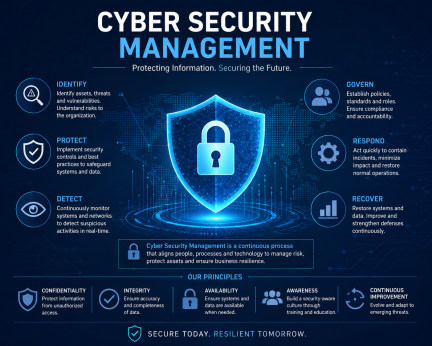
Cyber Security Management Process
- Identify critical business assets.
- Assess cyber risks and vulnerabilities.
- Develop security policies and governance.
- Deploy preventive security controls.
- Continuously monitor systems and networks.
- Detect suspicious activity and threats.
- Respond to security incidents.
- Recover affected systems.
- Review performance and improve security controls.
Cyber security management is an ongoing cycle rather than a one-time project.
Key Components of Cyber Security Management
Effective cyber security management includes multiple layers of protection.
Risk Assessment and Management
Risk assessment helps organizations identify:
- vulnerabilities
- critical assets
- potential attack vectors
- business impact
Security teams prioritize risks based on:
- likelihood
- severity
- operational impact
This allows businesses to focus resources on the most critical threats.
Identity and Access Management (IAM)
Identity management controls who can access systems and data.
Strong IAM practices include:
- multi-factor authentication (MFA)
- least privilege access
- role-based permissions
- single sign-on (SSO)
Limiting unnecessary access reduces insider and external attack risks.
Endpoint Security
Endpoints such as laptops, desktops, mobile devices, and servers are common attack targets.
Modern endpoint security includes:
- endpoint detection and response (EDR)
- behavioral analysis
- malware protection
- ransomware detection
- device monitoring
Endpoint visibility is critical for detecting suspicious activity early.
Network Security
Network security protects internal and external communications.
Common network security measures include:
- firewalls
- intrusion detection systems (IDS)
- intrusion prevention systems (IPS)
- VPNs
- network segmentation
Continuous monitoring helps identify unusual traffic patterns and unauthorized access attempts.
Cloud Security
As businesses adopt cloud platforms, cloud security becomes a core part of cyber security management.
Cloud security focuses on:
- securing workloads
- protecting cloud data
- monitoring cloud activity
- enforcing access policies
Misconfigured cloud environments remain a major cause of data breaches.
Incident Response
No organization is completely immune to cyberattacks.
Incident response planning helps businesses:
- contain attacks quickly
- reduce downtime
- recover systems
- preserve forensic evidence
- improve future defenses
Well-prepared response teams reduce operational disruption during cyber incidents.
Cyber Security Management Framework
Management Framework Overview
| Function | Primary Objective |
|---|---|
| Identify | Discover assets, risks, and vulnerabilities |
| Protect | Implement preventive security controls |
| Detect | Continuously monitor for threats |
| Respond | Contain and investigate incidents |
| Recover | Restore systems and improve resilience |
| Govern | Align cybersecurity with business objectives and compliance requirements |
This lifecycle aligns closely with modern cybersecurity management practices and recognized industry frameworks.
Common Cyber Security Threats Businesses Face
Understanding modern threats helps organizations build stronger security strategies.
Ransomware Attacks
Ransomware encrypts files and demands payment for recovery.
Modern ransomware groups often:
- steal sensitive data
- target backups
- use double extortion tactics
Ransomware attacks can shut down entire operations.
Phishing Attacks
Phishing emails trick employees into:
- revealing credentials
- downloading malware
- clicking malicious links
AI-generated phishing campaigns are becoming harder to detect.
Insider Threats
Employees or contractors may intentionally or accidentally expose sensitive information.
Insider threats often involve:
- weak access controls
- poor password practices
- excessive permissions
Malware and Fileless Attacks
Attackers increasingly use:
- Trojans
- spyware
- rootkits
- fileless malware
to bypass traditional antivirus defenses.
Behavioral analysis helps identify these advanced threats.
Supply Chain Attacks
Cybercriminals may compromise third-party vendors or software providers to gain access to larger targets.
These attacks are growing rapidly across industries.
Risk Management in Cyber Security
An effective risk management process includes:
- Asset identification
- Threat analysis
- Vulnerability assessments
- Risk prioritization
- Security control implementation
- Continuous monitoring
- Regular reassessment
- Executive reporting
Managing cyber risk helps organizations allocate resources where they have the greatest impact.
Benefits of Strong Cyber Security Management
Organizations that invest in cyber security management gain several important advantages.
Reduced Cyber Risk
Strong security controls reduce exposure to:
- malware
- phishing
- ransomware
- unauthorized access
Proactive protection lowers overall business risk.
Faster Threat Detection
Continuous monitoring and behavioral analytics help organizations identify attacks earlier.
Faster detection reduces damage and recovery costs.
Improved Regulatory Compliance
Many industries must comply with:
- GDPR
- HIPAA
- PCI DSS
- SOC 2
- ISO 27001
Cyber security management supports compliance through:
- monitoring
- access controls
- audit logging
- encryption
Better Business Continuity
Strong security management minimizes downtime caused by:
- ransomware
- system outages
- data breaches
This helps organizations maintain productivity and customer trust.
Enhanced Customer Confidence
Customers increasingly expect businesses to protect their data.
Strong cybersecurity practices improve:
- reputation
- customer loyalty
- trust
especially in industries handling sensitive information.
Cyber Security Management Best Practices
Organizations should follow proven best practices to improve security resilience.
Implement Zero Trust Security
Zero trust assumes no user or device should be automatically trusted.
This approach continuously verifies:
- identities
- devices
- access requests
- user behavior
Zero trust reduces lateral movement inside networks.
Enable Multi-Factor Authentication
MFA adds an extra security layer beyond passwords.
Even if credentials are stolen, attackers cannot easily access systems without secondary verification.
Use Endpoint Detection and Response (EDR)
EDR solutions monitor endpoints continuously for suspicious behavior.
Modern EDR platforms help:
- detect ransomware
- isolate compromised devices
- automate response actions
- improve forensic visibility
Conduct Employee Security Training
Employees remain one of the largest cybersecurity risks.
Training should cover:
- phishing awareness
- password security
- safe browsing habits
- suspicious activity reporting
Security awareness significantly reduces human error.
Keep Systems Updated
Unpatched software vulnerabilities remain a major attack vector.
Organizations should:
- apply patches promptly
- remove unsupported software
- monitor vulnerabilities continuously
Develop an Incident Response Plan
Businesses should establish:
- communication procedures
- recovery workflows
- backup strategies
- forensic investigation processes
before incidents occur.
Preparation improves recovery speed and reduces chaos during attacks.
Security Metrics and KPIs
Key Cyber Security Metrics
- Mean Time to Detect (MTTD)
- Mean Time to Respond (MTTR)
- Patch compliance rate
- Number of critical vulnerabilities
- Security awareness training completion
- Phishing simulation success rate
- Incident volume
- Endpoint coverage
- Backup recovery success
- Compliance audit results
Tracking these metrics helps demonstrate security maturity and identify areas for improvement.
The Role of AI in Cyber Security Management
Artificial intelligence is transforming modern cybersecurity operations.
AI-powered cyber security management tools help organizations:
- detect anomalies
- automate threat analysis
- reduce false positives
- identify zero-day attacks
- improve incident response speed
Machine learning systems analyze massive amounts of security data much faster than human analysts.
This improves:
- threat visibility
- response efficiency
- operational scalability
AI-driven cybersecurity is becoming increasingly important as attack complexity grows.
AI and Automation in Cyber Security Management
Artificial intelligence improves cyber security management by helping organizations:
- Detect anomalous behavior
- Prioritize security alerts
- Predict emerging risks
- Automate routine investigations
- Accelerate incident response
- Improve threat intelligence
- Reduce false positives
- Optimize security operations
AI enables security teams to focus on high-priority threats while improving operational efficiency.
Cyber Security Management Challenges
Despite its importance, organizations still face major cybersecurity management challenges.
Security Skill Shortages
Many businesses struggle to hire experienced cybersecurity professionals.
This creates operational pressure on internal teams.
Complex IT Environments
Modern infrastructures include:
- cloud platforms
- remote devices
- IoT systems
- hybrid networks
Managing security across complex environments is difficult.
Evolving Threat Landscape
Attackers constantly develop:
- new malware variants
- phishing techniques
- AI-assisted attacks
- evasion tactics
Organizations must continuously adapt defenses.
Budget Constraints
Some businesses lack the resources needed for advanced security technologies and staffing.
However, the cost of cyberattacks often exceeds the cost of prevention.
Future Trends in Cyber Security Management
Cyber security management continues evolving rapidly.
Key trends include:
- AI-driven threat detection
- automated incident response
- zero trust security
- cloud-native protection
- extended detection and response (XDR)
- behavioral analytics
- identity-first security
Organizations adopting proactive cybersecurity strategies will be better prepared for future threats.
Why Endpoint Security Is Essential for Cyber Security Management
Endpoints are often the first target in cyberattacks.
Compromised devices can:
- spread ransomware
- steal credentials
- bypass network defenses
- access sensitive cloud resources
Modern cyber security management should include:
- endpoint visibility
- behavioral monitoring
- ransomware protection
- automated threat response
to strengthen overall security posture.
Conclusion
Cyber threats are evolving faster than ever, making cyber security management essential for modern businesses. Organizations must protect endpoints, networks, cloud environments, and sensitive data while continuously monitoring for advanced threats.
Strong cyber security management combines:
- risk assessment
- endpoint protection
- identity security
- incident response
- behavioral analytics
- employee awareness
to reduce cyber risks and improve resilience.
Businesses that invest in proactive cybersecurity strategies today will be better prepared to defend against tomorrow’s increasingly sophisticated attacks.
Ready to strengthen your endpoint visibility and cyber security management strategy?
Get started with Xcitium OpenEDR today:
https://openedr.platform.xcitium.com/register/
Frequently Asked Questions
What is cyber security management?
Cyber security management is the process of protecting digital systems, networks, applications, and data through security policies, monitoring, threat detection, and incident response.
Why is cyber security management important?
Cyber security management helps organizations reduce cyber risks, prevent data breaches, improve compliance, and respond quickly to attacks.
What are the main components of cyber security management?
Key components include risk management, endpoint security, identity management, network security, cloud security, and incident response.
How does AI improve cyber security management?
AI improves cyber security management by automating threat detection, reducing false positives, analyzing behavioral patterns, and accelerating incident response.
What industries need cyber security management?
All industries handling digital systems or sensitive data—including healthcare, finance, retail, manufacturing, and government—need strong cyber security management.

 Loading...