
Updated on April 21, 2026, by OpenEDR
In today’s digital world, DNS security is no longer optional—it’s essential. Every time you visit a website, send an email, or connect to an application, the Domain Name System (DNS) is working behind the scenes. But what happens when attackers exploit it? Without proper DNS security, your organization becomes vulnerable to phishing, malware, and data breaches.
So, how can you protect your network and sensitive data? Let’s break it down.
What Is DNS Security?
DNS security refers to the strategies, tools, and best practices used to protect DNS infrastructure from cyber threats. Since DNS acts like the internet’s phonebook—translating domain names into IP addresses—it’s a prime target for attackers.
When DNS is compromised, users can be redirected to malicious websites without even realizing it. This makes DNS security a critical layer in any cybersecurity strategy.
Key Components
- DNSSEC
- DNS Filtering
- Encrypted DNS (DoH, DoT)
- Threat Intelligence
- DNS Monitoring
- DNS Logging
- Access Control
- Policy Enforcement
How DNS Security Protects Organizations
- User enters a domain name.
- Recursive resolver receives the query.
- DNS filtering checks domain reputation.
- DNSSEC validates response authenticity.
- Threat intelligence blocks malicious domains.
- Secure resolver returns trusted IP address.
- Continuous monitoring logs suspicious activity.
Why DNS Security Matters More Than Ever
Cyberattacks are becoming more sophisticated. Hackers often exploit DNS because it is widely trusted and rarely monitored closely.
Here’s why DNS security is crucial:
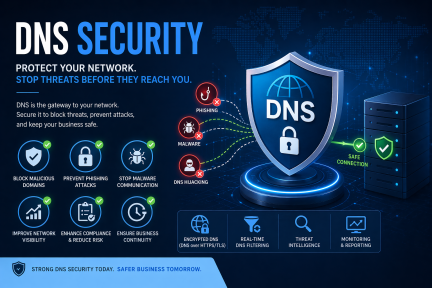
- Prevents phishing attacks by blocking malicious domains
- Stops malware communication before it spreads
- Protects sensitive data from exfiltration
- Improves network visibility for IT teams
- Reduces attack surface across your organization
For IT managers and business leaders, investing in DNS security means reducing risk and ensuring business continuity.
Common DNS Security Threats
Understanding threats is the first step toward protection. Below are the most common DNS-related attacks:
1. DNS Spoofing (Cache Poisoning)
Attackers manipulate DNS records to redirect users to fake websites.
2. DNS Tunneling
Hackers use DNS queries to secretly transfer data out of a network.
3. DDoS Attacks on DNS Servers
Overloading DNS servers can make websites and services unavailable.
4. Phishing via DNS Hijacking
Users are redirected to malicious sites that steal credentials.
5. Fast Flux Attacks
Attackers frequently change IP addresses to evade detection.
These threats highlight why DNS security should be a top priority for organizations of all sizes.
How DNS Security Works
DNS security uses multiple layers to detect and prevent threats. It combines filtering, monitoring, and advanced analytics.
Key Components of DNS Security:
- DNS Filtering: Blocks access to malicious domains
- Threat Intelligence: Identifies known bad IPs and domains
- Encryption (DNS over HTTPS/TLS): Protects DNS queries from interception
- Monitoring & Logging: Tracks suspicious activity
- Access Controls: Limits who can modify DNS settings
Together, these elements create a strong defense against cyber threats.
Best Practices for DNS Security
Implementing DNS security doesn’t have to be complicated. Follow these proven strategies:
1. Use DNS Filtering Solutions
Block malicious domains before users can access them.
2. Enable DNSSEC (Domain Name System Security Extensions)
This ensures DNS responses are authentic and not tampered with.
3. Monitor DNS Traffic Regularly
Look for unusual patterns that could indicate an attack.
4. Restrict DNS Access
Limit who can change DNS configurations.
5. Keep Systems Updated
Patch vulnerabilities that attackers might exploit.
6. Train Employees
Human error is a major cause of breaches. Awareness reduces risk.
DNS Security vs DNSSEC
| DNS Security | DNSSEC |
|---|---|
| Overall strategy for protecting DNS | Cryptographic protocol |
| Includes filtering, monitoring, encryption | Validates DNS responses |
| Prevents multiple attack types | Prevents spoofing and cache poisoning |
| Enterprise-wide security approach | One layer of DNS protection |
DNSSEC Explained
What Is DNSSEC?
DNS Security Extensions (DNSSEC) digitally sign DNS records to verify that responses come from legitimate authoritative servers and have not been altered in transit.
Benefits
- Prevents spoofing
- Prevents cache poisoning
- Validates DNS authenticity
- Improves trust
NIST recommends DNSSEC as a key control for protecting the integrity and authenticity of DNS information.
Encrypted DNS (DoH, DoT, DoQ)
Encrypted DNS Protocols
| Protocol | Purpose |
|---|---|
| DNS over HTTPS (DoH) | Encrypts DNS queries over HTTPS |
| DNS over TLS (DoT) | Encrypts DNS using TLS |
| DNS over QUIC (DoQ) | Faster encrypted DNS over QUIC |
Explain:
- Privacy benefits
- Performance considerations
- Enterprise deployment scenarios
Protective DNS (PDNS)
What Is Protective DNS?
Protective DNS blocks access to known malicious domains before users connect.
Protective DNS helps stop
- Phishing
- Malware downloads
- Botnet communication
- Ransomware
- Command-and-control traffic
Protective DNS is increasingly recommended as part of a defense-in-depth strategy.
DNS Filtering
How DNS Filtering Works
DNS filtering checks requested domains against threat intelligence feeds before allowing DNS resolution.
It can block:
- Malware domains
- Phishing websites
- Newly registered domains
- Command-and-control servers
- Risky categories
DNS Security for Businesses and Enterprises
For organizations, DNS security is more than just protection—it’s a strategic advantage.
Benefits for Businesses:
- Improved cybersecurity posture
- Reduced downtime and financial losses
- Better compliance with regulations
- Enhanced customer trust
Industries like finance, healthcare, and e-commerce rely heavily on DNS security to safeguard operations.
DNS Security vs Traditional Security Measures
| Feature | DNS Security | Traditional Security |
|---|---|---|
| Threat Detection | Early-stage | After infection |
| Network Visibility | High | Moderate |
| Malware Prevention | Proactive | Reactive |
| Deployment Complexity | Low | Medium |
DNS security works as a first line of defense, stopping threats before they reach endpoints.
DNS Monitoring and Logging
Why DNS Monitoring Matters
DNS logs help security teams detect:
- Data exfiltration
- Malware beaconing
- DNS tunneling
- Suspicious domains
- Insider threats
- Botnet activity
NIST recommends DNS logging and monitoring as part of secure DNS deployment.
Actionable Tips to Strengthen DNS Security Today
If you want immediate improvements, start here:
- Audit your current DNS settings
- Switch to a secure DNS provider
- Enable logging and alerts
- Use endpoint protection tools
- Regularly review DNS policies
Small changes can make a big difference in your security posture.
The Future of DNS Security
As cyber threats evolve, DNS security is becoming more advanced. AI-driven threat detection and zero-trust architectures are shaping the future.
Organizations that adopt modern DNS security solutions will be better prepared to handle emerging threats.
DNS Security and Zero Trust
DNS supports Zero Trust by:
- Acting as a policy enforcement point
- Providing telemetry for access decisions
- Blocking malicious destinations
- Enforcing secure access policies
Recent NIST guidance explicitly highlights DNS as both a policy enforcement point and a valuable source of security telemetry in Zero Trust environments.
Common DNS Attack Indicators
Signs of a DNS Attack
- Slow DNS resolution
- Unexpected redirects
- DNS query spikes
- Unknown DNS records
- Suspicious TXT records
- Large outbound DNS traffic
- Failed DNSSEC validation
- Unusual domain lookups
DNS Security Tools
| Tool | Purpose |
|---|---|
| DNS Filtering | Block malicious domains |
| DNS Firewall | Prevent DNS-based attacks |
| DNSSEC | Authenticate responses |
| SIEM | Analyze DNS logs |
| Threat Intelligence | Identify malicious domains |
| DNS Monitoring | Detect anomalies |
| Endpoint Detection and Response (EDR) | Correlate DNS events with endpoint activity |
Conclusion: Secure Your Network with DNS Security
Ignoring DNS security is like leaving your front door unlocked. Attackers are constantly looking for weak points, and DNS is one of the most targeted.
By implementing the right tools and best practices, you can protect your organization from costly cyberattacks.
👉 Take action now:
Secure your endpoints and network with advanced protection.
Get started here: https://openedr.platform.xcitium.com/register/
FAQs About DNS Security
1. What is DNS security in simple terms?
DNS security protects the system that translates website names into IP addresses, preventing cyber threats like phishing and malware.
2. Why is DNS security important for businesses?
It helps prevent data breaches, downtime, and financial losses by blocking threats early.
3. How does DNS filtering work?
DNS filtering blocks access to malicious or unsafe domains before a connection is established.
4. Can DNS security stop ransomware?
Yes, it can block communication between ransomware and its command-and-control servers.
5. Is DNSSEC enough for complete protection?
No, DNSSEC is important but should be combined with other DNS security measures for full protection.

 Loading...