Updated on August 13, 2026, by OpenEDR
Cyberattacks are no longer a matter of if—but when. That’s why SOC cyber security has become a critical priority for organizations of all sizes. Whether you’re an IT manager, CEO, or security professional, understanding how a Security Operations Center (SOC) works can help you stay ahead of evolving threats.
In today’s digital landscape, businesses face ransomware, phishing, and advanced persistent threats daily. Without a structured defense system, these risks can disrupt operations, damage reputation, and cause financial losses. This is where SOC cyber security plays a vital role.
What is SOC Cyber Security?
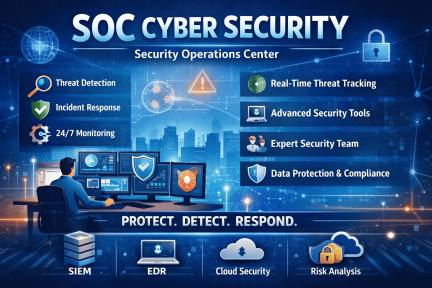
SOC cyber security refers to a centralized function where security teams monitor, detect, analyze, and respond to cybersecurity incidents in real time. A SOC acts as the nerve center of an organization’s security posture.
A typical SOC includes:
- Security analysts
- Threat intelligence tools
- Monitoring systems
- Incident response processes
The goal is simple: identify threats early and respond quickly before damage occurs.
Why SOC Cyber Security is Essential Today
Modern cyber threats are more sophisticated than ever. Traditional security tools alone are not enough. SOC cyber security provides continuous monitoring and rapid response, which are essential for minimizing risks.
Key Benefits:
- 24/7 threat monitoring
- Faster incident detection and response
- Improved compliance with regulations
- Reduced downtime and financial loss
Organizations that invest in SOC cyber security gain a strong defense against both external and internal threats.
What Does a SOC Do?
IBM’s competitor page provides much greater operational detail than a simple definition, including asset inventories, preventive maintenance, continuous monitoring, log management, and response.
How a SOC Works
Understanding how SOC cyber security operates can help you appreciate its importance.
1. Monitoring
SOC teams continuously monitor networks, endpoints, and systems for suspicious activity.
2. Detection
Advanced tools identify unusual patterns, such as unauthorized access or malware behavior.
3. Analysis
Security analysts investigate alerts to determine if they are real threats.
4. Response
Once a threat is confirmed, the SOC team takes action to contain and eliminate it.
5. Recovery
Systems are restored, and lessons are documented to prevent future attacks.
What Does a Security Operations Center Do?
A Security Operations Center continuously watches an organization’s technology environment for indicators of cyber threats.
Core SOC responsibilities include:
- Continuous monitoring – Monitor endpoints, networks, identities, cloud resources, applications, and security events.
- Alert triage – Determine whether security alerts represent genuine threats or false positives.
- Threat detection – Identify suspicious behavior, malware, compromised accounts, and attack patterns.
- Investigation – Analyze logs, endpoint telemetry, network activity, and threat intelligence.
- Incident response – Contain and remediate confirmed security incidents.
- Threat hunting – Proactively search for threats that automated controls may not have detected.
- Vulnerability awareness – Identify weaknesses that attackers could exploit.
- Threat intelligence – Use information about attackers, indicators, vulnerabilities, and campaigns to improve detection.
- Reporting – Document incidents, trends, risks, and SOC performance.
- Continuous improvement – Refine detection rules, playbooks, tools, and processes based on previous incidents.
An effective SOC does more than wait for alerts. It continuously improves the organization’s ability to prevent, detect, investigate, and respond to attacks.
What Are SOC Tier 1, Tier 2, and Tier 3 Analysts?
Traditional SOC teams often organize analysts into tiers according to investigation complexity.
Tier 1: Alert Triage
Tier 1 analysts:
- Monitor alerts.
- Perform initial validation.
- Gather basic evidence.
- Identify obvious false positives.
- Escalate credible threats.
Tier 2: Investigation
Tier 2 analysts:
- Perform deeper analysis.
- Investigate affected endpoints and accounts.
- Correlate multiple security signals.
- Determine incident scope.
- Recommend containment actions.
Tier 3: Advanced Analysis
Tier 3 analysts may handle:
- Advanced threat hunting
- Complex malware investigations
- Attack reconstruction
- Detection engineering
- Sophisticated intrusion analysis
- High-severity incidents
Not every modern SOC follows a strict tier model. Automation and integrated security platforms increasingly allow teams to organize around specialized functions rather than rigid escalation tiers.
Key Components of SOC Cyber Security
A strong SOC cyber security framework relies on multiple components working together.
People
- Skilled security analysts
- Incident response teams
- Threat hunters
Processes
- Incident response plans
- Threat intelligence workflows
- Compliance procedures
Technology
- SIEM (Security Information and Event Management)
- EDR (Endpoint Detection and Response)
- Firewalls and intrusion detection systems
Types of SOC Models
Not all SOCs are the same. Businesses can choose different models based on their needs.
1. In-House SOC
Managed internally by the organization. Offers full control but requires high investment.
2. Managed SOC (MSSP)
Outsourced to a third-party provider. Cost-effective and scalable.
3. Hybrid SOC
Combines internal teams with external expertise for flexibility.
Each model supports SOC cyber security differently depending on resources and goals.
Common Threats Handled by SOC Cyber Security
A SOC is designed to handle a wide range of cyber threats, including:
- Ransomware attacks
- Phishing and social engineering
- Malware and spyware
- Insider threats
- DDoS attacks
By using SOC cyber security, organizations can detect these threats early and prevent major damage.
Best Practices for Effective SOC Cyber Security
To maximize the benefits of SOC cyber security, follow these best practices:
Implement Continuous Monitoring
Ensure 24/7 visibility across all systems and networks.
Use Advanced Security Tools
Invest in SIEM, EDR, and threat intelligence platforms.
Train Your Security Team
Keep analysts updated with the latest threat trends.
Automate Where Possible
Automation reduces response time and human error.
Conduct Regular Audits
Test your SOC’s effectiveness through simulations and penetration testing.
SIEM vs EDR vs XDR vs SOAR
This is one of the most important semantic gaps. Modern security-operations coverage increasingly explains these tools together. IBM notes SIEM’s traditional central role in SOC monitoring and the increasing adoption of XDR, while current technical coverage also treats EDR, SIEM, and SOAR as complementary components of enterprise security operations.
SIEM vs EDR vs XDR vs SOAR in SOC Cyber Security
| Technology | Primary Role | How the SOC Uses It |
|---|---|---|
| SIEM | Centralizes and analyzes security logs | Detection, correlation, investigation, compliance |
| EDR | Monitors endpoint activity | Endpoint detection, investigation, containment |
| XDR | Correlates security signals across multiple domains | Cross-domain detection and response |
| SOAR | Automates security workflows | Enrichment, orchestration, response playbooks |
| Threat Intelligence | Provides information about threats | Enrichment and detection improvement |
| NDR | Monitors network behavior | Detects suspicious network activity |
These technologies are complementary.
For example, an EDR platform may identify suspicious behavior on an employee’s laptop. SIEM can correlate that event with identity and cloud logs, while SOAR can automate enrichment and predefined response actions. XDR can help connect related activity across multiple security domains.
Challenges in SOC Cyber Security
While powerful, SOC cyber security comes with challenges:
- High operational costs
- Shortage of skilled professionals
- Alert fatigue from too many notifications
- Integration issues between tools
Addressing these challenges requires strategic planning and the right technology stack.
Future of SOC Cyber Security
The future of SOC cyber security is driven by automation and AI. Organizations are moving toward:
- AI-powered threat detection
- Automated incident response
- Cloud-based SOC solutions
- Zero Trust security models
These advancements will make SOCs faster, smarter, and more efficient.
SOC vs SIEM: What’s the Difference?
A SOC is a security function or team, while a SIEM is a technology used by security teams.
| SOC | SIEM |
|---|---|
| People, processes, and technology | Security technology |
| Monitors cyber risk | Collects and analyzes logs |
| Investigates threats | Correlates security events |
| Responds to incidents | Generates alerts and investigation data |
| Includes analysts and responders | Used by analysts and security tools |
A SIEM can be an important part of a SOC, but purchasing a SIEM does not automatically create an effective Security Operations Center.
Actionable Tips for Businesses
If you’re planning to implement SOC cyber security, start with these steps:
- Assess your current security posture
- Choose the right SOC model
- Invest in modern security tools
- Build or outsource a skilled team
- Continuously monitor and improve
SOC vs NOC: What’s the Difference?
| Security Operations Center (SOC) | Network Operations Center (NOC) |
|---|---|
| Focuses on cybersecurity | Focuses on network and IT availability |
| Detects cyber threats | Detects outages and performance problems |
| Investigates malicious activity | Troubleshoots operational issues |
| Responds to security incidents | Restores service availability |
| Monitors security telemetry | Monitors infrastructure performance |
| Protects confidentiality and integrity | Prioritizes uptime and performance |
SOC and NOC teams may collaborate during incidents where security problems also affect network or system availability.
SOC vs NOC: What’s the Difference?
| Security Operations Center (SOC) | Network Operations Center (NOC) |
|---|---|
| Focuses on cybersecurity | Focuses on network and IT availability |
| Detects cyber threats | Detects outages and performance problems |
| Investigates malicious activity | Troubleshoots operational issues |
| Responds to security incidents | Restores service availability |
| Monitors security telemetry | Monitors infrastructure performance |
| Protects confidentiality and integrity | Prioritizes uptime and performance |
SOC and NOC teams may collaborate during incidents where security problems also affect network or system availability.
Important SOC Cyber Security Metrics
A SOC should measure outcomes, not simply the number of alerts processed.
| Metric | What It Measures |
|---|---|
| Mean Time to Detect (MTTD) | How quickly threats are identified |
| Mean Time to Acknowledge (MTTA) | How quickly alerts receive attention |
| Mean Time to Contain (MTTC) | How quickly threats are restricted |
| Mean Time to Respond/Remediate (MTTR) | How quickly incidents are addressed |
| False Positive Rate | How many alerts are not genuine threats |
| Escalation Rate | How frequently alerts require deeper investigation |
| Alert Backlog | Number of alerts awaiting investigation |
| Detection Coverage | How well controls cover relevant attack techniques |
| Incident Recurrence | How often similar incidents return |
Metrics should lead to action. For example, consistently high false-positive rates may indicate that detection rules need tuning, while long containment times may expose gaps in automation, tooling, or decision authority.
Conclusion
In a world where cyber threats are constantly evolving, SOC cyber security is no longer optional—it’s essential. It provides the visibility, control, and response capabilities needed to protect your organization from modern attacks.
By implementing a strong SOC strategy, businesses can reduce risks, improve resilience, and maintain trust with customers.
FAQs on SOC Cyber Security
1. What does SOC stand for in cyber security?
SOC stands for Security Operations Center, a centralized unit that monitors and manages security threats.
2. Is SOC cyber security only for large enterprises?
No, businesses of all sizes can benefit from SOC solutions, especially through managed SOC services.
3. What tools are used in SOC cyber security?
Common tools include SIEM, EDR, firewalls, intrusion detection systems, and threat intelligence platforms.
4. How much does a SOC cost?
Costs vary depending on the model. In-house SOCs are expensive, while managed SOCs are more affordable.
5. Can SOC prevent all cyberattacks?
No system can prevent all attacks, but SOC significantly reduces risk by detecting and responding quickly.
Get Started with Advanced Security Today
Protect your organization with cutting-edge SOC capabilities and real-time threat detection.
👉 Register now: https://openedr.platform.xcitium.com/register/

 Loading...