
Updated on August 21, 2026, by OpenEDR
Are your current security systems keeping up with modern threats, remote work, and cloud environments? Many organizations struggle to secure distributed networks—and that’s where SASE solutions come in.
SASE solutions (Secure Access Service Edge) combine networking and security into a single cloud-based framework. For IT managers, cybersecurity teams, and business leaders, adopting SASE solutions is becoming essential to protect data, users, and applications in today’s digital-first world.
What Are SASE Solutions?
SASE solutions, or Secure Access Service Edge solutions, combine networking and security capabilities into a cloud-delivered architecture that securely connects users, devices, branches, cloud services, and applications.
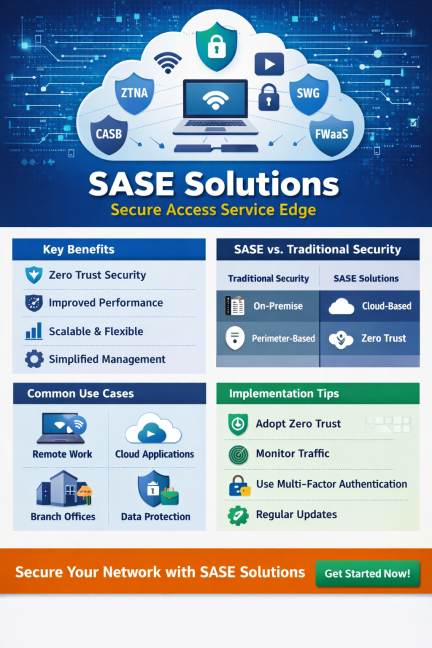
Instead of forcing organizations to operate separate networking and security products, SASE brings technologies such as SD-WAN, Zero Trust Network Access (ZTNA), Secure Web Gateway (SWG), Cloud Access Security Broker (CASB), and Firewall as a Service (FWaaS) into an integrated architecture.
SASE is particularly useful for businesses supporting remote employees, branch offices, SaaS applications, public clouds, private applications, and hybrid work.
Cisco similarly defines SASE as a cloud-delivered architecture combining SD-WAN with security services under consistent policy and visibility.
SASE solutions are a cloud-delivered security model that integrates networking and security services into a unified platform. Instead of relying on traditional perimeter-based security, SASE solutions provide protection closer to users and devices.
Key Components of SASE Solutions
- Secure Web Gateway (SWG) – Filters web traffic
- Cloud Access Security Broker (CASB) – Secures cloud applications
- Zero Trust Network Access (ZTNA) – Verifies user access
- Firewall as a Service (FWaaS) – Provides cloud-based firewall protection
- Software-Defined WAN (SD-WAN) – Optimizes network performance
These components work together to deliver seamless and secure access across distributed environments.
What Does SASE Stand For?
SASE stands for Secure Access Service Edge.
The architecture moves networking and security controls closer to users, applications, devices, and cloud resources rather than depending exclusively on traditional data-center security appliances.
SASE is built around two major technology areas:
Networking
- SD-WAN
- Traffic optimization
- Dynamic routing
- Branch connectivity
Security
- ZTNA
- SWG
- CASB
- FWaaS
- Threat prevention
- Data protection
The important idea is convergence.
A true SASE strategy is not simply purchasing five unrelated products and calling them SASE. The capabilities should work together through common policies, visibility, management, and cloud-delivered enforcement.
Why Businesses Need SASE Solutions
Modern businesses are no longer confined to a single office. Employees work remotely, use cloud apps, and access sensitive data from anywhere. Traditional security models struggle to keep up.
Key Benefits of SASE Solutions
- Enhanced Security
SASE solutions enforce Zero Trust policies, ensuring only verified users gain access. - Improved Performance
Cloud-based delivery reduces latency and improves user experience. - Scalability
Easily adapts to growing business needs. - Simplified Management
Combines multiple tools into one platform. - Cost Efficiency
Reduces infrastructure and maintenance costs.
👉 For enterprises, SASE solutions provide a smarter and more flexible approach to cybersecurity.
How SASE Solutions Work
Understanding how SASE solutions function helps organizations implement them effectively.
Step-by-Step Workflow
- User requests access to an application
- Identity verification is performed (Zero Trust)
- Traffic is routed through secure cloud gateways
- Security policies are applied in real time
- Access is granted or denied based on risk
This process ensures secure access without compromising performance.
SASE Architecture: Control Plane vs. Data Plane
A useful technical section missing from many introductory SASE pages is how policy management differs from policy enforcement.
Control Plane
The control plane manages:
- Security policies
- Networking policies
- Configuration
- Orchestration
- Identity rules
- Administration
Data Plane
The data plane handles traffic and enforces those policies.
Depending on the platform, enforcement may include:
- Firewall rules
- Threat inspection
- URL filtering
- DLP
- CASB controls
- Application access
- Network routing
Palo Alto Networks describes modern SASE architecture using this separation: the control plane manages policy and orchestration, while the data plane applies those policies to traffic.
SASE vs Traditional Security Models
Traditional security relies on centralized data centers, while SASE solutions are cloud-native.
| Feature | Traditional Security | SASE Solutions |
|---|---|---|
| Deployment | On-premise | Cloud-based |
| Scalability | Limited | Highly scalable |
| Security Model | Perimeter-based | Zero Trust |
| Performance | Slower | Optimized |
| Remote Access | Complex | Seamless |
👉 This shift is why many organizations are moving toward SASE solutions.
Key Use Cases of SASE Solutions
1. Remote Workforce Security
Employees working remotely can securely access company resources without VPN limitations.
2. Cloud Application Protection
SASE solutions secure SaaS apps like Microsoft 365, Google Workspace, and others.
3. Branch Office Connectivity
Simplifies network management across multiple locations.
4. Data Protection
Ensures sensitive data remains secure regardless of location.
SASE vs. VPN
Traditional VPNs remain useful in some environments, but SASE and ZTNA introduce a different access model.
| Traditional VPN | SASE/ZTNA |
|---|---|
| Often connects users to a network | Can connect users directly to authorized applications |
| Frequently location/network oriented | Identity and context oriented |
| May provide broader network access | Supports granular application access |
| Often backhauls traffic | Cloud enforcement can reduce unnecessary backhaul |
| Primarily remote-access focused | Covers users, branches, cloud and applications |
| Usually separate from other controls | Integrates multiple security services |
ZTNA does not necessarily eliminate every VPN use case immediately. Organizations often migrate gradually based on application requirements.
Challenges in Implementing SASE Solutions
While SASE solutions offer many benefits, adoption can be complex.
Common Challenges
- Integration with existing systems
- Initial setup complexity
- Vendor selection confusion
- User training requirements
How to Overcome These Challenges
- Start with a phased rollout
- Choose a reliable vendor
- Train IT teams and employees
- Monitor performance continuously
Best Practices for Implementing SASE Solutions
To maximize the benefits of SASE solutions, follow these best practices:
Implementation Tips
- Adopt a Zero Trust architecture
- Monitor network activity in real time
- Use strong authentication (MFA)
- Regularly update security policies
- Integrate with endpoint protection tools
👉 A layered approach ensures stronger security.
SASE vs. Zero Trust
SASE and Zero Trust are also related but different.
Zero Trust is a security strategy.
SASE is an architecture that can help implement Zero Trust principles.
Zero Trust emphasizes:
- Explicit verification
- Least privilege
- Context-aware access
- Continuous assessment
SASE provides technologies such as ZTNA, identity-aware policy, SWG, CASB, and FWaaS that can help enforce those principles.
Future of SASE Solutions
The demand for SASE solutions is growing rapidly as businesses shift to cloud-first strategies.
Emerging Trends
- AI-driven threat detection
- Deeper cloud integration
- Enhanced user identity verification
- Automated security responses
Organizations adopting SASE solutions early gain a competitive advantage in security and performance.
How to Choose a SASE Solution
Do not select SASE based only on the longest feature list.
Evaluate how well the architecture matches actual business requirements.
1. Define Your Use Cases
Determine whether your priorities are:
- Remote access
- Branch modernization
- VPN replacement
- SaaS security
- Cloud access
- SD-WAN
- Data protection
- Security consolidation
2. Evaluate Networking Capabilities
Look at:
- SD-WAN maturity
- Traffic steering
- Routing
- Resilience
- Branch support
- Application optimization
3. Evaluate Security Depth
Review:
- ZTNA
- SWG
- CASB
- FWaaS
- Threat prevention
- DLP
- DNS security
4. Evaluate Identity Integration
The platform should integrate effectively with the organization’s identity infrastructure.
5. Examine the PoP Architecture
Performance depends partly on where security inspection occurs.
Evaluate:
- PoP locations
- Global coverage
- Redundancy
- Service availability
- Connectivity to cloud providers
6. Measure User Experience
Security should not create unacceptable latency.
Test:
- Web performance
- SaaS performance
- Private application access
- Video conferencing
- Branch traffic
7. Evaluate Unified Management
Gartner lists centralized management covering SASE capabilities—with both GUI and API support—as a mandatory platform feature.
Look for:
- Unified policy
- Centralized logs
- Reporting
- Troubleshooting
- APIs
- Role-based administration
8. Evaluate Data Protection
Consider DLP, SaaS controls, sensitive-data policies, and AI application visibility.
9. Test Before Migrating
Run a pilot with representative:
- Users
- Applications
- Branches
- Devices
- Regions
Why SASE Solutions Matter for Cybersecurity Leaders
For IT managers and business leaders, SASE solutions offer a unified approach to security and networking.
Key Takeaways
- Simplifies complex security environments
- Reduces risk of cyberattacks
- Improves operational efficiency
- Supports remote and hybrid work models
👉 Investing in SASE solutions is a strategic move for long-term security.
Common SASE Implementation Mistakes
Avoid these problems:
- Treating SASE as a single appliance.
- Buying products before defining use cases.
- Ignoring SD-WAN quality.
- Ignoring SSE security depth.
- Assuming every SASE vendor has identical capabilities.
- Failing to test PoP performance.
- Migrating all applications simultaneously.
- Ignoring legacy applications.
- Failing to integrate identity systems.
- Focusing only on security and ignoring user experience.
Gartner continues to note meaningful differentiation among SASE vendors even as the market matures.
How to Measure SASE Success
Add this section because it moves the article beyond basic definitions.
| Metric | What It Measures |
|---|---|
| Application latency | User experience |
| VPN reduction | ZTNA migration progress |
| Security-tool reduction | Consolidation |
| Policy consistency | Operational simplification |
| Threats blocked | Security effectiveness |
| SaaS visibility | Cloud governance |
| Branch deployment time | Operational agility |
| Help-desk tickets | User impact |
| Mean time to resolve issues | Administrative efficiency |
| DLP incidents | Data-security risk |
SASE success should be measured across security, networking, operations, and user experience.
Conclusion
SASE solutions are transforming how organizations approach cybersecurity. By combining networking and security into a single cloud-based framework, they provide a scalable, efficient, and secure solution for modern businesses.
As cyber threats evolve and work environments become more distributed, adopting SASE solutions is no longer optional—it’s essential.
Take your cybersecurity to the next level with advanced endpoint protection.
👉 Get started today: https://openedr.platform.xcitium.com/register/
FAQs
What are SASE solutions?
SASE solutions are cloud-based security frameworks that combine networking and security services to provide secure access to applications and data.
Why are SASE solutions important?
They protect distributed networks, improve performance, and simplify security management for modern businesses.
How do SASE solutions improve security?
They use Zero Trust principles, real-time monitoring, and cloud-based protection to prevent unauthorized access and cyber threats.
Are SASE solutions suitable for small businesses?
Yes, SASE solutions are scalable and can benefit businesses of all sizes.
What is the difference between SASE and VPN?
Unlike VPNs, SASE solutions provide cloud-native, secure, and scalable access without relying on centralized infrastructure.

 Loading...