
Updated on February 5, 2026, by OpenEDR
What happens when your cloud infrastructure grows faster than your security strategy?
For many organizations, this gap creates serious risks. As businesses migrate critical workloads to the cloud, the role of a cloud security architect has become essential. Without the right architecture in place, misconfigurations, identity misuse, and data exposure can quickly turn into costly breaches.
A cloud security architect designs, implements, and maintains secure cloud environments that support business growth without compromising security. In this guide, we’ll explore what the role involves, why it matters, key skills required, and how organizations can benefit from cloud security architecture done right.
What Is a Cloud Security Architect?
A cloud security architect is a cybersecurity professional responsible for designing secure cloud infrastructures and ensuring that security controls are built into cloud platforms from the ground up.
Unlike traditional security roles, a cloud security architect focuses specifically on:
Public, private, and hybrid cloud environments
Identity and access management (IAM)
Cloud-native security services
Compliance and governance in the cloud
Their job is not just to react to threats, but to architect security proactively so risks are minimized before attackers can exploit them.
Why the Cloud Security Architect Role Is Critical Today
Cloud adoption has transformed how organizations operate—but it has also introduced new security challenges.
Key reasons this role matters:
Rapid cloud adoption increases attack surfaces
Misconfigured cloud resources remain a top cause of breaches
Shared responsibility models create confusion
Compliance requirements continue to expand
A skilled cloud security architect helps organizations navigate these challenges by aligning cloud security with business objectives while maintaining strong defenses.
Core Responsibilities of a Cloud Security Architect
A cloud security architect plays a strategic and technical role across the organization.
Primary responsibilities include:
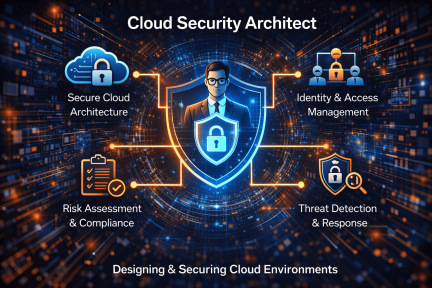
1. Secure Cloud Architecture Design
Designing secure cloud frameworks that align with Zero Trust and least privilege principles.
2. Identity and Access Management
Implementing strong IAM policies to control who can access cloud resources and under what conditions.
3. Risk Assessment and Threat Modeling
Identifying potential threats and vulnerabilities within cloud environments before deployment.
4. Security Tool Integration
Integrating firewalls, CASB, CSPM, SIEM, and other cloud-native security tools.
5. Compliance and Governance
Ensuring cloud environments meet regulatory standards such as ISO 27001, SOC 2, HIPAA, and GDPR.
Through these responsibilities, a cloud security architect ensures security is embedded—not bolted on.
Key Skills Every Cloud Security Architect Needs
To be effective, a cloud security architect must combine technical expertise with strategic thinking.
Technical Skills
Deep knowledge of cloud platforms (AWS, Azure, GCP)
Cloud networking and segmentation
Identity and access management (IAM)
Encryption and key management
Cloud workload protection
Security & Architecture Skills
Zero Trust architecture
Secure DevOps (DevSecOps)
Threat modeling and risk analysis
Incident response planning
Business & Communication Skills
Translating security risks into business impact
Collaborating with DevOps, IT, and leadership teams
Designing scalable security strategies
A strong cloud security architect bridges the gap between security teams and business leaders.
Cloud Security Architect vs Traditional Security Architect
While both roles focus on protecting systems, their scope and tools differ significantly.
| Area | Traditional Security Architect | Cloud Security Architect |
|---|---|---|
| Environment Focus | On-premises | Cloud & hybrid |
| Security Controls | Perimeter-based | Identity-based |
| Scalability | Limited | Highly scalable |
| Tooling | Hardware-centric | Cloud-native |
| Deployment Speed | Slower | Rapid |
A cloud security architect adapts security design to the speed and flexibility of modern cloud environments.
Cloud Security Architect and the Shared Responsibility Model
One of the biggest sources of confusion in cloud security is the shared responsibility model. Cloud providers secure the infrastructure, but customers are responsible for securing their data, identities, and configurations.
A cloud security architect ensures:
Clear ownership of security responsibilities
Proper configuration of cloud services
Continuous monitoring and improvement
This clarity prevents dangerous gaps that attackers often exploit.
Best Practices Followed by Cloud Security Architects
Successful cloud security architects follow proven best practices to reduce risk and improve resilience.
Top best practices include:
Enforcing least privilege access
Using multi-factor authentication everywhere
Encrypting data at rest and in transit
Automating security policy enforcement
Continuously monitoring cloud activity
These practices create a strong security foundation that scales with the organization.
Cloud Security Architecture for Different Industries
The role of a cloud security architect varies slightly by industry, but the core principles remain the same.
Healthcare
Protect patient data and meet HIPAA compliance requirements.
Financial Services
Secure transactions, prevent fraud, and meet regulatory standards.
SaaS and Technology
Protect APIs, microservices, and DevOps pipelines.
Manufacturing
Secure cloud-connected OT and IoT environments.
Retail and E-commerce
Protect customer data and payment systems.
Industry knowledge enhances the effectiveness of cloud security architecture.
Common Cloud Security Challenges and How Architects Solve Them
Misconfigurations
Cloud security architects use automated tools and secure templates to reduce human error.
Identity Sprawl
They implement centralized IAM and enforce access reviews.
Visibility Gaps
Security monitoring and logging tools provide real-time insights.
Rapid Change
Infrastructure-as-code and policy automation keep security consistent.
A cloud security architect anticipates these challenges and designs systems to handle them.
The Future of the Cloud Security Architect Role
As cloud environments evolve, so does the role of the cloud security architect.
Key trends shaping the future:
Increased automation and AI-driven security
Deeper integration with DevSecOps
Expanded focus on identity security
Unified security platforms
Organizations that invest in cloud security architecture today are better prepared for tomorrow’s threats.
FAQs About Cloud Security Architects
1. What does a cloud security architect do?
A cloud security architect designs and maintains secure cloud infrastructures, focusing on identity, access control, compliance, and threat prevention.
2. Is a cloud security architect necessary for small businesses?
Yes. Even small organizations face cloud security risks, and proper architecture prevents costly mistakes.
3. What skills are required to become a cloud security architect?
Strong cloud platform knowledge, security architecture skills, IAM expertise, and communication abilities are essential.
4. How does a cloud security architect support compliance?
They design controls, logging, and governance frameworks that align with regulatory requirements.
5. Can a cloud security architect work with hybrid environments?
Absolutely. Most modern cloud security architects specialize in hybrid and multi-cloud environments.
Final Thoughts: Why a Cloud Security Architect Is a Strategic Asset
Cloud adoption without security architecture is a risk most organizations can’t afford. A skilled cloud security architect ensures that security scales with innovation, not against it.
By embedding security into cloud design, organizations gain:
Stronger defenses
Better compliance
Reduced operational risk
Increased confidence in cloud growth
For IT leaders and executives, investing in cloud security architecture is a smart business decision.
Take the Next Step Toward Smarter Cloud Security
Ready to strengthen your cloud security posture with a modern, proactive approach?
👉 Get started today:
https://openedr.platform.xcitium.com/register/
Build securely. Scale confidently. Stay protected.

 Loading...