Updated on December 30, 2025, by OpenEDR
Managing secure access across multiple applications is one of the biggest challenges modern organizations face. Employees expect seamless login experiences, while IT teams must enforce strong authentication and compliance. This is where security assertion markup language plays a critical role.
Security Assertion Markup Language, commonly known as SAML, is a widely adopted standard that enables secure single sign-on (SSO) across enterprise environments. It allows users to authenticate once and gain access to multiple systems without repeatedly entering credentials—while maintaining strong security controls.
In this guide, we’ll explore what security assertion markup language is, how it works, why it matters, and how organizations use it to strengthen identity and access management.
What Is Security Assertion Markup Language?
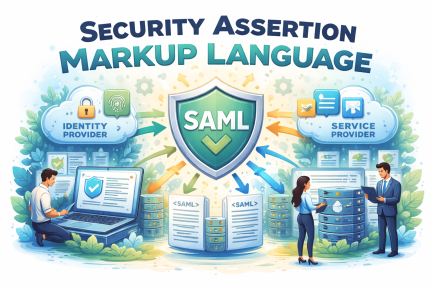
Security assertion markup language (SAML) is an XML-based open standard used for exchanging authentication and authorization data between two parties: an identity provider (IdP) and a service provider (SP).
In simple terms, SAML allows organizations to verify who a user is without sharing passwords between systems. Instead of logging in separately to each application, users authenticate once through a trusted identity provider, and SAML securely passes that authentication information to other services.
This approach improves both security and user experience, making SAML a cornerstone of modern enterprise identity management.
Why Security Assertion Markup Language Is Important
As organizations adopt cloud services, SaaS platforms, and remote work models, identity has become the new security perimeter. Traditional username-password models are no longer sufficient.
Security assertion markup language addresses these challenges by:
Reducing password fatigue
Minimizing credential exposure
Centralizing access control
Supporting compliance requirements
For IT leaders and executives, SAML offers a scalable and standardized way to manage authentication across complex digital ecosystems.
How Security Assertion Markup Language Works
Understanding security assertion markup language is easier when broken into a step-by-step flow.
Key Components of SAML
Identity Provider (IdP): Authenticates users (e.g., Okta, Azure AD)
Service Provider (SP): Hosts the application or service
SAML Assertions: Statements that confirm user identity and permissions
XML Tokens: Secure messages exchanged between IdP and SP
Step-by-Step SAML Authentication Flow
A user attempts to access an application (service provider)
The service provider redirects the user to the identity provider
The user authenticates with the identity provider
The identity provider sends a SAML assertion back
The service provider grants access without requiring a password
This seamless exchange is what enables single sign-on (SSO) using security assertion markup language.
Security Assertion Markup Language and Single Sign-On (SSO)
One of the most common uses of security assertion markup language is enabling SAML single sign-on.
Benefits of SAML SSO
One login for multiple applications
Reduced password-related support tickets
Faster employee onboarding
Stronger centralized security controls
For large organizations managing dozens—or even hundreds—of applications, SAML SSO dramatically improves efficiency while reducing security risks.
Key Benefits of Security Assertion Markup Language
Security assertion markup language remains widely used because it delivers tangible benefits across technical and business domains.
1. Enhanced Security
SAML eliminates the need to transmit passwords between systems. Authentication happens only at the identity provider, reducing the attack surface.
2. Improved User Experience
Users log in once and access multiple services without interruption. This boosts productivity and reduces frustration.
3. Centralized Access Management
IT teams can enforce policies, disable access instantly, and manage permissions from a single point.
4. Compliance and Auditing
SAML supports regulatory requirements such as:
SOC 2
ISO 27001
HIPAA
GDPR
Audit logs and centralized authentication simplify compliance reporting.
Common Use Cases for Security Assertion Markup Language
Security assertion markup language is used across industries where secure access is critical.
Typical SAML Use Cases
Enterprise SaaS access
Cloud application authentication
Partner and vendor access
Remote workforce enablement
Mergers and acquisitions IT integration
Industries That Rely on SAML
Financial services
Healthcare
Technology companies
Government and public sector
Manufacturing and logistics
Anywhere identity security matters, SAML plays a vital role.
Security Assertion Markup Language vs OAuth vs OpenID Connect
A common question is how security assertion markup language compares to other authentication standards.
| Feature | SAML | OAuth | OpenID Connect |
|---|---|---|---|
| Primary Use | Authentication | Authorization | Authentication |
| Format | XML | JSON | JSON |
| Best For | Enterprises | APIs | Consumer apps |
| SSO Support | Strong | Limited | Strong |
| Complexity | High | Medium | Low |
While OAuth and OpenID Connect are popular for modern applications, security assertion markup language remains the enterprise standard for complex, large-scale environments.
Challenges and Limitations of Security Assertion Markup Language
Despite its strengths, security assertion markup language is not without drawbacks.
Key Limitations
XML-based complexity
More difficult to configure than modern protocols
Less flexible for mobile-first environments
Requires careful certificate management
These challenges are why some organizations combine SAML with other identity technologies rather than replacing it entirely.
Best Practices for Implementing Security Assertion Markup Language
To get the most out of security assertion markup language, organizations should follow proven best practices.
SAML Implementation Tips
Use strong certificate management and rotation
Enforce multi-factor authentication (MFA) at the IdP
Limit assertion lifetimes
Monitor authentication logs continuously
Regularly audit user access permissions
When properly configured, SAML significantly reduces identity-related security incidents.
Security Assertion Markup Language and Zero Trust Security
Modern security strategies increasingly follow a Zero Trust model—never trust, always verify.
Security assertion markup language supports Zero Trust by:
Centralizing identity verification
Enforcing least-privilege access
Supporting continuous authentication
Integrating with endpoint security tools
However, SAML alone is not a complete Zero Trust solution. It must be combined with endpoint protection, monitoring, and threat detection.
Is Security Assertion Markup Language Still Relevant in 2026?
Despite newer protocols, security assertion markup language remains highly relevant.
Reasons SAML continues to thrive include:
Deep enterprise adoption
Strong vendor support
Mature security model
Proven reliability at scale
For organizations with complex infrastructures, SAML is still a trusted foundation for identity and access management.
Frequently Asked Questions (FAQs)
1. What is security assertion markup language used for?
Security assertion markup language is used to enable secure authentication and single sign-on between identity providers and service providers.
2. Is SAML more secure than passwords?
Yes. SAML reduces password exposure by centralizing authentication and eliminating credential sharing between applications.
3. What is the difference between SAML and OAuth?
SAML is primarily for authentication, while OAuth focuses on authorization. SAML is more common in enterprise environments.
4. Does SAML support multi-factor authentication?
Yes. MFA is enforced at the identity provider level and works seamlessly with SAML.
5. Is SAML suitable for cloud applications?
Absolutely. Many cloud and SaaS platforms rely on security assertion markup language for enterprise access control.
Final Thoughts: Why Security Assertion Markup Language Matters
As identity becomes the frontline of cybersecurity, security assertion markup language remains one of the most reliable standards for secure authentication. It balances usability with security, enabling organizations to scale without sacrificing control.
For IT managers, CISOs, and executives, SAML is not just a technical protocol—it’s a strategic asset that strengthens security posture while improving operational efficiency.
Ready to Strengthen Identity Security?
Authentication is only one piece of the cybersecurity puzzle. To truly protect your organization, you need comprehensive visibility, control, and threat prevention.
👉 See how Xcitium can help secure your identity, endpoints, and network.
Request a Demo Today

 Loading...