
Updated on December 22, 2025, by OpenEDR
Every time a customer swipes a credit card or enters payment details online, sensitive financial data is exchanged. But how do organizations ensure that this data stays protected? The payment card industry data security standard exists to answer that exact question. With cybercrime and payment fraud on the rise, compliance is no longer optional—it’s essential.
For cybersecurity professionals, IT managers, CEOs, and founders, understanding the payment card industry data security standard is critical to protecting customer trust, avoiding fines, and maintaining operational resilience. This guide breaks down what PCI DSS is, why it matters, and how businesses can achieve and maintain compliance.
What Is the Payment Card Industry Data Security Standard?
The payment card industry data security standard (PCI DSS) is a global security framework designed to protect cardholder data during payment transactions. It applies to any organization that stores, processes, or transmits credit or debit card information.
PCI DSS was created by major card brands—including Visa, Mastercard, American Express, Discover, and JCB—to reduce fraud and ensure consistent security practices. Its primary goal is simple: prevent data breaches and protect sensitive payment information.
Why the Payment Card Industry Data Security Standard Matters
Understanding the payment card industry data security standard is vital because payment card data is one of the most targeted assets for cybercriminals. A single breach can result in:
Financial losses
Regulatory fines
Legal liability
Reputational damage
For business leaders, PCI DSS compliance is not just a technical requirement—it’s a business necessity that safeguards revenue and customer confidence.
Who Must Comply With PCI DSS?
If your organization handles card payments in any form, the payment card industry data security standard applies to you.
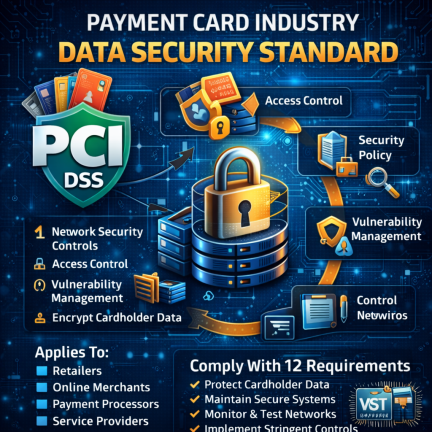
PCI DSS Applies To:
Online retailers
Brick-and-mortar stores
Payment processors
SaaS platforms with billing systems
Service providers handling card data
Even small businesses are not exempt. Compliance requirements scale based on transaction volume, but the obligation remains universal.
Core Goals of the Payment Card Industry Data Security Standard
The payment card industry data security standard is built around six core security objectives:
Build and maintain secure networks
Protect cardholder data
Maintain a vulnerability management program
Implement strong access control measures
Monitor and test networks regularly
Maintain an information security policy
Each goal supports a layered security approach that reduces risk across environments.
PCI DSS Requirements Explained
To fully understand the payment card industry data security standard, it’s important to look at its 12 core requirements.
1. Network Security Controls
Firewalls and secure configurations protect cardholder environments from unauthorized access.
2. Secure System Configurations
Default passwords and insecure settings must be eliminated.
3. Protect Stored Cardholder Data
Sensitive data must be encrypted or masked when stored.
4. Encrypt Data in Transit
Cardholder data must be encrypted when transmitted over public networks.
5. Malware Protection
Anti-malware solutions must be deployed and updated.
6. Secure Systems and Applications
Regular patching and vulnerability management are required.
7. Restrict Access to Cardholder Data
Access must be limited based on business need-to-know.
8. Identify and Authenticate Users
Strong authentication mechanisms must be enforced.
9. Restrict Physical Access
Physical environments housing card data must be secured.
10. Log and Monitor Access
All access to cardholder data must be logged and monitored.
11. Test Security Systems Regularly
Penetration testing and vulnerability scanning are mandatory.
12. Maintain a Security Policy
Organizations must define and enforce security policies.
PCI DSS Compliance Levels
The payment card industry data security standard defines compliance levels based on transaction volume.
PCI DSS Levels
Level 1: Over 6 million transactions annually
Level 2: 1–6 million transactions
Level 3: 20,000–1 million e-commerce transactions
Level 4: Fewer than 20,000 transactions
Each level has different validation requirements, but security expectations remain high.
Common PCI DSS Compliance Challenges
Despite its importance, many organizations struggle with PCI DSS compliance.
Top Challenges Include:
Complex IT environments
Legacy systems
Limited security visibility
Manual compliance processes
Resource constraints
For IT managers, maintaining compliance requires ongoing effort—not a one-time checklist.
Best Practices for PCI DSS Compliance
Organizations can simplify compliance by following proven strategies.
Actionable Tips
Reduce card data storage whenever possible
Segment cardholder data environments
Automate patching and monitoring
Use endpoint detection and response tools
Conduct regular security assessments
Automation and zero-trust principles significantly improve compliance outcomes.
Benefits of the Payment Card Industry Data Security Standard
While compliance may seem demanding, the benefits are substantial.
Key Benefits
Reduced risk of data breaches
Increased customer trust
Improved security posture
Stronger incident response readiness
Regulatory alignment
For executives, PCI DSS compliance demonstrates commitment to data protection.
PCI DSS and Cybersecurity Strategy
The payment card industry data security standard aligns closely with modern cybersecurity frameworks. Its controls support:
Zero Trust security models
Defense-in-depth strategies
Continuous monitoring
Threat detection and response
Organizations that integrate PCI DSS into their broader cybersecurity strategy achieve better resilience and faster threat mitigation.
Industries Most Impacted by PCI DSS
PCI DSS is critical across multiple industries, including:
Retail and e-commerce
Financial services
Hospitality
Healthcare billing platforms
Subscription-based SaaS companies
Any industry accepting card payments must prioritize compliance.
The Future of the Payment Card Industry Data Security Standard
PCI DSS continues to evolve to address modern threats.
Emerging Trends
PCI DSS 4.0 modernization
Increased focus on continuous security
Cloud and hybrid environment coverage
Stronger authentication requirements
For business leaders, staying ahead of updates is essential to long-term compliance.
FAQs: Payment Card Industry Data Security Standard
1. What is the payment card industry data security standard?
It is a global security framework designed to protect cardholder data and reduce payment fraud.
2. Is PCI DSS mandatory?
Yes. Any organization that stores, processes, or transmits card data must comply.
3. What happens if you fail PCI DSS compliance?
Non-compliance can result in fines, higher transaction fees, legal action, and reputational damage.
4. How often is PCI DSS compliance required?
Compliance must be maintained continuously and validated annually.
5. Does PCI DSS apply to cloud environments?
Yes. Cloud-hosted systems handling card data must also meet PCI DSS requirements.
Final Thoughts: Why PCI DSS Compliance Is Non-Negotiable
The payment card industry data security standard is more than a compliance obligation—it’s a safeguard for your customers, your brand, and your business continuity. In a threat landscape where payment data is constantly targeted, strong security controls are essential.
For IT managers, cybersecurity teams, and executives, proactive PCI DSS compliance reduces risk, builds trust, and strengthens operational resilience.
Secure Your Payment Environment Today
Protect your cardholder data and simplify PCI DSS compliance with advanced endpoint and security solutions.
👉 Get started now:
https://openedr.platform.xcitium.com/register/

 Loading...