Updated on November 20, 2025, by OpenEDR
If you’ve ever wondered how data stays secure when it travels across the internet — even over public Wi-Fi, remote networks, or cloud connections — the answer likely involves Internet Protocol Security, also known as IPsec. Whether you’re in cybersecurity, IT management, or simply using VPNs to secure your network, understanding how IPsec works can help strengthen your organization’s security posture.
In this conversational and easy-to-understand guide, we’ll break down everything you need to know about internet protocol security IPsec: what it is, why it matters, how it works, and how businesses use it today.
Let’s dive in.
What Is Internet Protocol Security (IPsec)?
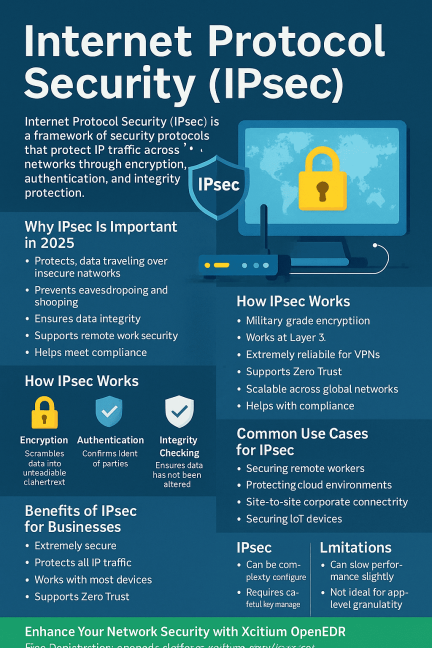
Internet Protocol Security (IPsec) is a framework of security protocols used to protect data as it travels across IP networks. It provides:
Encryption
Authentication
Integrity
Confidentiality
In simple terms:
👉 IPsec makes sure your data is safe, private, and unaltered while traveling over the internet.
Whether you’re using a VPN, connecting to remote offices, or protecting cloud traffic — IPsec is often working behind the scenes.
Why IPsec Is Important in 2026
Cyber threats are increasing in both volume and complexity. With remote work, cloud adoption, and global connectivity, securing data in motion is critical.
Here’s why IPsec matters more than ever:
✔ Protects data traveling over insecure networks
Public Wi-Fi, shared networks, and cloud connections are risky.
✔ Prevents eavesdropping and snooping
Hackers cannot read encrypted packets.
✔ Ensures data integrity
If someone attempts to tamper with data, IPsec detects it.
✔ Supports remote work security
Most enterprise VPNs use IPsec as the backbone.
✔ Helps meet compliance
Organizations meet requirements like HIPAA, PCI-DSS, and GDPR.
✔ Works at the network layer
Meaning it protects all data — not just specific apps.
IPsec is like putting your network traffic into a locked, armored vehicle before sending it across the internet.
How IPsec Works (Explained Simply)
Even though IPsec is deeply technical, we’ll break it down in a simple, conversational way.
IPsec protects data by using three major security functions:
1. Encryption
Scrambles data into unreadable ciphertext.
2. Authentication
Confirms that both parties are who they claim to be.
3. Integrity Checking
Ensures data hasn’t been changed in transit.
To deliver these protections, IPsec uses security protocols, security associations, and cryptographic algorithms.
Let’s break down the key components.
⭐ The Three Main IPsec Protocols
1. AH — Authentication Header
Provides:
Data integrity
Authentication
Anti-tampering
But does NOT encrypt data.
Used where confidentiality is not required.
2. ESP — Encapsulating Security Payload
Provides:
Encryption
Authentication
Integrity
Confidentiality
ESP is widely used in VPNs and secure tunnels.
3. IKE — Internet Key Exchange
Manages secure key exchange between devices.
IKE has two versions:
IKEv1 — older
IKEv2 — faster, stronger, and more secure
IKE ensures both devices trust each other and agree on encryption rules.
⭐ IPsec Modes: Transport Mode vs Tunnel Mode
IPsec can operate in two modes depending on your needs:
1. Transport Mode
Protects the payload of the packet (data), but not the header.
Used for:
Internal networks
Server-to-server communication
End-to-end encryption
2. Tunnel Mode
Encrypts the entire IP packet, including the header.
Used for:
VPNs
Site-to-site connections
Remote worker protection
Tunnel mode is considered the most secure because it hides everything — even routing details.
⭐ IPsec and VPNs — The Perfect Combination
If you’ve ever used a VPN, you’ve probably used IPsec, even if you didn’t realize it.
Most VPNs rely on IPsec for:
Strong encryption
Authentication
Secure tunneling
Data protection
Two popular VPN types use IPsec:
1. Site-to-Site VPN
Connects two networks (like HQ ↔ branch office).
Used by enterprises.
2. Remote Access VPN
Connects remote users to a business network.
Used by remote workers.
IPsec ensures your data travels safely from point A to point B — encrypted, verified, and tamper-proof.
🔥 Benefits of IPsec for Businesses
Here’s why organizations rely on IPsec:
✔ Military-grade encryption
Protects highly sensitive data.
✔ Works at Layer 3
So it protects all applications and traffic automatically.
✔ Extremely reliable for VPNs
Standard for enterprise VPN security.
✔ Supports Zero Trust
IPsec enforces strict authentication and verification.
✔ Scalable across global networks
Great for corporations with distributed offices.
✔ Helps with compliance
Useful for industries like healthcare, finance, retail, and government.
🧩 Common Use Cases for IPsec in 2026
IPsec is used almost everywhere in modern cybersecurity.
1. Securing remote workers
Protects VPN connections for employees at home.
2. Protecting cloud environments
Used to secure traffic between on-prem datacenters and cloud services.
3. Site-to-site corporate connectivity
Connects multiple office locations through secure tunnels.
4. Securing IoT devices
Used to protect communication between IoT sensors and servers.
5. Protecting government and military networks
Highly sensitive networks require strong encryption.
6. Enforcing Zero Trust architectures
IPsec ensures that all connections are authenticated and validated.
🔧 Technical Components of IPsec (Explained Simply)
Here are the core building blocks:
✔ Security Associations (SAs)
Define how two devices will communicate securely.
✔ Cryptographic Algorithms
Includes:
AES
SHA-256
RSA
DH groups
✔ Keys and Certificates
Used for authentication and encryption.
✔ ISAKMP
Framework for key management.
✔ ACLs (Access Control Lists)
Used to define what traffic should be protected.
Security experts need to tune these correctly to maintain secure communication.
⭐ IPsec Advantages
✔ Extremely secure
✔ Protects all IP traffic
✔ Works with most devices
✔ Flexible and scalable
✔ Ideal for remote work
✔ Supports both IPv4 and IPv6
⭐ IPsec Limitations
Nothing is perfect, not even IPsec.
❌ Can be complex to configure
❌ Requires careful key management
❌ Can slow performance slightly due to encryption
❌ Not ideal for environments needing app-level granularity
Still, IPsec remains one of the strongest and most trusted network security protocols available.
🔍 IPsec vs SSL VPN: What’s the Difference?
Both secure network traffic — but for different use cases.
| Feature | IPsec | SSL VPN |
|---|---|---|
| Layer | Network (Layer 3) | Application (Layer 7) |
| Best For | Full network access | App-specific access |
| Setup | More complex | Easier |
| Speed | Fast | Medium |
| Security | Very high | High |
IPsec is preferred for enterprise-grade VPNs and site-to-site connections.
🧭 How IPsec Fits Into Modern Cybersecurity Architectures
IPsec plays a major role in:
Zero Trust security
SASE frameworks
Cloud security
Network segmentation
Identity-based access
Remote workforce protection
When combined with EDR tools like Xcitium OpenEDR, organizations gain complete visibility and control over threats and data movement.
🎯 Conclusion: IPsec Is Essential for Modern Network Security
If you’ve been wondering what internet protocol security IPsec is and why it matters, here’s the takeaway:
👉 IPsec protects your data as it travels across networks by encrypting it, validating it, and ensuring it cannot be intercepted or altered.
It’s reliable, secure, and built to handle modern challenges like:
Remote work
Cloud migration
IoT systems
Cyberattacks
Compliance requirements
Simply put — IPsec is foundational to secure communication in 2026 and beyond.
🔐 Enhance Your Network Security with Xcitium OpenEDR (Free Registration)
Protect your endpoints, networks, and users with modern, real-time threat detection.
👉 https://openedr.platform.xcitium.com/register/
❓ FAQs About IPsec
1. What is IPsec used for?
To secure data as it travels across networks, especially for VPNs.
2. Does IPsec encrypt data?
Yes — using ESP. AH does not encrypt.
3. Is IPsec better than SSL VPN?
For full network protection, yes. SSL VPN is better for app-specific access.
4. Where is IPsec used most?
VPNs, remote work, cloud security, and site-to-site connectivity.
5. Is IPsec still used in 2025?
Absolutely — it remains a core security protocol for businesses.

 Loading...